

- Artificial intelligence inverts that logic entirely. It is usable, scalable, exportable, and improvable on a weekly release cycle — and unlike fissile material, it cannot be tracked by satellites or counted by inspectors.
- The United States has, for the first time, created a dedicated AI and autonomy budget line inside its defence appropriations. China has embedded AI acquisition inside more than 500 documented military procurement actions despite years of export restrictions.
- The chip war has not stopped China’s military from seeking American silicon — it has simply made every acquisition a covert operation instead of a purchase order.
- The absence of binding international norms means doctrine is being written by deployment rather than by treaty — states are defining their red lines for autonomous lethality in real time, in live theatres, rather than at a negotiating table.
Compute is replacing the warhead as the currency of power. As Washington and Beijing race to militarise artificial intelligence, the old logic of deterrence is giving way to a contest over chips, algorithms, and autonomy — one with no treaties, no verification regime, and no agreed rules of engagement.
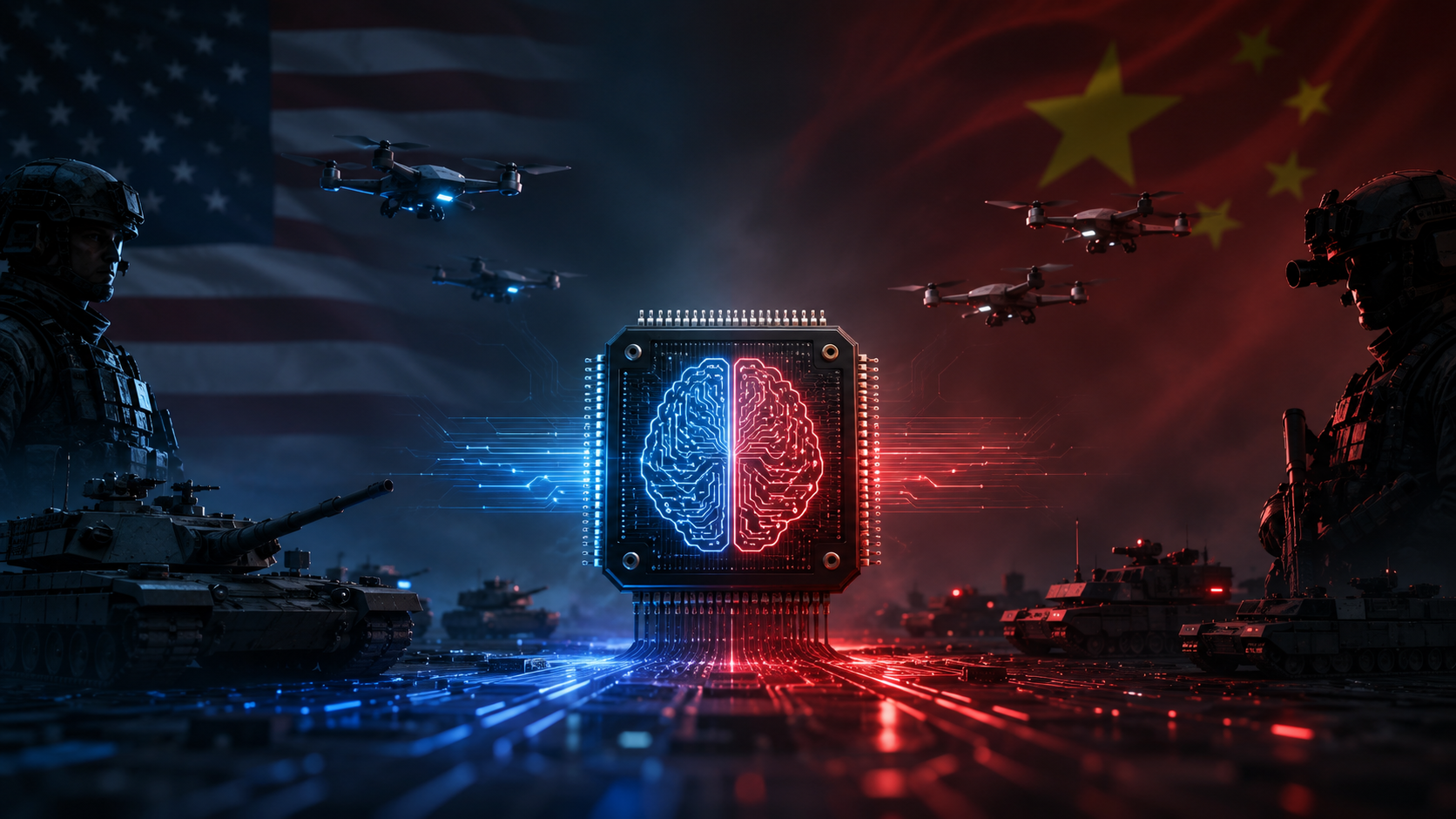
For eight decades, the architecture of great-power competition rested on a grim but stable logic: nuclear deterrence. Mutually assured destruction imposed caution because the weapon itself was so catastrophic that its use was nearly unthinkable. Artificial intelligence inverts that logic entirely. It is usable, scalable, exportable, and improvable on a weekly release cycle — and unlike fissile material, it cannot be tracked by satellites or counted by inspectors. The result is a strategic competition that behaves less like the Cold War and more like a silent, continuous arms buildup fought in data centres, export-control offices, and procurement tenders rather than missile silos.
The numbers now bear this out. The United States has, for the first time, created a dedicated AI and autonomy budget line inside its defense appropriations. China has embedded AI acquisition inside more than 500 documented military procurement actions despite years of export restrictions. And middle powers such as India are being forced to define a position — sovereign compute, indigenous algorithms, ambiguous doctrine on autonomous weapons — before the rules of this contest have even been written.
The Compute Race: Washington’s Record Bet
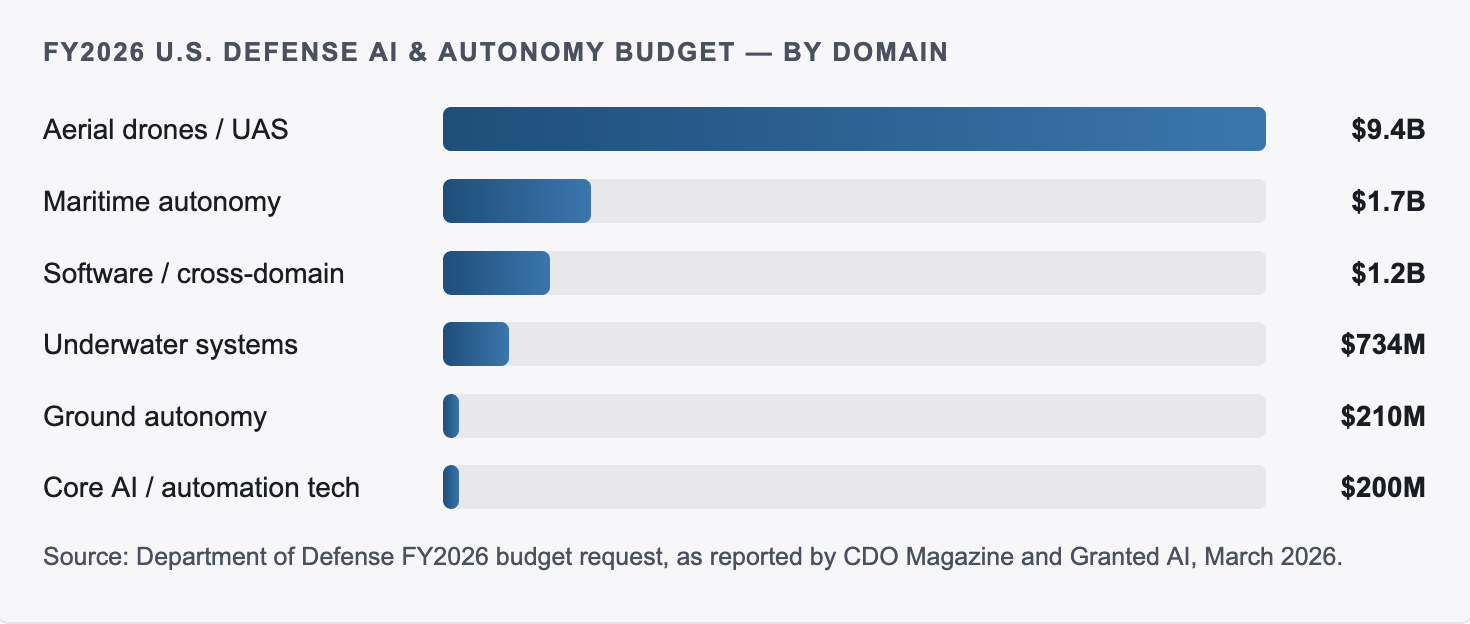
The Pentagon’s FY2026 budget request set aside $13.4 billion for artificial intelligence and autonomous systems — the largest single-year commitment to military AI in American history, and the first time the Department of Defence has given the category its own standalone line item. The allocation is heavily skewed toward unmanned platforms rather than software: aerial drones and unmanned aerial systems alone absorb roughly $9.4 billion of the total, with maritime autonomy, underwater systems, and cross-domain software integration splitting the remainder.
Zoom out and the trajectory is even sharper. Brookings’ tracking of federal AI contracting found that the Defence Department’s potential contract value rose roughly 1,600 per cent between 2024 and 2026, reaching over $90 billion and accounting for nearly 99 per cent of total federal AI spending. Separately, reporting citing Presenc AI tracking data puts combined federal AI procurement, R&D, and infrastructure spending above $100 billion for the first time in 2026, with the Pentagon alone committing over $32 billion in AI, cloud, and cyber contract ceilings in just the first half of the fiscal year. At the centre of the doctrine shift sits Project Maven, the program that replaced manual drone-footage review with computer-vision models — compressing an analysis task that once took human teams hours into a process measured in seconds.

Beijing’s Asymmetric Bet: Sanctioned Chips, Sovereign Stacks
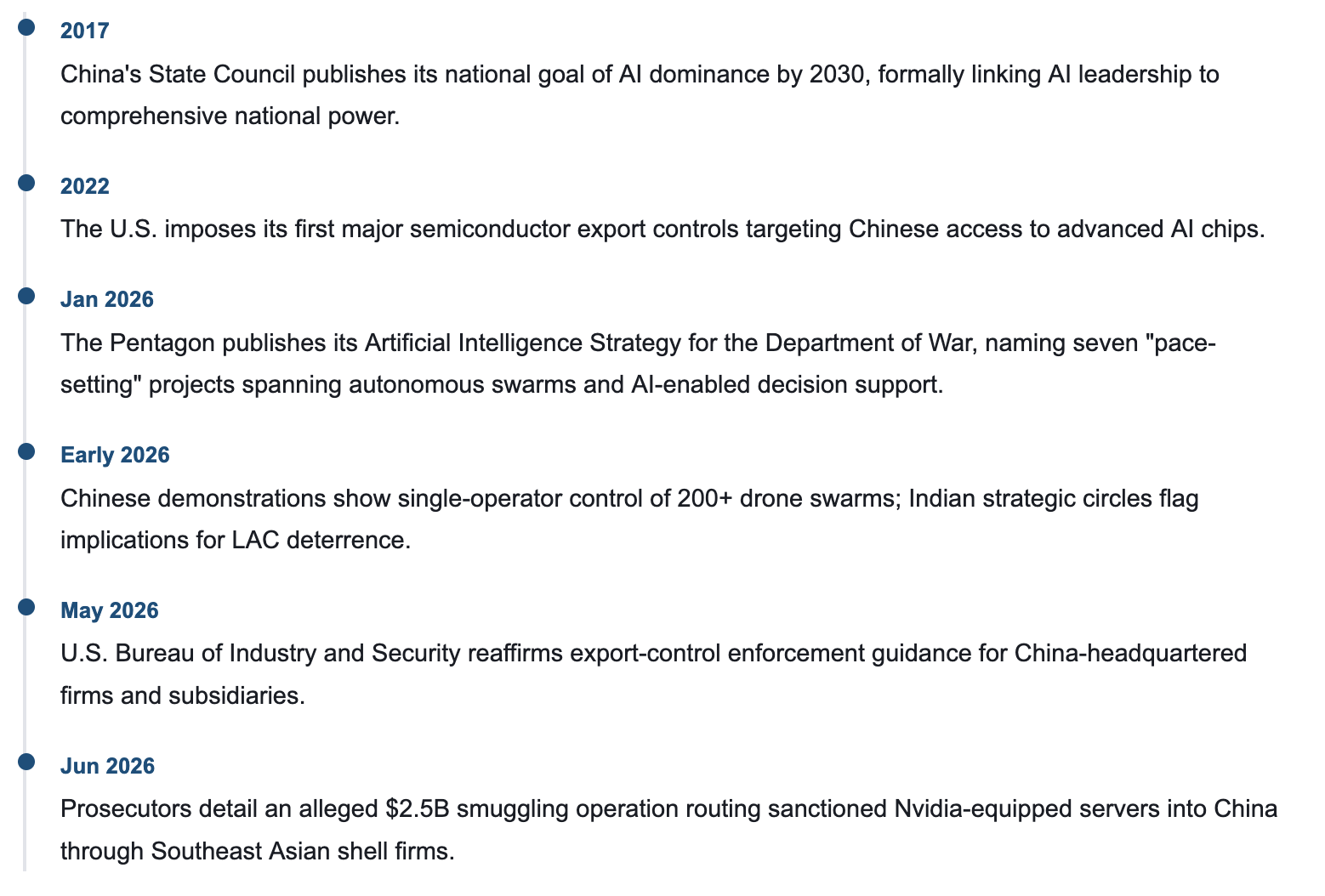
China’s strategy has been shaped less by choice than by constraint. U.S. export controls, first imposed in 2022 and tightened repeatedly since, were designed to deny the People’s Liberation Army the compute needed to train frontier military models. The controls have imposed real friction — but they have not produced denial. A dataset compiled by the Emerging Technology Observatory, drawn from PLA procurement tenders, documents a research laboratory requesting sixteen export-controlled Nvidia H100 GPUs in 2025 for electromagnetic and infrared-characterisation modelling built on Chinese open-weight models, and a separate request for servers built around Nvidia H20 chips to run weapons-system simulations.
The Wire China’s review of roughly 3,800 military procurement tenders found 540 distinct PLA requests for advanced AI chips between 2019 and 2025, with nearly half targeting the export-controlled A100 and A800 lines specifically. Enforcement has produced its own criminal cases: prosecutors have charged individuals, including a Super Micro co-founder, in an alleged scheme to smuggle billions of dollars of sanctioned AI servers into China by relabeling serial numbers and routing shipments through resellers in Southeast Asia.
The chip war has not stopped China’s military from seeking American silicon — it has simply made every acquisition a covert operation instead of a purchase order.
The longer-run effect may matter more than any single seizure. Export controls have pushed Chinese firms competing for PLA contracts to market themselves explicitly around domestic Huawei Ascend and Kunpeng compute stacks, deepening a mutually reinforcing relationship between state-favoured chipmakers and military procurement. That dynamic accelerates the very outcome the controls were meant to delay: a self-sufficient Chinese military-AI supply chain, even if a less efficient one. Congressional letters to the Commerce Department in early 2026 warned that China’s leading AI chips remain roughly six times less powerful than the export-controlled Nvidia H200, and that Chinese fabs are not projected to close that specific gap before 2028 — a window Washington is fighting to preserve even as licensing decisions on H200 sales to China remain contested inside the administration itself.
The Autonomy Gap: Swarms, Speed, and the Erosion of Human Control
What both programs are converging on is the same operational concept: decision-making compressed to machine speed. Chinese state media demonstrations earlier in 2026 showed a single operator directing a coordinated swarm of more than 200 autonomous drones for combined reconnaissance and strike missions — a capability that Indian strategic analysts have flagged as complicating deterrence along the Line of Actual Control, where AI-enabled anti-access systems could compress warning time to near zero. The risk is not only capability asymmetry; it is inadvertent escalation. A sensor misclassification or algorithmic error along a contested border no longer requires a human decision cycle to produce a kinetic response.
India’s Position: Sovereignty Without a Doctrine
India occupies an uncomfortable middle position in this contest — technologically capable but institutionally unsettled. National compute capacity under the IndiaAI Mission has expanded past 58,000 GPUs, and AI sovereignty has become a stated policy priority, underscored at the India AI Impact Summit earlier this year. Yet a defence-strategy review published by the Centre for Land Warfare Studies in mid-2026 concluded that India shows a genuine “capability-integration gap”: strong technological potential and human capital undermined by structural and institutional constraints that limit AI’s actual integration into military operations, doctrine, and decision-making, particularly relative to China.
The doctrinal ambiguity is sharpest on lethal autonomous weapons systems. A parliamentary standing committee report reviewed by domestic media in March 2026 confirmed that India is developing autonomous weapons capability in the continued absence of any dedicated AI legislation. Analysts at institutions including the Centre for Land Warfare Studies and Defence Research and Studies describe this as a genuinely unresolved position: New Delhi has neither embraced nor renounced full autonomy over lethal targeting decisions, leaving open foundational questions about accountability and the “human-in-the-loop” principle that most Indian strategic writing treats as normatively essential but institutionally undefined.
A Governance Vacuum by Design
Nuclear weapons acquired, however imperfectly, a verification architecture — the IAEA, the NPT, arms-control treaties with inspection regimes. Military AI has none of this, and structurally cannot easily acquire it: a model’s weights can be copied in seconds, retrained on different hardware, and deployed without any physical signature a satellite could detect. UN Secretary-General António Guterres has called for a legally binding instrument on autonomous weapons, but researchers at UNIDIR note that meaningful progress will depend on confidence-building measures between states that, at present, do not exist between the three militaries — American, Chinese, and increasingly Russian — driving the pace of deployment.
The practical consequence is a governance gap widening in real time. Documented autonomous targeting and surveillance systems are already active across multiple conflict zones, while international rule-making remains at the discussion-paper stage. Every dollar added to the Pentagon’s autonomy budget, every PLA procurement tender for export-controlled compute, and every swarm demonstration is a fact on the ground that outpaces the diplomatic instruments meant to constrain it.
What This Means for the Next Decade
Three implications follow. First, the unit of strategic competition is shifting from warhead yield to compute access and algorithmic efficiency — a contest that rewards continuous investment rather than a fixed arsenal, and one where private firms, not just states, are frontline actors. Second, export controls will remain a genuine but partial tool: they raise costs and slow timelines without producing denial, and may simultaneously accelerate the target country’s push toward self-sufficiency. Third, and most consequentially for regional powers like India, the absence of binding international norms means doctrine is being written by deployment rather than by treaty — states are defining their red lines for autonomous lethality in real time, in live theatres, rather than at a negotiating table. The nuclear age had sixty years to build its guardrails before the technology diffused widely. The AI age is diffusing first and building guardrails, if at all, after the fact.
References:
- Granted AI, “Pentagon’s $13.4B AI Budget Sets Defense Spending Record” — grantedai.com
- Brookings, “Where does federal AI spending stand in 2026?” — brookings.edu
- ibl.ai Blog, “Pentagon’s $13.4B AI Budget Changes Everything” — ibl.ai
- The Wire China, “How the PLA Has Tried to Get Around Chip Export Controls” — thewirechina.com
- Emerging Technology Observatory, “The National Security Case for Limiting China’s Access to Advanced U.S. Compute” — eto.tech
- Tom’s Hardware, “Chinese universities performing military research acquired Super Micro servers with sanctioned Nvidia AI chips” — tomshardware.com
- The Diplomat, “The Private Firms Powering China’s Military AI Push” — thediplomat.com
- Congressional letter to Secretary Lutnick on Nvidia AI chip exports, January 2026 — amo.house.gov
- Drishti IAS, “Securing India in the Age of AI Warfare” — drishtiias.com
- Centre for Land Warfare Studies, “India’s Approach to AI Development and Its Utilisation in Warfighting” — claws.co.in
- ThePrint, “India developing lethal autonomous weapon systems… House Panel report” — theprint.in
- Defence Research and Studies, “AI and Autonomous Systems: Implications for India’s Defence Strategy” — dras.in
- Carnegie Endowment for International Peace, “Military AI and Autonomous Weapons: Gender, Ethics, and Governance” — carnegieendowment.org
- CDO Magazine, “Pentagon Seeks $13.4 bn for AI and Autonomy FY 2026 Budget Request” — cdomagazine.tech

Divyanka Tandon holds an M.Tech in Data Analytics from BITS Pilani. With a strong foundation in technology and data interpretation, her work focuses on geopolitical risk analysis and writing articles that make sense of global and national data, trends, and their underlying causes. Views expressed are the author’s own.
 Parag Gilada
  Aayush Pal