
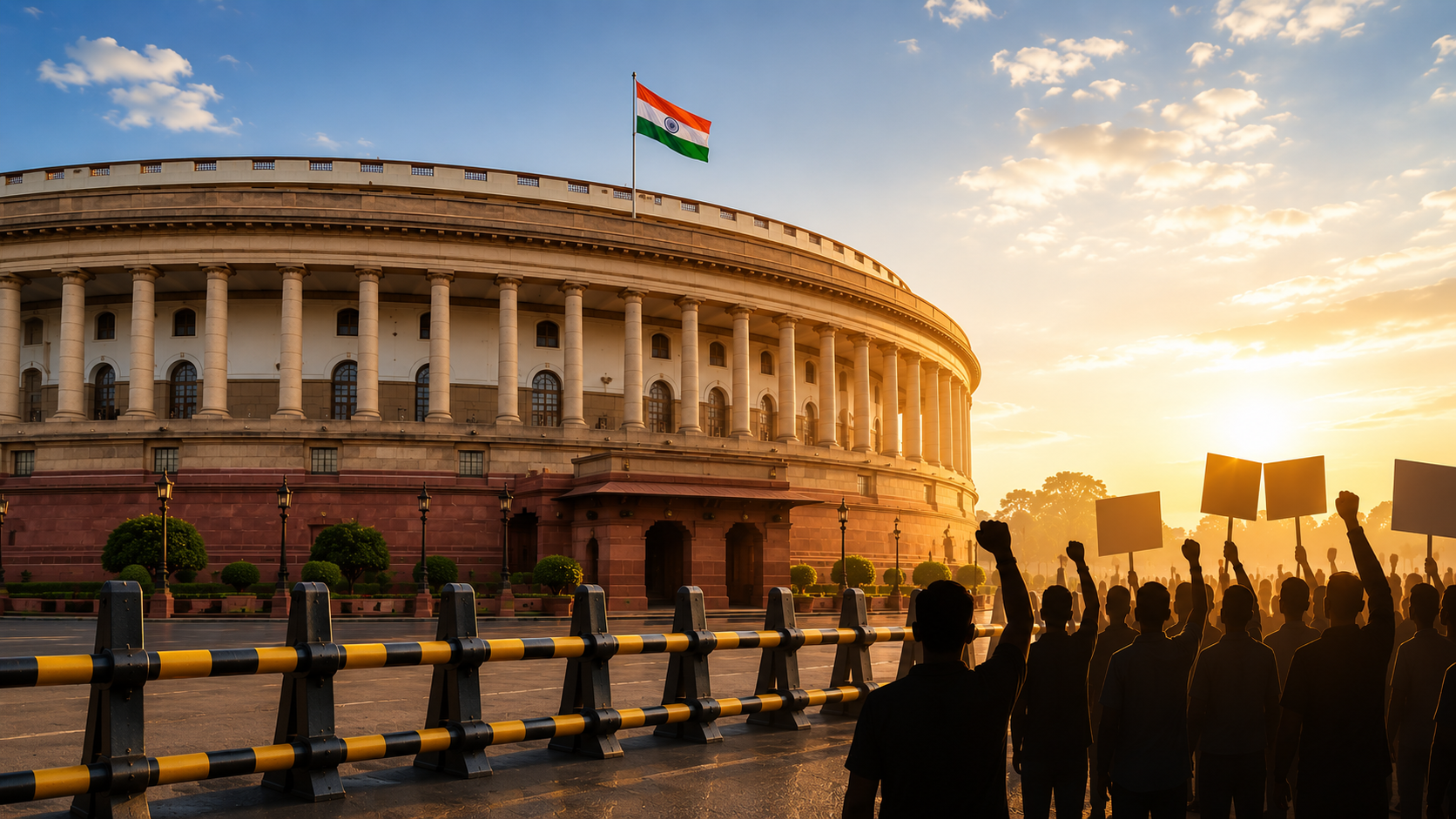
- The 20 July 2026 “Chalo Sansad” march, presented by some as an exercise in Satyagraha, raises important questions about the relationship between democratic dissent and national security.
- When demonstrations deliberately seek to breach or approach prohibited security zones in defiance of lawful restrictions, they depart from the essential principles that distinguish Satyagraha from confrontation.
- Security succeeds when potential threats are prevented before they develop into crises. A resilient security framework depends upon timely intelligence, seamless coordination among agencies, robust layered defence, effective access control, rapid communication, and well-rehearsed contingency plans.
- India’s democratic strength lies in its ability to protect both the constitutional right to peaceful dissent and the sanctity of its national institutions. Neither objective should ever be achieved at the expense of the other.
The Parliament of India is far more than a building of stone and steel. It is the visible embodiment of the sovereignty of the people and the heart of India’s constitutional democracy. Any incident that raises questions about its security must therefore be viewed with the utmost seriousness, irrespective of the political affiliations of those involved.
The importance of Parliament’s security has been reinforced by painful experience. On 13 December 2001, India witnessed a devastating terrorist attack on Parliament in which nine people, including security personnel and civilian staff, were killed, while all five terrorists were also killed by the security forces. Having witnessed the attack from Vijay Chowk, I have since observed the transformation of Parliament’s security architecture into a sophisticated, multi-layered system supported by fortified positions, advanced surveillance technology, and coordinated security agencies.
Yet, despite these measures, another significant security breach occurred on 13 December 2023, the twenty-second anniversary of the terrorist attack, when two intruders entered the Lok Sabha chamber from the visitors’ gallery and released yellow smoke canisters. The incident demonstrated that even the most robust security arrangements require constant review and adaptation.
For this reason, every incident occurring in or around Parliament carries national and international significance. The protection of India’s highest democratic institution can never be treated as routine.
The 20 July 2026 “Chalo Sansad” march, presented by some as an exercise in Satyagraha, raises important questions about the relationship between democratic dissent and national security. Satyagraha, as conceived by Mahatma Gandhi, is founded upon truth, self-discipline, and non-violence, while Gandhian civil disobedience also involved a willingness to accept the legal consequences of deliberate non-violent disobedience. When demonstrations deliberately seek to breach or approach prohibited security zones in defiance of lawful restrictions, they depart from the essential principles that distinguish Satyagraha from confrontation.
Equally, the response of the State must reflect the highest standards of professionalism. In any democracy governed by the rule of law, the use of force by law enforcement should always remain the last resort. Security personnel are expected to act with restraint and employ only such force as is lawful, necessary, and proportionate to the threat. Effective intelligence, advance planning, communication, and disciplined crowd management are always preferable to physical confrontation.
The recent events nevertheless raise legitimate questions regarding preventive security planning. Large protest groups should never be allowed to reach the immediate vicinity of Parliament in a manner that creates avoidable security risks. If demonstrators succeed in approaching sensitive security perimeters, it becomes necessary to objectively examine whether intelligence assessment, operational planning, inter-agency coordination, or execution could have been strengthened.
Security succeeds when potential threats are prevented before they develop into crises. A resilient security framework depends upon timely intelligence, seamless coordination among agencies, robust layered defence, effective access control, rapid communication, and well-rehearsed contingency plans.
These circumstances therefore warrant an objective professional review of whether intelligence inputs were adequately assessed and disseminated, whether coordination among the CISF, Parliament Security Service, Delhi Police, intelligence agencies, and relevant civil authorities was effective, and whether the existing outer, middle, and inner security arrangements around Parliament functioned as intended. Such a review could also examine crowd-management procedures, command, control and communication mechanisms during rapidly evolving situations, as well as the extent to which recommendations arising from previous security reviews and incidents have been implemented.
Security must never become a partisan issue. Regardless of the ideology, objective, or affiliation of those protesting, the standard of protection afforded to Parliament must remain uncompromising.
At the same time, protest organisers should recognise that actions today shape expectations tomorrow. If crowds are perceived to have successfully approached highly sensitive national institutions, future groups—irrespective of their intentions—may believe that similar attempts are feasible. Consistent enforcement of established security protocols is therefore essential both for deterrence and for maintaining public confidence.
As someone who has served in uniform and later held responsibilities involving high-security administration, I believe every such incident should be treated as an opportunity for institutional learning rather than political contestation. Professional security organisations continually evaluate emerging threats, review operational performance, and refine their procedures.
An equally important dimension is contingency planning. Security arrangements should always be designed to prevent situations from escalating to the point where extraordinary measures become necessary. If circumstances were ever to exceed the capacity of the civil authorities, established constitutional and legal procedures provide for escalation through the appropriate chain of command. The objective of every security plan, however, is to ensure that such a stage is never reached.
Force deployment and reserve positioning should always be guided by dynamic threat assessments, credible intelligence, and realistic contingency planning. During periods of heightened tension, any significant redeployment of forces responsible for protecting Parliament and the wider National Capital should be carefully evaluated to ensure that sufficient reserves remain available for unforeseen emergencies.
The changing character of public mobilisation also demands fresh thinking. Social media now enables large numbers of people, particularly young participants, to assemble rapidly and unpredictably. Traditional assumptions regarding crowd behaviour and escalation therefore require continuous reassessment.
Recent developments in neighbouring countries, including Bangladesh and Sri Lanka, have demonstrated how rapidly large gatherings can evolve into situations that challenge public order and place critical national institutions under pressure. While every nation’s political and social circumstances are unique, regional experiences offer valuable lessons that should inform India’s security planning and contingency preparedness.
Accordingly, modern security strategy must remain intelligence-driven, preventive, and layered. Its principal objective should be to prevent crowds from reaching sensitive security zones rather than relying upon physical confrontation after tensions have escalated.
Wherever possible, security agencies should emphasise advance intelligence, negotiated crowd management, clearly demarcated security perimeters, controlled access, and professionally trained personnel in identifiable uniform. Any deployment of plain-clothes personnel for crowd-control duties should be based on clear legal authority, operational necessity, and transparent accountability so that public confidence in law enforcement is preserved.
Ultimately, the success of a security operation is measured not by the amount of force employed but by its ability to prevent escalation while simultaneously protecting constitutional freedoms and the security of Parliament. Every significant security incident should therefore be followed by an objective and professional after-action review, ensuring that future planning reflects evolving threats, technological developments, and changing patterns of mass mobilisation.
India’s democratic strength lies in its ability to protect both the constitutional right to peaceful dissent and the sanctity of its national institutions. Neither objective should ever be achieved at the expense of the other. The enduring challenge is to maintain this delicate balance through vigilance, professionalism, restraint, and an unwavering commitment to the rule of law.

Lt Col Ashok Kini H, SM, VSM, is a former Comptroller to then President Bharat Ratna Dr. APJ Abdul Kalam and a former Advisor to the Minister of State for Defence. Views expressed are the author’s own.
 Hridbina Chatterjee
  Divyanka Tandon
  Kumar Satish