
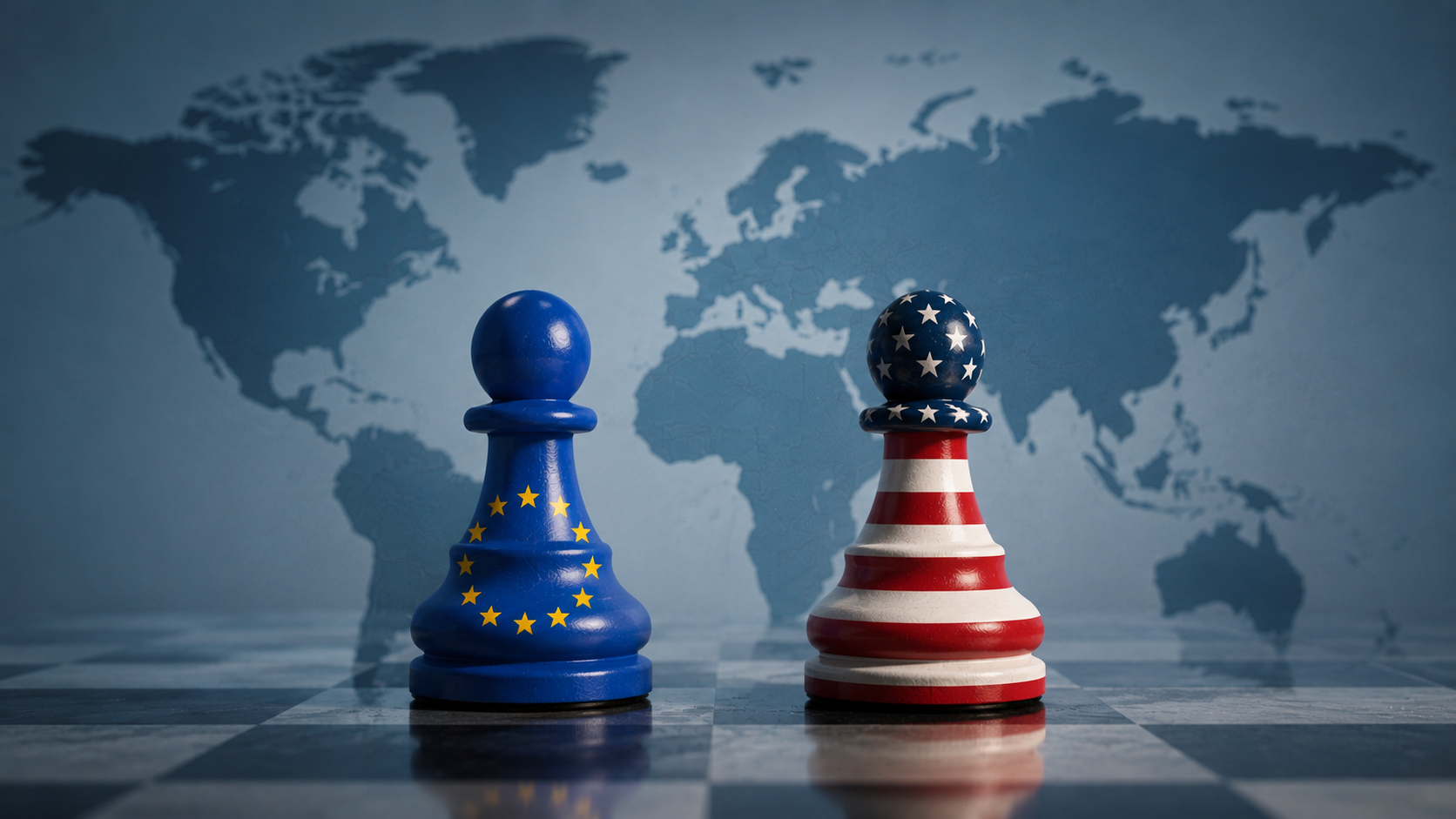
- The United States has gone all guns blazing against Europe, targeting European sovereignty, the European economy, and increasingly interfering in Europe’s political affairs.
- Since the Second World War, Europe’s security, economy, and military capabilities have been deeply dependent on the United States. European militaries rely heavily on American weapons systems, and European economies are closely intertwined with US markets.
- Europe has begun to realise that placing all its strategic weight behind the United States may not be sustainable.
- Europe is attempting to diversify its economic and diplomatic relationships so that no single external power becomes indispensable to its future.
The transatlantic partnership between the United States of America and Europe has been one of the most successful and strongest relationships in modern political history. The United States and Europe share deep civilizational links, common ideology, similar economic beliefs, free values, democratic societies, and a rule-of-law-based order. This partnership has also been anchored in one of the strongest military organisations in the world, NATO. Since the Second World War, these shared principles have guided relations between the two sides.
Europe has long been a major geopolitical and economic hotspot for the United States. It has served American strategic interests across the European continent and has represented one of the strongest political, economic, historical, and cultural partnerships in the world. However, this long-standing relationship now appears to be approaching a critical turning point. The United States has gone all guns blazing against Europe, targeting European sovereignty, the European economy, and increasingly interfering in Europe’s political affairs.
The United States is now openly vocal about political realities within Europe and is infringing upon Europe’s political autonomy. President Trump has significantly altered the overall dynamics of US-Europe relations. One of the most striking examples is the recent move regarding Greenland, where the United States has openly claimed that Greenland should belong to the United States. The argument presented by Washington is that if Greenland does not come under US control, it could fall under the influence of Russia and China, which would pose a serious threat to American national security.
The Greenland Saga
This position has put the United States in direct confrontation with Denmark, a NATO member state, as Greenland is an autonomous territory under the Kingdom of Denmark. The United States has openly called for Greenland to belong to it, directly challenging Danish sovereignty. On top of this, the United States has imposed tariffs on European countries, citing European obstruction of the US move on Greenland.
This has come as a major shock to Europe. Several European countries that have been targeted for refusing to cooperate with the United States over Greenland issued a joint statement stating that any matter involving Denmark and Greenland should be decided only by Denmark and Greenland. Europe has made it clear that it will not allow violations of its sovereignty by the United States.
This moment represents one of the biggest turning points in US Europe relations. It raises serious questions about where Europe stands today and what its next move might be. Is Europe truly ready to distance itself from the United States and build relations with other global powers?
These tensions did not emerge overnight. They trace back to President Trump’s first term beginning in 2016, when the United States became increasingly vocal about political issues within Europe. The US openly targeted progressive liberal politics in Europe, arguing that Europe was no longer the same as it once was. President Trump frequently criticised cities such as London and Paris, stating that they had changed drastically due to open border policies and immigration, which, according to him, altered their social and cultural dynamics.
European countries strongly opposed such comments, arguing that they amounted to interference in domestic political matters and were unacceptable. President Trump’s approach clearly showed support for conservative political forces in Europe. He openly endorsed Hungarian Prime Minister Viktor Orban and supported Italian Prime Minister Giorgia Meloni, while simultaneously criticising the United Kingdom and France. This created a perception that the US leadership was selectively backing conservative ideologies while opposing liberal political values across Europe.
President Trump’s Differences with Europe
During President Trump’s second term, relations reached a historic low. The United States introduced tariffs on European markets that are deeply intertwined with the US economy through merchandise trade, services, people-to-people exchanges, and heavy industries such as manufacturing. These tariffs placed significant pressure on European economies.
Another major disagreement emerged over defence spending. President Trump demanded that European NATO members increase defence expenditure to nearly 5 percent of GDP. He also insisted that the responsibility for the war in Ukraine should rest primarily on European NATO members. However, Europe currently lacks the military-industrial capacity and economic strength to match the United States. The American defence industrial base and economic capacity far exceed those of Europe, creating an imbalance and deepening tensions.
The Greenland issue, however, stands out as the most critical flashpoint. Greenland is one of the largest islands in the world and geographically falls within North America. It is an autonomous territory under Danish control. President Trump has repeatedly claimed Greenland as vital to American national security, arguing that Chinese and Russian presence in the Arctic is increasing. According to Washington, failure to control Greenland would pose a serious threat to US security interests.
European countries have categorically rejected this claim, stating that it violates Danish sovereignty. Greenland itself has rejected the proposal, reaffirming its desire to remain within the Kingdom of Denmark. Denmark has stated that it is open to diplomacy but will never allow Greenland to be taken over by the United States.
France has emerged as a leading voice against US actions. French President Emmanuel Macron has made it clear that France will not remain silent if European sovereignty is threatened and will take necessary steps to protect European integrity. The UK Prime Minister Keir Starmer has also stated that US actions are completely unacceptable.
In response, European countries increased their diplomatic and military attention towards Greenland, with France, Germany and Denmark demonstrating greater security cooperation in the Arctic. The message was clear: Greenland may be geographically distant from continental Europe, but its sovereignty is now being treated as a European strategic issue.
Reinstating the Monroe Doctrine
This raises the question of whether Russia and China truly pose a major threat in Greenland. In reality, both countries have limited influence in the region due to a strong European and American security presence. President Trump’s interest in Greenland appears to be driven more by a desire to revive the Monroe Doctrine, under which the United States seeks dominance over the entire American continent and rejects external influence.
President Trump has also indirectly supported conservative leaders across the Americas, including backing conservative candidates in Central America. Europe now finds itself under pressure from the United States, creating a continental dilemma. Since the Second World War, Europe’s security, economy, and military capabilities have been deeply dependent on the United States. European militaries rely heavily on American weapons systems, and European economies are closely intertwined with US markets.
One of the most striking examples of this dependence is Europe’s relationship with Russia. Russia is Europe’s largest geographical neighbour and a major nuclear power. Despite long-standing energy ties that once supported European economic growth, Europe severed much of its relationship with Russia following the war in Ukraine. This shift was largely driven by US strategic interests, as the United States views Europe as a critical lever to counter Russia.
For the US, Russia is a strategic rival without deep economic interdependence. For Europe, the situation is far more complex due to geography, energy dependence, and economic ties. Yet Europe aligned itself fully with the US, benefiting Washington by making Europe more dependent on American energy, security, and markets.
European Resurgence
Now a shift is becoming visible. Europe has begun to realise that placing all its strategic weight behind the United States may not be sustainable. The Greenland issue, tariffs, and political interference have pushed European leaders to reconsider their approach.
German Chancellor Friedrich Merz has repeatedly emphasised the need for Europe to take greater responsibility for its own security, while France has continued to push the idea of European strategic autonomy. Italy under Giorgia Meloni has maintained close relations with Washington but has simultaneously supported the strengthening of European defence capabilities. These developments indicate that Europe is not necessarily preparing to abandon the United States, but is increasingly preparing for a future in which it cannot depend entirely on Washington.
This shift has become particularly visible in defence.
The European countries have begun increasing military expenditure at a scale that would have been difficult to imagine only a few years ago. NATO allies agreed to move towards spending 5 percent of GDP on defence and security by 2035, with the larger share directed towards core military capabilities. European countries are also attempting to expand their domestic defence industries and reduce their dependence on American military equipment.
This represents an important change in the European mindset.
For decades, Europe depended on the United States to provide the overwhelming military strength of the Western alliance. Europe could concentrate on economic development while Washington provided the strategic security umbrella. But the events of recent years have demonstrated that this arrangement may no longer be sustainable.
The war in Ukraine exposed Europe’s military dependence on the United States. The Greenland crisis exposed Europe’s political vulnerability. The tariff disputes exposed its economic vulnerability.
Europe is now attempting to address all three.
However, this does not mean that Europe is leaving NATO or abandoning the United States. Instead, Europe is attempting to create a stronger European pillar within NATO. The objective is increasingly to ensure that European countries have the capability to act even when the United States does not want to lead. This could ultimately transform NATO itself.
Instead of NATO remaining an alliance in which the United States provides the overwhelming military capability while Europe depends on American leadership, Europe could gradually become a much stronger military pillar within the alliance.
Europe Looks Beyond America
The economic side of this transformation is equally important.
Europe has increasingly begun looking towards other major economies, particularly India and the countries of the Global South. The European Union and India concluded negotiations for a historic free trade agreement in January 2026, creating one of the largest new trade relationships between two major economic powers.
The importance of this agreement goes far beyond trade.
India is one of the fastest-growing major economies in the world, while Europe remains one of the world’s most advanced economic and technological centres. Both sides also share growing interests in maritime security, defence, supply-chain resilience, technology, connectivity and the Indo-Pacific.
The relationship between India and Europe is therefore moving from a primarily economic partnership towards a broader strategic partnership.
Europe has also strengthened its economic engagement with Latin America. The European Union and Mercosur formally signed their major partnership and trade agreements, covering Brazil, Argentina, Paraguay and Uruguay. This creates another major economic avenue for Europe at a time when global trade is becoming increasingly fragmented.
The message coming from Brussels is becoming increasingly clear.
Europe does not want to replace the United States. It wants alternatives.
India represents one alternative in Asia. Mercosur represents another in Latin America. Africa represents another major area of opportunity. Europe is attempting to diversify its economic and diplomatic relationships so that no single external power becomes indispensable to its future. But Russia Remains the Biggest Challenge
At the same time, the idea that Europe is preparing to move closer to Russia must be treated with caution. The war in Ukraine has fundamentally changed European perceptions of Russia. European countries continue to provide military, financial, and political support to Ukraine, while countries in Eastern Europe remain deeply concerned about Russian military power. The strategic objective of Europe is therefore not necessarily reconciliation with Moscow. It is the independence of decision-making. Europe wants the ability to determine its Russia policy without automatically requiring Washington to provide the military capabilities necessary to implement it.

Aayush Pal is a freelance writer on contemporary geopolitical developments. The views expressed in his work are entirely his own.
 Kumar Satish