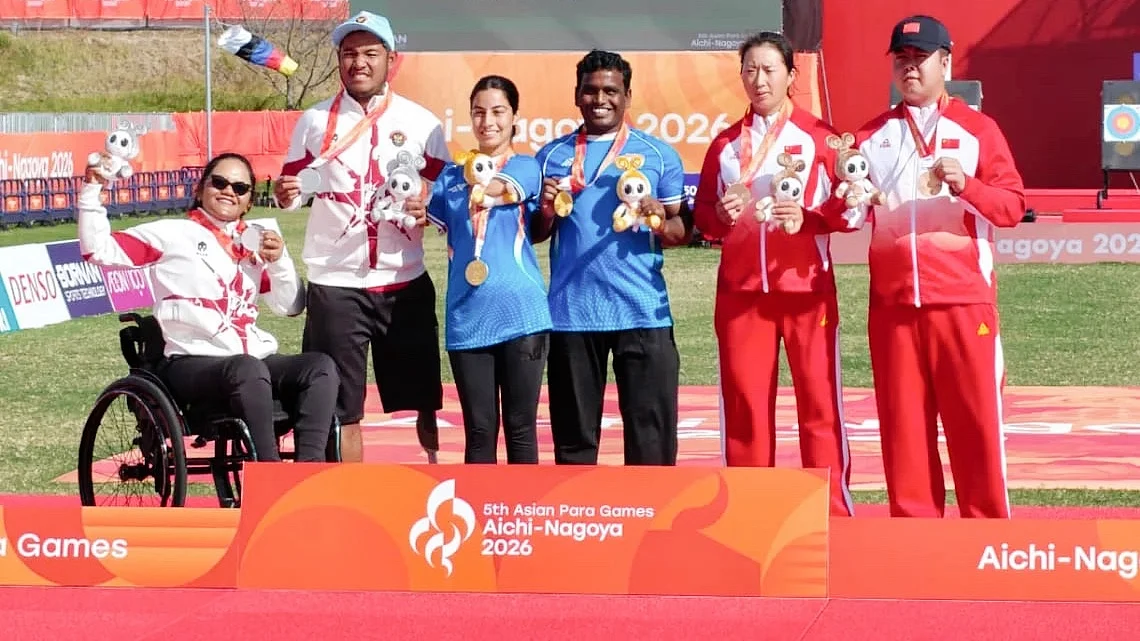
- Having secured 114 medals comprising 30 gold, 35 silver, and 49 bronze medals, India has not only bettered its previous record of 111 medals won at the Hangzhou 2023 Asian Para Games but has also emerged in the fourth position on the final medal table.
- At the same time, the case under consideration proves the importance of creating an environment for people with disabilities to have access to training, equipment, coaching, and competitions.
- The next phase would be ensuring that the record-breaking result becomes a starting point for future achievements.
The outstanding performance of India at the Aichi-Nagoya 2026 Asian Para Games is certainly a major milestone in the sporting history of the nation. Having secured 114 medals comprising 30 gold, 35 silver, and 49 bronze medals, India has not only bettered its previous record of 111 medals won at the Hangzhou 2023 Asian Para Games but has also emerged in the fourth position on the final medal table. Prime Minister Narendra Modi appreciated the team for its determination and inspirational capacity. However, apart from the achievements, there are many more questions that arise concerning the issue.
Sporting Success and National Identity
In the context of International Relations and constructivism, national identity is dynamic in nature and is constructed based on common experiences, narratives and accomplishments. Sporting events offer an opportunity for the construction of the national identity of a nation.
The accomplishments of para-athletes from India have formed a narrative of resilience and determination. The public felicitations of the Prime Minister reinforce this by framing the individual success stories of the athletes as national successes. The acknowledgement of medal winners like Sheetal Devi, Sumit Antil, Mona Agarwal and Sandeep makes visible athletes who confound expectations regarding ability to excel in sports despite disability.
Nevertheless, national pride cannot be limited to positive messages. What remains significant about this accomplishment will be dependent on whether the recognition translates into sustained efforts for the benefit of para-athletes.
Human Security and Persons with Disabilities
Another concept that could be used to highlight the importance of the Games is human security. Whereas the traditional notion of security has always been about territorial security and safety from military threats, the concept of human security centres around individual dignity, well-being, and opportunities.
India’s performance in 11 sports, such as para-athletics, badminton, swimming, table tennis, archery, and shooting, shows the diversity of talents of India’s para-sportspeople. Para-athletics alone accounted for 65 medals out of all medals won in the Games, which made it the biggest contributor. Outstanding results were achieved by Haney in the men’s javelin throw and Sandeep in the 400 metres race of the T64 category.
Such achievements refute the idea that people with disabilities cannot fully participate in social life. At the same time, the case under consideration proves the importance of creating an environment for people with disabilities to have access to training, equipment, coaching, and competitions.
Within the context of human security, the goal of the government is not just to make India’s athletes winners on the international arena. It should also focus on making their everyday lives more convenient.
State Capacity and Sports Governance
Apart from considering the record number of medals, one can analyse India’s medal tally using the concept of the developmental state, which stresses the significance of institutions, strategic planning, and public investment for accomplishing national goals.
India’s success in various types of sport can demonstrate the importance of the identification of talented people, their specialised training, and assistance in preparing for competitions. The successes of those athletes who managed to win more than one medal and even sweeps on the podium in some types of athletics indicate achievements in some parts of the contingent.
However, a number of medals won during the Games does not make it possible to evaluate how successful the policy of a country in sports is. To do this, one should consider such factors as financing, quality of coaches, sports science, accessibility, and distribution of opportunities, among other aspects. Thus, the task of the government is to transform this success into a sustainable system of sports.
Soft Power and the International Profile of India
The Games are also linked to soft power, which is an idea first introduced by Joseph Nye to refer to how countries are able to get their way without the use of coercion. Success on the sporting front will improve the international reputation of a country by demonstrating prowess, discipline, and ambition.
The performance of India in fourth place and in setting new records provides it with a great example of sporting excellence that can have an impact on its international reputation.
But soft power will have its maximum impact when the international successes are reflective of what takes place in the domestic arena. In the case of India, its sporting success will only mean something when it creates a domestic environment where it becomes accessible to everyone.
Conclusion
India’s results in Asian Para Games 2026 go beyond being a sports milestone. Through constructivism, human security, developmental state theory, and soft power, it can be viewed as a case of national identity, human dignity, capacity building, and international recognition.
The next phase would be ensuring that the record-breaking result becomes a starting point for future achievements. Consistent effort, availability of facilities and participation by para-athletes will determine the future for persons with disabilities in India.

Anjali Singh is a postgraduate student of Political Science and International Relations, a Social Media Analyst, and a former Research Intern at the Indian Council of World Affairs. Views expressed are the author’s own.
 Piyush Anand
 Aayush Pal
 Pranav S