
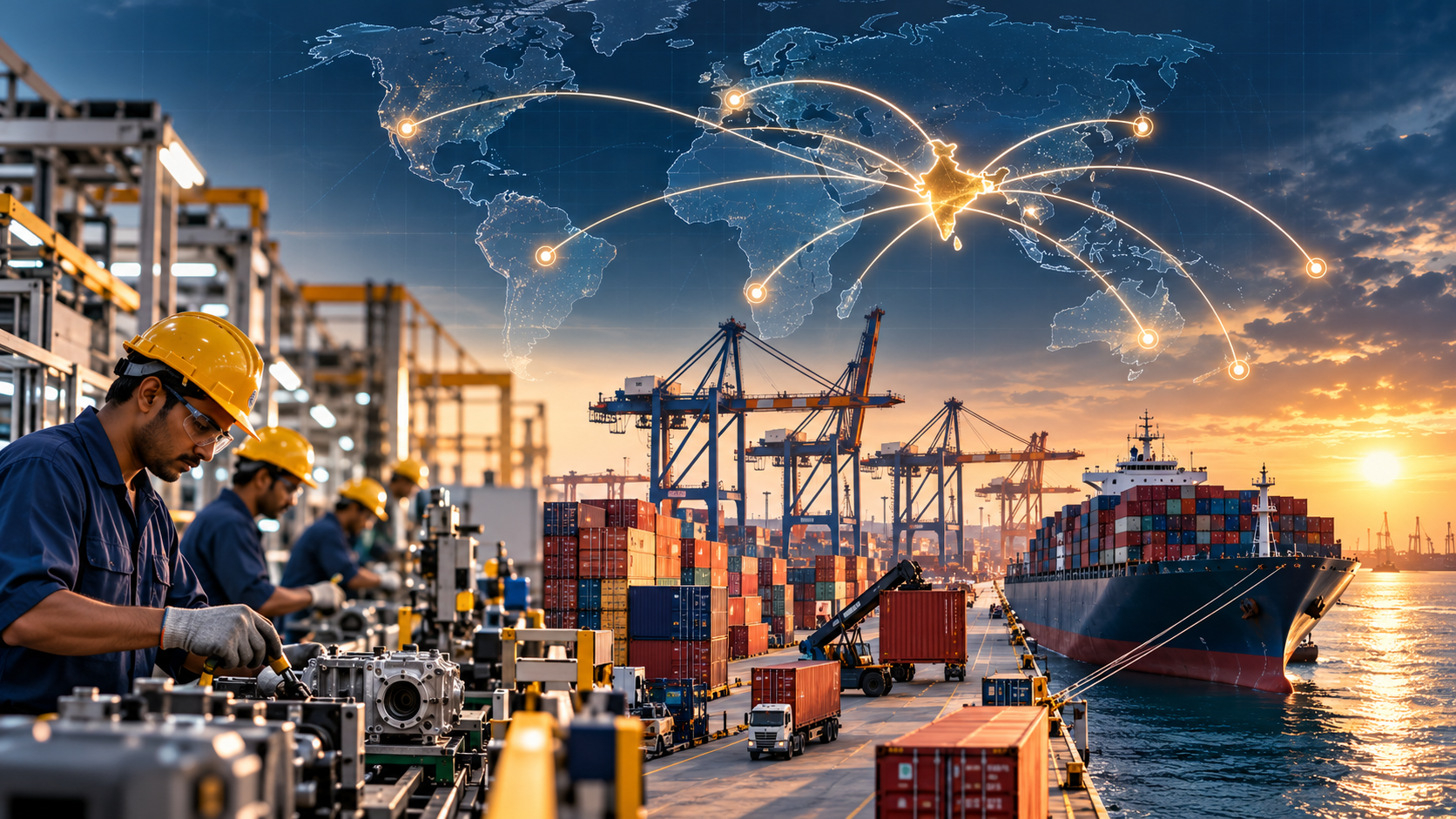
- India is trying to establish itself as a global manufacturing hub, but this is no longer simply about bringing large factories to the country.
- For India, therefore, the question is not merely how much it exports, but how many Indian firms can export consistently and compete in international markets.
- The real opportunity lies in combining digital market access with finance, logistics, standards and trade intelligence.
- India does not merely need more factories producing for the world. It needs more Indian firms capable of competing, supplying and growing in the world.
India is trying to establish itself as a global manufacturing hub, but this is no longer simply about bringing large factories to the country. Increasingly, it is about building an ecosystem of companies that can produce, sell and export at scale. This makes India’s micro, small and medium enterprises (MSMEs) central to the country’s global economic ambitions.
The numbers already speak for themselves. MSMEs accounted for 48.55 per cent of India’s merchandise exports in 2024–25, according to the Ministry of Commerce and Industry. They operate across labour-intensive and value-added sectors, making them significant not only for employment generation and domestic output, but also for diversifying India’s export basket.
However, a crucial question remains: can India’s vast MSME base become more deeply integrated into global trade?
India’s Global Manufacturing Ambition Has an MSME Question
Over the past decade, India has been strengthening its manufacturing ecosystem through initiatives aimed at improving infrastructure, logistics, production capacity and investment. The Production Linked Incentive schemes, industrial corridors and ease-of-doing-business initiatives have all been part of this broader push.
But global manufacturing is not simply the domain of large factories. Large exporters depend on networks of smaller suppliers that provide components, intermediate goods, specialised services and local expertise.
This is where MSMEs become strategically important.
A manufacturing ecosystem dominated by a handful of large firms can increase domestic production, but it does not necessarily translate into broad-based participation in global value chains. By contrast, a more dispersed network of globally connected MSMEs can spread the gains from trade across regions and sectors, while also contributing to more diversified and resilient supply chains.
For India, therefore, the question is not merely how much it exports, but how many Indian firms can export consistently and compete in international markets.
Trade Agreements Are Only the Beginning
India’s growing network of trade agreements has opened new routes to international markets, but a deal on paper does not automatically create an exporter. For an MSME seeking to enter a foreign market, the challenges extend well beyond tariffs. Firms must navigate product standards, certification, packaging requirements, customs procedures, logistics, market discovery, payment risks and access to working capital. Non-tariff measures can be particularly significant, as complying with a foreign market’s regulatory requirements can impose substantial costs on smaller businesses.
This creates an important distinction between market access and market participation. A trade agreement may lower tariffs, but a small Indian producer still needs to understand what buyers in that market demand, comply with its regulatory requirements, and have the financing and logistical capacity to fulfil an international order.
India’s policy framework is beginning to recognise this distinction. The Export Promotion Mission, with a financial outlay of ₹25,060 crore for 2025–26 to 2030–31, is intended to provide more targeted support to exporters. Its two components — Niryat Protsahan and Niryat Disha — cover areas ranging from trade finance and export factoring to quality compliance, branding, logistics, market access and trade exporters. This is a notable shift because export policy is being brought closer to the actual costs of entering global markets.
The Missing Link Is Export Capability
However, the challenge extends beyond financial incentives.
India needs to build what could be called an export-capability ecosystem — one that helps firms develop the knowledge, systems and networks required to compete in international markets.
For a first-time exporter, a subsidy may not be the most important intervention. The more immediate questions may be: Which market should the firm enter? What certifications are required? How should the product be priced? Which logistics route should it use? And how can it identify reliable international buyers?
These questions matter because the cost of getting them wrong is considerably higher for smaller firms. A failed export order, an unexpected compliance requirement or a delayed payment can impose a financial burden that a small business may struggle to absorb.
Recent policy measures increasingly acknowledge this wider challenge. The government has been developing the framework for e-commerce exports and export-oriented logistics infrastructure, including E-Commerce Export Hubs, which are intended to support MSMEs and artisans with warehousing, fulfilment and other infrastructure needed to reach global markets.
The growing policy emphasis on helping smaller firms navigate international trade is also reflected in the Centre for Trade and Investment Law’s guidebook specifically designed to help Indian MSMEs enter global markets.
These initiatives point towards a broader shift in thinking: export promotion should not end with helping firms sell abroad. It must equip them to do so repeatedly, competitively and sustainably.
Digital Trade Could Change the Equation
Digitalisation offers another potential route for MSMEs to overcome the traditional disadvantages of scale.
Historically, an Indian small manufacturer looking for an overseas buyer had to rely heavily on intermediaries, trade fairs or established distribution networks. Digital platforms can reduce some of these information and market-discovery barriers.
India’s e-commerce export infrastructure is consequently becoming an important part of its broader trade strategy. The government has also proposed BharatTradeNet as a digital public infrastructure for international trade documentation and financing, potentially reducing some of the friction involved in cross-border transactions.
But technology alone will not solve the problem. A digital marketplace can help a firm find a customer; it cannot automatically ensure that the firm meets international quality standards, has sufficient production capacity or can manage foreign currency and payment risks.
The real opportunity lies in combining digital market access with finance, logistics, standards and trade intelligence.
Why This Matters for India’s Geoeconomics
The MSME export question has implications beyond domestic economic policy.
As geopolitical competition increasingly intersects with trade, supply chains and technology, economic resilience has become an important component of national strategy. Countries are seeking to diversify suppliers, reduce excessive concentration and build more resilient production networks.
For India, this creates an opportunity.
A broader base of globally connected MSMEs could make India a more attractive node in international supply chains. Instead of positioning India merely as a destination for large-scale foreign investment, the country could increasingly offer international firms an ecosystem of domestic suppliers capable of meeting global standards.
This could also strengthen India’s economic engagement with emerging markets.
India’s external economic relationships need not be built exclusively around large corporations and major export sectors. Smaller firms can create commercial linkages in specialised products, textiles, food processing, engineering goods, pharmaceuticals, handicrafts and digitally enabled services.
In this sense, MSME internationalisation can become an instrument of economic diplomacy.
From Export Promotion to Export Participation
India’s export strategy is therefore entering an important phase.
The country has already demonstrated that it can expand its aggregate exports. India’s total exports of goods and services reached an estimated US$863.1 billion in FY2025–26, according to the Ministry of Commerce and Industry.
The next challenge is more structural: ensuring that a wider range of Indian firms can participate in this expansion.
That requires moving from an approach centred primarily on export incentives towards one centred on export capability.
The objective should not simply be to produce more exporters for one year. It should be to create firms that can enter international markets, meet global standards, develop repeat buyers, withstand trade disruptions and gradually move into higher-value segments.
This is particularly relevant to India’s manufacturing ambitions. Large investments may create the visible foundations of a manufacturing hub, but the depth of an industrial economy is ultimately determined by the ecosystem surrounding those investments.
India therefore faces a question that is both economic and strategic: can its MSMEs move from being participants in India’s export story to becoming active participants in global value chains?
If the answer is yes, India’s manufacturing ambition could acquire a broader foundation—one in which globalisation is not limited to a handful of large companies but becomes an opportunity for a much wider network of Indian enterprises.
India does not merely need more factories producing for the world. It needs more Indian firms capable of competing, supplying and growing in the world.

Archita Gaur is a postgraduate student at the School of International Studies, JNU. She specialises in the World Economy and has a strong interest in public policy, economic research, and governance. The views expressed are the author’s own.
 Hridbina Chatterjee
  Divyanka Tandon
  Aayush Pal