
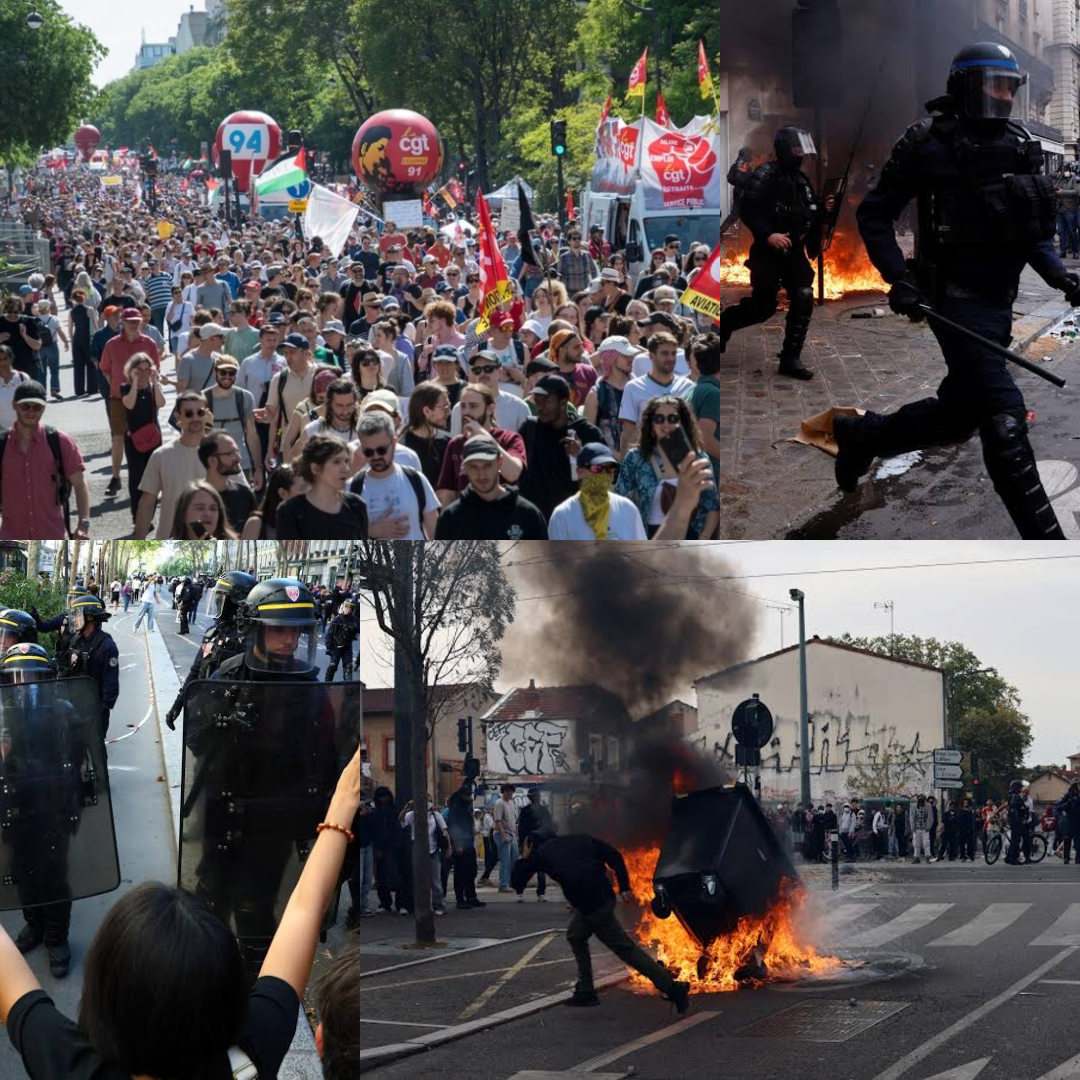
- France is standing at a critical juncture, and arguably, the biggest litmus test for President Macron is yet to come.
- Years of state-led fiscal policies have created a state debt of around €3.6 trillion, equivalent to nearly 119% of France’s overall GDP.
- The country’s politics became deeply divided, with one section of the political spectrum becoming more sympathetic towards immigrants in France, while the centre-right and other political forces increasingly opposed immigration.
- As France moves towards the 2027 presidential elections, President Macron faces a complex political environment both at home and abroad.
With the presidential elections set to take place in 2027, political heat is once again building up in France. This comes amid the already ongoing political instability in the country, where no government has been able to secure a majority and where President Emmanuel Macron is facing arguably the biggest political test of his entire political career. France is standing at a critical juncture, and arguably, the biggest litmus test for President Macron is yet to come.
France’s Streets Erupt Ahead of the 2027 Presidential Election
However, the run-up to the 2027 presidential elections is not necessarily on the right path for President Macron, as the streets of France have been witnessing growing unrest. Almost 400 schools have reportedly been closed or disrupted, while nearly 5,000 people have been arrested, most of them minors, who have taken to the streets protesting poor school conditions, overcrowding, inadequate resources and staff shortages. With the protests increasingly turning violent, students have come out in large numbers to protest against the government, forcing French police to carry out a crackdown. The bigger question that arises is: what is happening in France? A country once known for its strong academic standards and a country that, for years, enjoyed economic prosperity is now facing a much deeper crisis. The very question that comes up is: what exactly has been happening to France?
From Education Crisis to a Broader Economic Reckoning
However, it would be correct to say that the current academic and educational institutional crisis is not an isolated problem in France. Rather, it is a ramification of the country’s ongoing economic and broader structural crisis. Years of state-led fiscal policies have created a state debt of around €3.6 trillion, equivalent to nearly 119% of France’s overall GDP. With the government facing such a mammoth debt burden, it is now being forced to undertake fiscal restructuring. One of the biggest sectors being impacted by this fiscal restructuring is education. The education sector across France has not necessarily been receiving adequate state funding, because of which academic institutions across the country have been compromised. This has resulted in students taking to the streets in protest.
However, this is a structural problem within the French academic system, as it is not just students who are protesting. Educators and faculty members are also out on the streets, demanding better pay and improved purchasing power. French faculty members have been demanding higher salaries, arguing that their wages have not increased sufficiently, because of which their purchasing power has become increasingly uncompetitive. The entire protest has now expanded beyond education into issues surrounding public-sector wages, taxation, government spending, the quality of public services, policing and the treatment of protesters.
Macron’s Second-Term Crisis and the Fragmentation of French Politics
All of this is not an isolated development in France. One of the bigger reasons behind the current situation is that, ever since President Macron’s second presidential term, there has been a series of crises for his centrist Renaissance party. There has also been a greater strategic problem that President Macron has faced during his second term. When President Macron was re-elected in 2022, there was an expectation that he could become an indirect leader of the European Union and that this would provide France with a greater opportunity to rise and emerge as an economic giant. However, his aspirations met with a different reality when Russia invaded Ukraine. The war in Ukraine significantly altered Europe’s strategic environment. The greater idea of strategic autonomy and the aspiration of France becoming a greater power in Europe were constrained, as much of President Macron’s attention was redirected towards Ukraine. The war in Ukraine therefore became the first major challenge.
The second major problem for President Macron was the series of protests that emerged over his pension reforms. President Macron was forced to restructure France’s retirement policy, under which the retirement age was increased by two years. Large numbers of people came onto the streets and protested against the retirement and pension reforms that were being introduced. This created not only political unrest inside France but, more importantly, contributed to greater economic uncertainty. While all of this was happening, a series of immigration-related protests and debates also became increasingly intertwined with French politics. The country’s politics became deeply divided, with one section of the political spectrum becoming more sympathetic towards immigrants in France, while the centre-right and other political forces increasingly opposed immigration. This further intensified political unrest across France.
The entire political unrest has provided a greater political opportunity to many other parties in France. One of the biggest developments that has not helped the current regime of President Macron has been the series of changes in the country’s prime ministership. It is important to understand that, right now, no single party in France has a majority. More importantly, there have been multiple changes in the prime ministership, which President Macron has been forced to undertake. These repeated changes have contributed to a perception of political instability and have raised questions about public confidence in the current political establishment.
Far Right, Far Left and the Battle for France’s Political Future
This has created greater political opportunities for several other political parties across France, particularly the far-right. The far right has increasingly questioned President Macron over immigration and has argued that France has declined under his leadership. The far-right, led by Marine Le Pen, who has fought against President Macron in the last two presidential elections, has gained greater political space amid the issues surrounding the war in Ukraine, immigration, economic unrest and social instability. At the same time, the legal charges against Marine Le Pen relating to the alleged misuse of European Union funds have added another layer of politicisation to French politics. This has further intensified political divisions, particularly among supporters of the far right.
Along with this debate, the differences between the far right and the centrist political forces in France are also giving a greater opportunity to the far-left. The far-left, led by Jean-Luc Mélenchon, has significantly accelerated its political momentum. In the last parliamentary election in France, the left-wing alliance emerged as the largest bloc in terms of seats, further demonstrating how divided French politics has become. This very much tells us how fragmented and unpredictable French politics has become.
But whatever the scenario may be, with people on the streets, the economy facing a deadlock, and no clear parliamentary majority, President Emmanuel Macron is standing at a very critical junction. Amid all of this, the international situation is also not necessarily helping France. Ever since the return of President Donald Trump, tensions between Trump and President Macron have also emerged. President Trump has criticised Macron over his handling of French politics and has questioned his intentions on several issues. These differences of opinion between the President of the United States and France are not necessarily helpful for France, especially at a time when Ukraine remains at war with Russia and France is being asked to provide greater support to Europe and greater assistance to Ukraine.
Therefore, as France moves towards the 2027 presidential elections, President Macron faces a complex political environment both at home and abroad. Domestic protests, economic pressure, political fragmentation, immigration, the war in Ukraine and disagreements with the United States are all converging at a crucial moment. The question now is not simply whether France can overcome its immediate political and economic challenges. The larger question is whether the country’s political establishment can restore stability and public confidence before the presidential elections arrive in 2027.

Aayush Pal is a freelance writer on contemporary geopolitical developments. The views expressed in his work are entirely his own.
 Piyush Anand
  Parag Gilada