
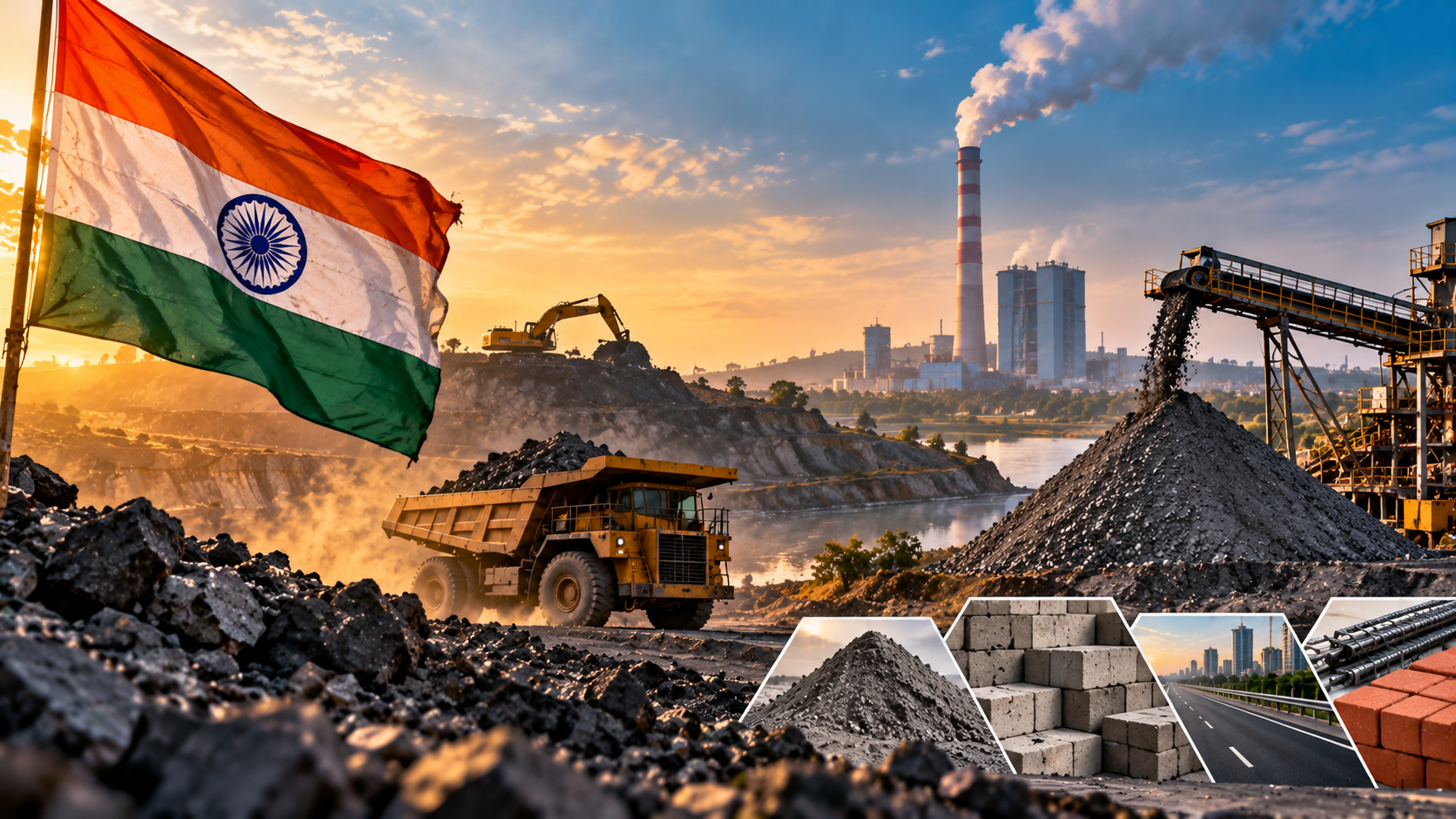
- India has generated 340.11 million tons of fly ash in 2024-25, out of which 332.63 million tons were utilised.
- The National Mineral Mission has earmarked ₹100 crore for pilot projects for extraction of important minerals from overburden, tailings, fly ash, and red mud, among others.
- Finally, performance reporting must distinguish between waste collected, waste processed, material sold, and virgin resources that have been demonstrably reduced.
- So the real test of India’s mining waste plan is not how much waste is officially recorded as utilised. It is whether recovered resources have long-term economic value without moving the costs of extraction and disposal to someone else.
India’s mining industry faces a significant waste-management challenge that also presents an economic opportunity. Waste products, such as coal overburden, fly ash, mine tailings, and others, have the potential to be used as construction materials, to aid in the recovery of important minerals, and to reduce the demand for virgin resources. The idea is seductive: change an environmental problem into an industrial boon. But a hopeful laboratory discovery is a long way from a workable business in waste recovery. If something is reusable, it doesn’t need to be inexpensive to process, transport, market consistently, or use safely at scale. So India’s dilemma extends beyond simply recycling more mining waste. The challenge is to establish a framework for the commercial, regulatory, and environmental conditions within which waste recovery can provide public benefit. There is considerable potential. As per the Press Information Bureau, India has generated 340.11 million tons of fly ash in 2024-25, out of which 332.63 million tons were utilised. The reported consumption was 32% for roads and flyovers, 27% for cement, 14% for bricks and tiles, about 11% for backfilling, and 10% for mine filling. The figures show that industrial byproducts have established uses. And they raise the more difficult question of what to do with commodities for which existing markets are restricted, geographically unavailable, or commercially unattractive.
The difference between usage and value creation
India’s experience with fly ash illustrates both the advantages and limitations of a recycling-focused approach. Thermal power plants produce large quantities of ash, putting pressure on land, storage, and environmental management. Its use in cement, construction, and mine fill can reduce disposal needs and replace some conventional materials. But an aggregate utilisation statistic does not tell the whole economics of the system. It does not establish whether ash consistently replaces virgin material, whether transport costs make its use competitive, or whether the resulting product meets quality and environmental criteria. Nor does it indicate what proportion of the material is used in applications that provide long-term economic value rather than simply shifting the burden of disposal elsewhere. These differences are important because industrial waste is rarely uniform. The composition varies according to the source, the manufacturing procedure, and the region. A material suitable for one construction application may not be suitable for another. Recovery may involve processing, quality control, storage, and special transportation. If such expenditures are greater than the value of the product recovered, a technically successful recycling plant may be unprofitable.
The policy objective should thus be expanded beyond that of maximising the tonnage that is labelled as used. It should specify what is recovered, what is replaced, what costs are incurred, and what environmental liabilities remain.
Coal overburden: a promising example but not a general solution.
One well-known example of both the opportunities and the limits is coal mining. Open-cast operations remove substantial quantities of soil and rock to reach the coal seams. Overburden can cover large areas, distort landscapes, and hamper mine reclamation. Depending on the geological and engineering properties, part of it can be used as a construction material. In a 2026 study published in the journal Land Degradation & Development, the overburden from the Bhowra and Dhansar mines in the Jharia Coalfield was studied as a potential substitute for conventional coarse aggregate in concrete. The researchers said the material tested met the basic standards for aggregates, and some of the concrete mixes performed well in mechanical tests. The results point to a promising direction for further exploration. Acceptable overburden can be used to replace part of natural aggregates, thus decreasing the demand for quarried material and providing a productive use for mining leftovers. The study estimated the potential for considerable resource substitution within the parameters considered.
However, the findings should not be interpreted to mean that all coal overburden is appropriate for use in concrete or that the proposed method is economically scalable at this time. Geological conditions are different in the mines. The material properties, the contamination concerns, the processing needs, and the transportation distances can all be very different. Performance in the mixtures tested is not a substitute for long-term durability testing, field validation, or compliance with applicable building codes. The commercial aspect is important, too. Supply chains, customers, and pricing processes are well established for natural aggregates. Any alternative must be able to compete with these established systems. Transport and processing may reduce the estimated savings if the overburden needs a lot of crushing, screening, or treatment, or if the building sites are far from the mine. Waste policy at this point needs a more rigorous economic underpinning. Local authorities and businesses should consider each site against factors such as material quality, local demand, processing costs, transport needs, and environmental risk. It should not be about forcing a standard model on different mining regions but about identifying possible applications.
Critical minerals have a degree of complexity.
The case for recovery becomes strategically important if the mine waste contains essential minerals. India is seeking to boost domestic supply chains for materials used in electronics, renewable energy, and other high-tech manufacturing sectors. Recovering usable elements from existing waste streams could supplement traditional exploration and mining methods. In July 2025, the government released the results of research on rare earth elements in coal-related samples of fly ash, bottom ash, and overburden. The National Mineral Mission has earmarked ₹100 crore for pilot projects for extraction of important minerals from overburden, tailings, fly ash, and red mud, among others. This policy direction is promising, but it is important to distinguish between the presence of a mineral and the existence of an economically viable deposit. Concentration is not the only factor in commercial viability. The chemical structure of the mineral, the complexity of the material, recovery rates, reagent and energy requirements, waste treatment, and the cost of separating and refining the final product determine extraction.
A pilot project that successfully extracts the target mineral may answer only the first of many questions. Can the process be reliably scaled up? What proportion of the target mineral can be recovered? How much water and energy is used? What happens to the garbage that is left behind? Can the end product be price-competitive while satisfying industrial requirements? These concerns must be addressed using public funds in a transparent manner. Pilot programs need to have clearly defined performance benchmarks, independent technical review, and reporting of both successful and unsuccessful results. Otherwise, efforts to recover valuable minerals risk remaining a story of theoretical potential rather than demonstrated value.
Who pays for waste recycling?
The economics of waste recovery must be considered together with the distribution of costs. Mining companies may be responsible for residue management, and downstream users benefit from cheaper commodities. Communities may bear the costs of poorly managed waste without receiving their fair share of the benefits generated by business use. Transportation is a particularly big bottleneck. A recovered resource with a low market price may be viable only within some radius of its source. Key to project success are rail connectivity, bulk handling facilities, local processing capacity, and predictable demand. In those cases, the cost of transporting waste can outweigh the savings from using other resources. There is also a danger of assuming that building a market will immediately reduce environmental risks. Waste containing potentially hazardous materials must be properly characterised, contained, and monitored. Reuse should be conditional on proof that the intended use is safe, rather than a blanket exemption from environmental scrutiny. The same argument applies to mine reclamation. In some cases, reuse of overburden for construction may be beneficial, but it cannot replace the need to stabilise disturbed ground, control drainage, and reclaim sites in accordance with approved closure plans. Waste-recovery companies should not be used as a means of shifting the cost of remediation to local governments or communities.
A reliable framework would clarify responsibilities. Companies will be required to disclose material characteristics and pay any applicable compliance fees. Regulators should have clear rules about what uses are allowed and conduct independent verification. Buyers must have access to reliable and quality information. Local communities should be informed of the movement, processing, and use of potentially hazardous products in their neighbourhood.
Create marketplaces, not just mandates.
India need not abandon utilisation targets or public funding for circular-economy projects. It must also adopt policies that encourage efficient resource use and penalise the transfer of environmental obligations. First, public procurement could create demand for certified secondary materials that meet technical and safety requirements. Instead of simply choosing materials based on recycled content or initial pricing, government construction projects should consider appropriate recovered aggregates, ash-based products, and other alternatives on a life-cycle basis. Second, financial assistance should be linked to measurable outcomes. Pilot grants and concessional financing can help firms to overcome technical concerns in the early stages, but projects need to demonstrate recovery efficiency, product quality, environmental compliance, and credible demand before they are eligible for expansion finance. Third, standards and testing infrastructure must progress with technology. Construction companies and manufacturers can reduce uncertainty by using independent laboratories, clear certification, and traceable material specifications. In the absence of these protections, quality concerns will stifle adoption even when a material has real potential. Fourth, policymakers should consider the full cost of recovery. It includes energy, water, transport, processing, pollution control, residue management, and long-term surveillance. Comparing those costs with the environmental and economic benefits of substituting virgin materials would provide a firmer basis for judging which technologies deserve public support.
Finally, performance reporting must distinguish between waste collected, waste processed, material sold, and virgin resources that have been demonstrably reduced. These are distinct measures of performance. You cannot compare a project that processes huge quantities but delivers little usable product with one that consistently feeds a market and reduces the demand for newly harvested resources.
From the problem of disposal to the industrial strategy.
India’s mining waste economy has the potential to contribute to construction, material innovation, and the recovery of critical minerals. But the opportunity will only be realised if policymakers do not regard recycling as an end in itself. The most successful projects won’t always be those that process the largest quantities of mining waste. They will be those that safely recover valuable materials, compete on cost and quality, reduce the extraction of virgin resources, and do not create new environmental liabilities. Some waste streams will meet these criteria, while others may be too costly or toxic for reuse in specific applications. This is not a failure of the circular economy. It is an acknowledgement that sound resource policy requires technical evidence, commercial discipline, and environmental accountability.
So the real test of India’s mining waste plan is not how much waste is officially recorded as utilised. It is whether recovered resources have long-term economic value without moving the costs of extraction and disposal to someone else. Recycling initiatives can create opportunities. Only credible economics, enforceable standards, and transparent assessment can make them an industrial strategy.

Anusreeta Dutta is a columnist and climate researcher with experience in political analysis, ESG research, and energy policy. Views expressed are the author’s own.
 Archita Gaur
 Aayush Pal
 Piyush Anand