- Allowing the treaty to renew automatically under its existing terms, or settling for a simple, unamended extension, would lock India into an obsolete allocation regime that actively ignores shifting hydrological realities, upstream climate pressures, growing domestic water stress, and the necessity of holistic basin management.
- The treaty’s formula was designed using average dry-season flow data collected at Farakka between 1949 and 1988, a baseline that no longer reflects the hydrological realities of the Ganges River system.
- Without enough flushes, there will be a negative impact on maritime trade, logistics and economic stability across Eastern India.
- Declining to automatically renew the agreement and transitioning into renegotiation will give India the leverage to address the issues with the treaty.
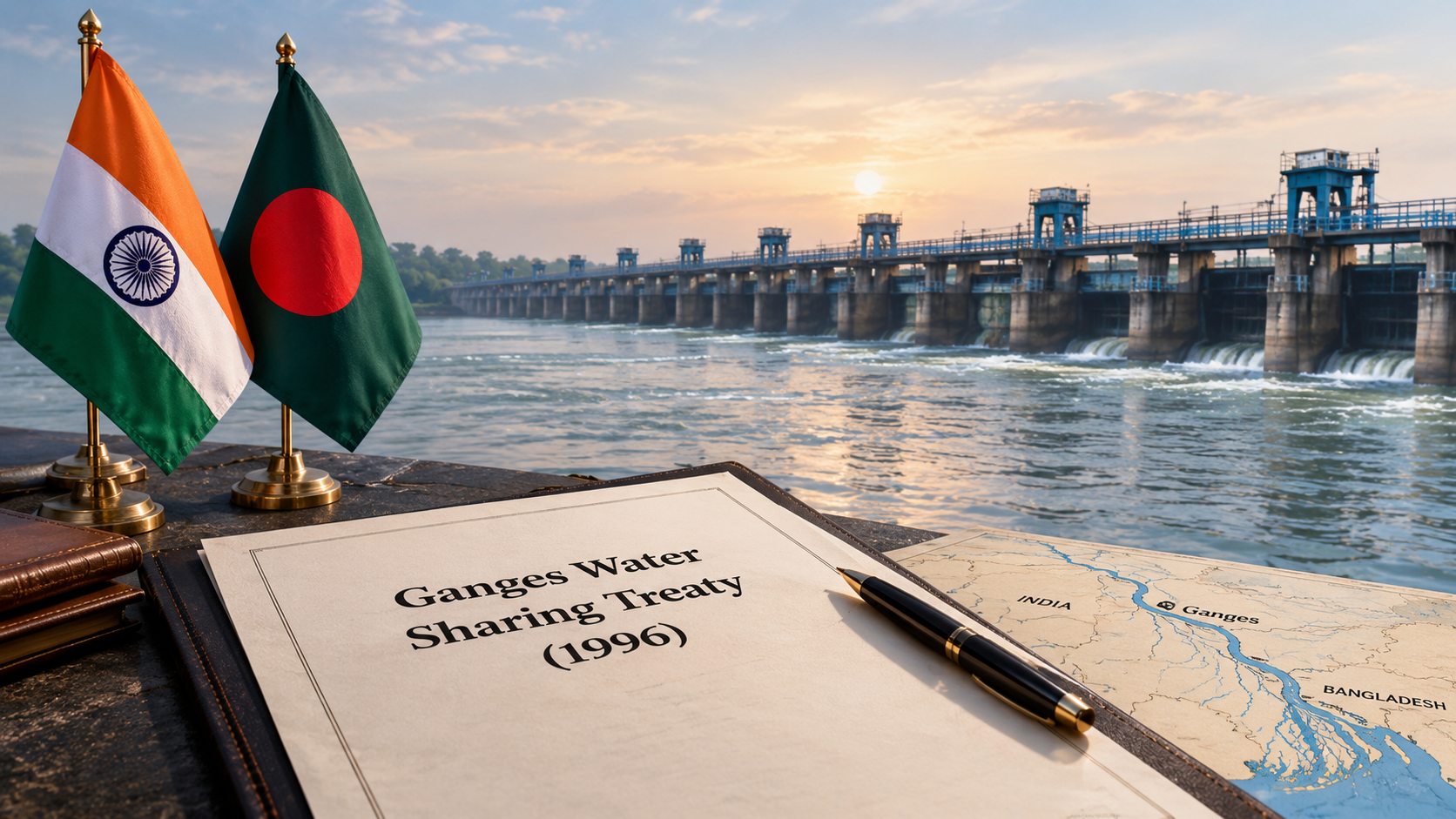
As the December 12, 2026 expiration date of the 1996 Ganges (Ganga) Water Sharing Treaty approaches, New Delhi stands at a critical diplomatic crossroads. Signed three decades ago by Indian Prime Minister H.D. Deve Gowda and Bangladeshi Prime Minister Sheikh Hasina, the treaty was widely hailed as a watershed moment in South Asian transboundary river diplomacy. By establishing a fixed mathematical schedule to divide lean-season flows (January 1 to May 31) at the Farakka Barrage in West Bengal, it resolved decades of bilateral friction. However, thirty years of profound ecological, demographic, and geopolitical transformations have laid bare the structural limitations of the 1996 framework. Allowing the treaty to renew automatically under its existing terms, or settling for a simple, unamended extension, would lock India into an obsolete allocation regime that actively ignores shifting hydrological realities, upstream climate pressures, growing domestic water stress, and the necessity of holistic basin management.
Crucially, declining automatic renewal should not be interpreted as a rupture in bilateral relations or an attempt to deprive downstream Bangladesh of vital water supplies. Rather, it serves as an indispensable diplomatic mechanism that gives India the leverage needed to replace an outdated, purely volumetric allocation scheme with a dynamic, basin-wide, data-transparent framework tailored for the twenty-first century.
The Flaw of Static Baselines in a Rapidly Changing Climate
The 1996 Treaty’s foundational weakness is its dependence on static, historical flow records to determine current allocations. The treaty’s formula was designed using average dry-season flow data collected at Farakka between 1949 and 1988, a baseline that no longer reflects the hydrological realities of the Ganges River system. Driven by climate change, accelerating glacial retreat across the Himalayas produces unpredictable spring runoffs, followed by acute depletion during the crucial lean months. Simultaneously, shifting monsoon patterns have intensified hydrological extremes, causing severe wet-season flooding alongside prolonged dry-season droughts. Because the 1996 agreement lacks an adaptive management clause, sudden drops in river levels inevitably create acute structural strain for both riparian. Renewing a rigid, volumetric treaty in an era of severe climate volatility guarantees friction during every low-flow cycle.
| Hydrological Dimension | 1996 Treaty Baseline Assumption | 2026 Hydrological Reality |
|---|---|---|
| Flow Dynamics | Stable glacier melt and predictable seasonal runoff | Accelerating Himalayan glacier retreat and erratic seasonal flows |
| Data Foundation | Fixed historical averages (1949–1988) | Extreme weather volatility and shifting precipitation baselines |
| Sharing Mechanism | Rigid volumetric quotas at a single point (Farakka) | Increased basin-wide siltation and unmanaged tributary variations |
Compound Domestic and Upstream Pressures
Since 1996, internal water demands within the huge Ganges basin have grown exponentially. The basin currently supports over 500 million people across the states of Uttarakhand, Uttar Pradesh, Bihar and West Bengal, with intensive agricultural areas, booming industrial areas and expanding urban areas. This has led to an intensification of two key domestic pressures for the country;
| [ Upstream Consumptive Demands ] (Uttarakhand, Uttar Pradesh, Bihar Irrigation & Urban Use) │ ▼ [ Farakka Barrage ] / \ / \ ▼ ▼ [ Kolkata Port & Delta ] [ Downstream Bangladesh ] (Requires ~40,000 cusecs (Mandatory dry-season share flushing flow for silt) under rigid 1996 schedule) |
Navigational viability
The main reason the Farakka Barrage was built in 1975 was to divert 40,000 cusecs of headwater into the Hooghly-Bhagirathi River. This is required to prevent the heavy silt build-up and ensure that the Kolkata Port remains navigable. Without enough flushes, there will be a negative impact on maritime trade, logistics and economic stability across Eastern India.
Upstream water usage
More canals have been built; therefore, more water is being extracted for agricultural purposes underground and for use in urban areas upstream. This has caused less water to reach Farakka. According to the 1996 formula, if the water level falls below 70,000 cusecs, then India and Bangladesh should each receive equal amounts of water (35,000 cusecs) every 10 days. However, during years of extremely low flow, this causes West Bengal to suffer due to them having to commit to receiving equal amounts of water. This negatively impacts their agriculture.
Governance, transparency and river morphology issues
There are also issues with the governance of the 1996 Treaty. Although daily measurements are taken at Farakka and Hardinge Bridge in Bangladesh by the Joint Monitoring Teams, the process is very slow and bureaucratic. This causes many suspicions during times of low flow. As the treaty only allows for one point of governance, this is at the Farakka Barrage. The upstream countries such as Nepal are not included in the treaty, and therefore do not benefit from the water that they contribute to the river via their tributaries. The treaty does not account for important river processes such as sediment transport and heavy siltation. This causes the river to change morphology, increasing flood risk in Bihar and West Bengal and causing erosion of the riverbanks on both sides.
Policy options
India must consider the following options:
Walk away: If India were to completely walk away from the transboundary agreement without offering an alternative, it would cause negative consequences. It would cause issues for Bangladesh as it would not receive water for its agriculture downstream. It would also cause India to lose face as a responsible leader.
Renew automatically: If India renewed the agreement without changing anything, New Delhi would be committing to unsustainable practices without considering the issues with the environment, climate change and water scarcity.
Decline automatic renewal and renegotiate (Recommended): Declining to automatically renew the agreement and transitioning into renegotiation will give India the leverage to address the issues with the treaty. It will show Dhaka that we want to have a fair agreement.
Reducing risk to the region: Bangladesh rely heavily on the Ganges for its agriculture, controlling salinity in the Sundarban mangroves and drinking water along the coast. If they feel that the water will be cut off suddenly, this can cause anti-Indian feelings within the country and cause issues for Dhaka. However, if India declines to renew the agreement automatically, it can reassure the region by:
Setting up a transitional agreement: This can be done over a period of 2-3 years. It will ensure Bangladesh receive basic ecological flows depending on how much water is available.
Modernising the JRC: Stream gauges can be placed along the river to monitor the water levels automatically. This will help to improve transparency.
Implementing an integrated water resources management approach: Instead of dividing the water at Farakka, implement an Integrated Water Resources Management approach. This will focus on protecting the environment, managing sediment, reducing salinity and eventually involving Nepal.
Overall, the 1996 Ganges Treaty coming up for renewal in December 2026 provides an opportunity for a new governance approach. Whilst the original treaty helped to overcome a long-standing issue between the two countries, it was designed for a time when the hydrology was different. By declining automatic renewal of the treaty, India can lead the way into a new modern approach that will take into consideration their need for development and navigable ports whilst also protecting the environment for Bangladesh downstream.
References:
- The Ganges Water Sharing Treaty: Genesis and Significance- https://www.ipcs.org/comm_select.php?articleNo=310
- A critical review of the Ganges Water Sharing arrangement- https://iwaponline.com/wp/article/21/2/259/66094/A-critical-review-of-the-Ganges-Water-Sharing
- Statute of the Indo-Bangladesh Joint Rivers Commission- https://faolex.fao.org/docs/pdf/bi203668.pdf

Parag Gilada is a Master’s student at IISM Mumbai in Sports Management, with a bachelor’s from OP Jindal Global University in Global Affairs, with an interest in Sports Diplomacy and Governance. Views expressed are the author’s own.
 Archita Gaur
 Hridbina Chatterjee
 Aayush Pal