
- Both countries have agreed to further foster their relationship in areas such as trade and investment, critical minerals, energy and uranium, digital public infrastructure, nuclear cooperation and many more.
- India has agreed to work towards securing long-term uranium supplies from Uzbekistan, which is particularly important for India’s energy security and its efforts to diversify its sources of nuclear fuel.
- In recent years, Central Asia has become a new geopolitical frontier for Asian as well as global powers.
- India’s relationship with the Central Asian countries is therefore of great importance, as both sides see each other as reliable partners that can contribute to their economic, strategic and geopolitical interests while respecting their strategic autonomy.
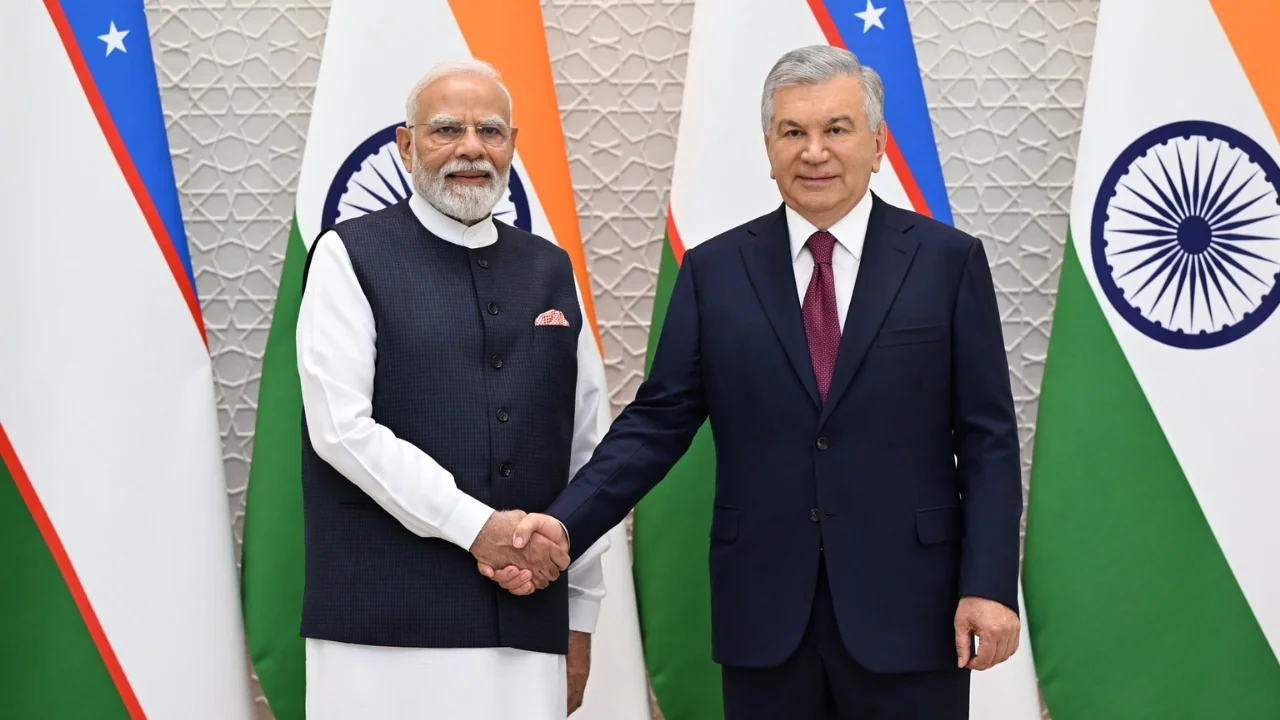
In an important geopolitical visit, Prime Minister Narendra Modi visited the Central Asian country of Uzbekistan for a two-day visit at the invitation of Uzbek President Shavkat Mirziyoyev. This was Prime Minister Modi’s fourth visit to Uzbekistan. The visit was significantly important because both India and Uzbekistan agreed to elevate their relationship to a Comprehensive Strategic Partnership.
Both countries have agreed to further foster their relationship in areas such as trade and investment, critical minerals, energy and uranium, digital public infrastructure, nuclear cooperation and many more. Both countries also agreed to further enhance their overall relationship, with India and Uzbekistan aiming to achieve a bilateral trade target of $5 billion by 2030.
The visit also holds importance because Prime Minister Modi was felicitated with Uzbekistan’s highest state award, recognising his contribution towards strengthening the relationship between India and Uzbekistan.
Uranium, Critical Minerals and India’s Strategic Interests
However, one of the biggest geopolitical significances of this visit comes from the agreement between India and Uzbekistan on critical minerals and long-term uranium supplies. India has agreed to work towards securing long-term uranium supplies from Uzbekistan, which is particularly important for India’s energy security and its efforts to diversify its sources of nuclear fuel.
The bigger geopolitical reason why this visit is important because India considers the Central Asian countries to be its extended neighbourhood. Considering the geopolitical location of Central Asia, situated at the heart of Eurasia, the region connects Asia with the rest of Europe. Therefore, any important relationship with the countries of this region provides a country with greater geopolitical accessibility and visibility.
Along with this, Central Asian countries are also powerhouses of geopolitical resources. The region possesses critical minerals, energy resources and large markets, making it increasingly important for major global powers. India has understood the importance of Central Asia and wants to further upgrade its relationship with the countries of the region.
Central Asia, Strategic Autonomy and India’s Role
In recent years, Central Asia has become a new geopolitical frontier for Asian as well as global powers. There has been a growing attempt by countries across the world to develop their relationships with the Central Asian countries. China has established a particularly strong presence in the region, with its overall trade with the Central Asian countries surpassing $100 billion.
India has also understood the strategic importance of Central Asia and has started to further elevate its relationship with these countries. One of the major reasons why Central Asian countries are important is also the question of strategic autonomy. These countries understand the geopolitical importance of their location. They are situated in a region where Russia continues to be a major regional power, while there has also been growing global interest in the region.
At the same time, the Central Asian countries want to maintain a neutral relationship with everyone and do not necessarily want to become a geopolitical bloc for any particular country. This is where India comes into the picture.
Central Asian countries have understood the importance of India, but more importantly, they also understand that when they formulate relationships with India, India does not necessarily come with strings attached to the relationship. India’s relationship with the Central Asian countries is therefore of great importance, as both sides see each other as reliable partners that can contribute to their economic, strategic and geopolitical interests while respecting their strategic autonomy.

Aayush Pal is a freelance writer on contemporary geopolitical developments. The views expressed in his work are entirely his own.
 Hridbina Chatterjee
  Divyanka Tandon
  Kumar Satish