
- By adopting Gross Ecosystem Product (GEP) as an approach to measure development in the country, Bhutan has embarked on the process of redefining national development indicators as the first nation ever to do so.
- The concept of measuring the economic value of forests, rivers, soil, biodiversity and other ecosystems is not only innovative in its measurement approach but is indicative of the changing attitudes towards development, sustainability and security on the global stage.
- The implementation of GEP means the extension of the above concept into natural capital accounting.
- This is about using the economic value of nature to improve policy, climate resilience and sustainable development and to encourage other countries to follow suit.
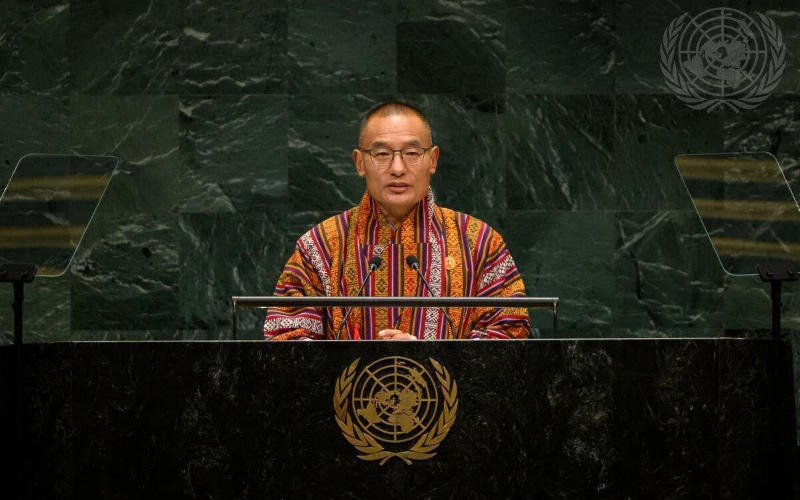
By adopting Gross Ecosystem Product (GEP) as an approach to measure development in the country, Bhutan has embarked on the process of redefining national development indicators as the first nation ever to do so. According to the Prime Minister of Bhutan, Tshering Tobgay, who made the announcement in New York on September 23, 2026, Bhutan’s Gross Ecosystem Product was estimated to be around US$6.2 billion for the year 2024, which is roughly double its GDP.
The concept of measuring the economic value of forests, rivers, soil, biodiversity and other ecosystems is not only innovative in its measurement approach but is indicative of the changing attitudes towards development, sustainability and security on the global stage.
Going beyond GDP
While GDP measures the monetary value of all the goods and services produced in an economy, GEP seeks to measure the economic value of ecosystem services like carbon storage, water regulation, soil retention, flood prevention, biodiversity and cultural and recreational services.
The point here is that many contributions made by nature lack a market price. A forest, for example, might regulate water, store carbon and prevent soil erosion, but none of these contributions will necessarily show up in the national economic accounts.
In terms of international political economy, GEP in Bhutan questions the assumption that national economic value is essentially based on market production. Natural resources need to enter into the debate on national wealth since an economy cannot be studied in isolation from its ecological foundation.
So the figure of US$6.2 billion cannot be regarded as an alternative GDP.
Environmental Security and Resilience of Nations
In addition, the initiative can also be considered under the theory of environmental security. Traditionally, the study of security issues has always been limited to military dangers, conflicts over territories and the power of nations. The theory of environmental security is an expansion of the concept, where the impact of ecological degradation on the stability of economies and the well-being of people is studied.
It is especially relevant for Bhutan, because its economy and society are based on forests, rivers, mountainous areas, agricultural land, and other ecosystems. Hydropower needs river systems and watersheds, agriculture relies on fertile soil and pollination, and tourism is related to the presence of forests, mountains and cultural landscapes.
Thus, climate change can lead not only to environmental consequences, but also to problems with infrastructure, agricultural land and livelihoods. Using a GEP to evaluate the monetary value of ecological services will allow governments to use an additional means of assessing the danger.
Bhutan as a norm entrepreneur
Moreover, the Bhutanese case can be analysed from a constructivist perspective as well, as it considers the importance of ideas, norms, and identity in international relations.
For many years, Bhutan has been advocating for the concept of Gross National Happiness as another approach to progress. As for Gross National Happiness, it is focused not only on economic development but also on human wellbeing, environmental preservation, and other aspects of life.
The implementation of GEP means the extension of the above concept into natural capital accounting. Instead of considering environmental preservation a limitation to economic growth, the Bhutanese government tries to show that ecosystems create economic benefits.
This way, Bhutan may become a norm entrepreneur as a country that advances new ideas and concepts that may affect the international agenda. This country’s GEP initiative relates to the global movement concerning the insufficiency of GDP for assessing the progress of a country.
From environmental conservation to strategic governance
Ultimately, the importance of GEP will come down to how the measure impacts policy choices. The accounts of Bhutan have been created in partnership with Stanford University’s Natural Capital Alliance, in conjunction with the Enlight Foundation. This approach could conceivably have an impact on land use planning, environmental management, payments for ecosystem services and green finance.
It is consistent with the concept of ecological modernisation, where environmental sustainability and economic development need not be in opposition to one another. With the right technology, institutions, economic incentives and improved information, states can potentially develop sustainably without sacrificing their ecosystems.
In this way, GEP could alter the decision-making process with regard to infrastructure development and investments in development projects. A project that brings economic benefit, but harms forests or water systems and their associated ecosystem services, would appear in a different light under the system of accounting.
Another dimension to global development
This is not just a matter of Bhutan’s attempt to measure its development; rather, it is part of the wider international dialogue around “beyond GDP” and sustainable development. It does not mean that Bhutan has rejected GDP. It means that Bhutan has put GDP into context with wellbeing and ecology.
Each of these three indicators answers a different question. GDP answers the question about the level of economic activity. GNH provides a wider context for evaluating wellbeing. GEP asks what value the economy produces from nature.
From the perspective of international relations, Bhutan’s experience reflects changes in the perception of power and wealth in addition to purely material economic indexes. Climate change and vulnerability make nature a part of national resilience.
The fact of having a GEP of US$6.2 billion has additional value. This is about using the economic value of nature to improve policy, climate resilience and sustainable development and to encourage other countries to follow suit.

Anjali Singh is a postgraduate student of Political Science and International Relations, a Social Media Analyst, and a former Research Intern at the Indian Council of World Affairs. Views expressed are the author’s own.
 Kumar Satish