
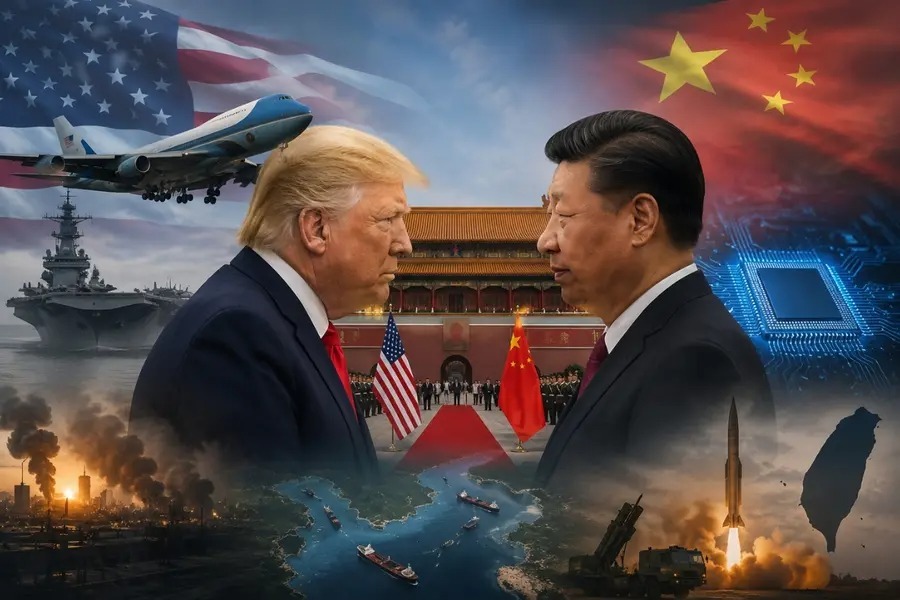
- The United States today is more dependent on China than China is dependent on the United States. As a result, it has become important for Washington to maintain cordial economic ties with Beijing.
- Taiwan represents a major strategic dilemma for the United States. Washington cannot allow China unrestricted influence over Taiwan, yet at the same time, the American economy remains deeply interconnected with China.
- The new trade understanding appears to be largely on Chinese terms, making it a significant compromise from the Trump administration.
In his first state visit after a long nine years, United States President Donald Trump visited China for the very first time in his second administration. It was a visit that could not have come at a more interesting, difficult, and complicated time, especially when world politics is changing at a rapid scale where conflicts and confrontation have become the new reality. World powers are no longer hesitant in seeking legitimacy and dominance. In this environment, cooperation and coordination have taken a backseat, and both China – United States are the very countries contesting for global hegemony.
The two biggest powers with the two largest economies holding a bilateral meeting is extremely important, particularly in the present context where the world economy has taken a downward trajectory driven by global conflicts, supply chain disruptions, and increasing instability amid the United States – Iran conflict, which has severely impacted the global economy. In such a scenario, the understanding between China – United States becomes extremely important. It is not just because China sees its interests being threatened, but also because China itself is being heavily impacted by the ongoing conflict. That is why the whole world closely watched President Trump’s visit to China.
Diplomacy, Business and Economic Realignment
For President Trump, it was a special meeting as it balanced diplomacy and economic engagement. The biggest business leaders in the world, including Elon Musk, the founder of SpaceX, Jensen Huang, and Tim Cook, were present during the special occasion. President Trump was given a red carpet welcome, and he could not stop himself from talking about how grand the reception had been. He went on to say that China is beautiful. Later, during his one-on-one meeting with Chinese President Xi Jinping, President Trump repeatedly emphasised how important the visit was for him. He said that he was fortunate and honoured to be friends with President Xi and that it was an honour for him to visit China officially. He further stated that both China and the United States would continue working on economic engagement and maintain an understanding on the changing world order to avoid conflict and enhance cooperation between the two countries.
President Xi Jinping used this opportunity to present a new meaning to China – United States relations. According to him, both countries should enhance cooperation and avoid confrontation. President Xi stated that both nations have much to work on and much to focus upon if they avoid geopolitical tensions. He emphasised that there should be a complete economic reset between China – United States and that economic rivalry between the two countries should be avoided.
The economy remains a key pillar for both China – United States because when President Trump returned to power in the United States, he had promised that he would call out countries benefiting from the American economy. He stated that he would not allow other powers to exploit the United States, and China was specifically named as a country taking advantage of American trade and industries. President Trump accused China of being a bully to the American economy and a security threat to the United States. His administration attempted to create economic parity and deterrence against China. However, these policies largely failed because the global trade order has significantly changed.
Interestingly, the United States today is more dependent on China than China is dependent on the United States. As a result, it has become important for Washington to maintain cordial economic ties with Beijing. Chinese rare earth minerals are extremely important for American semiconductors and defense technologies. China responded offensively by curbing the export of rare earth minerals, which weakened President Trump’s economic policies further. More importantly, China has become the factory of the world, and both the United States and other global powers were late in their attempts at decoupling and de-risking strategies. Most countries still depend heavily on China for manufacturing and production.
Trade Dependency and China’s Strategic Advantage
This was one of the main reasons why major business leaders accompanied President Trump during his two-day China visit. It also explains why President Trump appeared willing to agree to several Chinese terms. While these agreements may help the American economy, they are expected to benefit the Chinese economy even more. Therefore, it became a necessity for President Trump to mend relations with China, and many observers see this as a victory for China in the ongoing economic cold war with the United States.
Under the new understanding, China wants the United States to increase commercial ties by purchasing Chinese goods while also encouraging China to buy American agricultural and energy products. In exchange, China wants the United States to open its markets further for Chinese products and ensure the continued flow of Chinese rare earth minerals into the United States. The new trade understanding appears to be largely on Chinese terms, making it a significant compromise from the Trump administration.
Taiwan – The Strategic Red Line
Another major compromise concerns Taiwan, which remains the biggest bone of contention between China – United States. Situated in East Asia, Taiwan has become the epicentre of geopolitical tensions. China has consistently maintained that Taiwan is an inalienable part of Chinese territory. Although the United States officially follows the One China policy, it has often shown a tendency to prevent China from taking control over Taiwan because such a move could reshape global power dynamics and strengthen China’s position as a superpower, challenging American dominance in the region.
For China, the Taiwan issue is not just about territorial control but also about political messaging and global projection of power. Previous American administrations, both Democratic and Republican, have supported Taiwan through military aid and engagement, something that China strongly opposes. This has remained one of the primary causes of instability between China – United States. Under President Trump, Taiwan continued receiving military assistance despite repeated warnings from Beijing.
Taiwan represents a major strategic dilemma for the United States. Washington cannot allow China unrestricted influence over Taiwan, yet at the same time, the American economy remains deeply interconnected with China. The United States understands that Taiwan is a red line for Beijing, and any aggressive American posture on the Taiwan issue could create major tensions that may evolve into economic consequences for the United States itself.
Iran Conflict, G2 Resurgence and the Future Challenge
Along with this, another major issue discussed during the visit was the ongoing Iran conflict. China has significant influence and stakes in Iran because Iran is an important energy supplier for China. Beijing imports massive amounts of energy from Iran, and the blockage of the Strait of Hormuz has severely affected Chinese access to West Asian energy resources. This is something China cannot afford, which is why Beijing has strongly opposed the conflict.
China has also criticised Iran for threatening the Strait of Hormuz because China has direct stakes in the region. Reports suggest that Chinese navigation systems and satellite assistance may have helped Iran target American military bases across West Asia. According to reports in the American media, several American military facilities in the region suffered damage because of these attacks.
For China, this creates a complicated strategic situation. Beijing understands American intentions in the region and cannot allow the Iranian regime to collapse easily because that could significantly increase American influence in West Asia and disrupt China’s economic engagement in the region. China needs to continue importing energy resources and wants the Iranian regime to remain stable. That is why President Trump had earlier criticized China for not helping in reopening the Strait of Hormuz. However, during this visit, President Trump appeared to soften his stance and acknowledged that China is interested in reopening the Strait and restoring stability in energy trade routes.
Many analysts believe that this new understanding between China – United States, based on cooperation while avoiding confrontation, signals a resurgence of the G2 policy that was once associated with former United States President Barack Obama. Although China – United States remain strategic adversaries under the contemporary world order, the two largest economies are also deeply interdependent. For the United States, the dependency on China remains substantial, making continued engagement a necessity.
There is clearly a growing resurgence of G2-style thinking in global politics. However, at present, it appears that China is increasingly dictating the terms of engagement. The major challenge for the United States will be balancing national security concerns, countering the rise of China, and simultaneously managing its deep economic dependency on Beijing.
Reference:
2)https://abcnews.com/Politics/trump-xi-summit-day-1-takeaways-analysis/story?id=132963988
4)https://www.cnbc.com/2025/12/31/trump-china-trade-war-tariffs.html
5)https://www.brookings.edu/articles/more-pain-than-gain-how-the-us-china-trade-war-hurt-america/

Aayush Pal is a freelance writer on contemporary geopolitical developments. The views expressed in his work are entirely his own.
 Kumar Satish
  Anjali Singh