
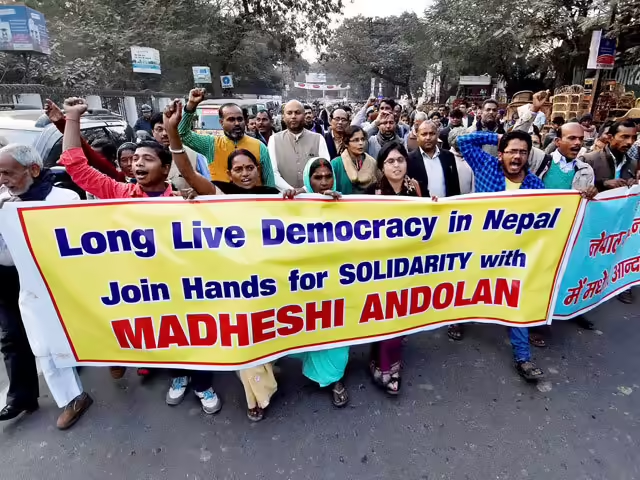
- In Nepal, the question of Madhesis’ demands in the new political order remains stuck in a paradox, which is the difference between representation and recognition.
- Balen Shah’s triumph was a symbolic success as it showed that a Madhesi-origin leader can win capital city support. But there needs to be greater shifts in state attitudes and public awareness.
- The citizenship rights of citizens have long been problematic in Nepal, especially for women who are married across the India-Nepal border, and their children.
- At the end, the future of Madhesis in the new political order of Nepal will rely on the state’s ability to overcome symbolic diversity to substantive inclusion.
After the abolition of the monarchy and the enactment of the 2015 Constitution, Nepal’s political transformation has raised expectations of inclusion, federalism and a restructuring of the country’s political system. But political recognition has been symbolic and not substantial for the Madhesi people of the southern plains. Balendra Shah, or Balen Shah, is a new political imagination in Nepal that breaks down the party structure and fosters technocratic government, urban nationalism, and anti-establishment politics. In Nepal, the question of Madhesis’ demands in the new political order remains stuck in a paradox, which is the difference between representation and recognition. Although Madhesis have gained greater visibility in state institutions and political debates, many continue to say that Madhesian identity, language, citizenship issues, and historical marginalisation have not been addressed in significant ways by the state.
The Madhesi movement in Nepal has always grown out of the dissatisfaction of the people of Madhes with the centralised political system, which is mainly operated by the hill people. Following the People’s Movement in 2006 and the end of the monarchy in 2008, Madhesi political groups called for representation, federal autonomy, citizenship reforms, and more representation in political institutions like the army, bureaucracy, and judiciary. The Madhes uprising of 2007 showed that even a democratic transition would not be enough to address the gaps in ethnic and regional equality. Despite inclusion in the new constitution, many Madhesis felt that it was incomplete as there was a lack of representation and distribution of provincial boundaries, which did not align with Madhesi aspirations. The 2015 Constitution had brought in a lot of frustration about so-called ‘tokenistic inclusion’ without structural change, particularly in the Terai region, as seen in the protests that followed.
This Balen Shah represents a change in politics, a generational change in Nepali politics. He became popular as an independent mayor of Kathmandu for his condemnation of various issues, including corruption, weak governance and party-based patronage networks. The public’s disenchantment with the mainstream political parties, like the Nepali Congress and the Communist Party factions, has contributed to his rise. More significantly, Balen Shah comes from a Madhesi Muslim community background; his election was quite symbolic to many marginalised communities. His achievements seemed to question the conventional thought that Kathmandu politics were closed to those outside the dominating hill-caste elites. But at the same time, his identity had profound implications as regards the possibility of individual success leading to greater community empowerment.
This difference between representation and recognition is apparent in such examples. Representation is the number of marginalised groups represented in political institutions, while recognition is the inclusion of their culture, language, dignity and history in the national identity. Balen Shah’s triumph was a symbolic success as it showed that a Madhesi-origin leader can win capital city support. But there needs to be greater shifts in state attitudes and public awareness. For example, although the constitution has mandated recognition of diversity, Madhesi people are still suspected of being disloyal with respect to their national loyalty because of their linguistic and cultural relationship with neighbouring India, reflecting domestic perceptions rather than any external reality. It is a statement on the fact that formal political inclusion does not automatically end social prejudice or historical exclusion.
The first example of language politics is found in a series of events concerning language. In the past, the Nepali language and the hill culture have been given preference to build a state in Nepal. The administration and education were marginalised with respect to Madhesi languages like Maithili, Bhojpuri and Awadhi. Federalism, in theory, provides for linguistic inclusion, but this is not uniform in practice. In many government offices, the use of the Nepali language is still overwhelming, and the Madhesis who speak this language are unable to communicate very well. Thus, the quest for recognition is not just for entitlement to vote, but also for the legitimacy of Madhesi cultural identity in the national system as well. In fact, Madhesi activists believe that the state’s stance towards diversity is often talkative, while it has one set of norms.
Citizenship is yet another big concern that is driving Madhesi dissatisfaction. The citizenship rights of citizens have long been problematic in Nepal, especially for women who are married across the India-Nepal border, and their children. The policies are also said to affect Madhesi communities more than others due to historical cross-border social networks among the Madhesi communities. Debates over citizenship amendments can also easily get caught up in nationalist concerns on demographic change and foreign influence, even though under the new political system. Critics say the state’s strategy of surveillance of Madhesis is an approach to much more than just recognition of their equal citizenship. These concerns are ongoing, however, which shows the limits of institutional representation to solve the questions of belonging and legitimacy.
Meanwhile, political fragmentation and transformation of Madhesi politics have taken place. The earlier Madhesi parties, which had organised protest rallies, began to lose credibility with time due to internal differences, compromises in coalition and allegations of corruption. The growing recognition of the young Madhesis of alternative political models, which focus on the efficiency of governance, in addition to mobilising around identity. Part of the reason for Balen Shah’s success is this change. His popularity is not so much for ethnic politics but for administrative reform, urban development and anti-corruption efforts. This shift and change, however, also present dilemmas. But if identity-based demands are put to the side of technocratic governance, then structural inequalities towards Madhesis can be left unchallenged under the discourses of modernisation and nation-building. The challenge here is to reconcile the inclusiveness of government with future attention to past injustices.
At the end, the future of Madhesis in the new political order of Nepal will rely on the state’s ability to overcome symbolic diversity to substantive inclusion. Representation is important because it provides visibility within the institutions that can inspire marginalised populations and question entrenched hierarchies. But the recognition of others calls for a wider process of societal change that entails constitutional implementation, cultural pluralism, equal citizenship rights and overcoming discriminatory perceptions. In Balen Shah’s rise, one can see the changing possibilities in the political system, which is an important moment in the evolution of the democratic system in Nepal. His success, however, does not solve the bigger questions and contradictions of national identity and regional diversity that have defined Nepal’s modern history. The Madhesi issue, therefore, is foundational to the discussion on democracy, federalism, and social justice in the current Nepal, as it reflects upon the country that identity and narratives of Madhesis are really accepted as an integral part of the nation, and not just who is ruling the country.
Kumar Sheni is an Assistant Professor of Political Science at the School of Geopolitics and Public Policy, REVA University, Bengaluru. Views expressed are the author’s own.
 Archita Gaur
  Hridbina Chatterjee
  Divyanka Tandon