
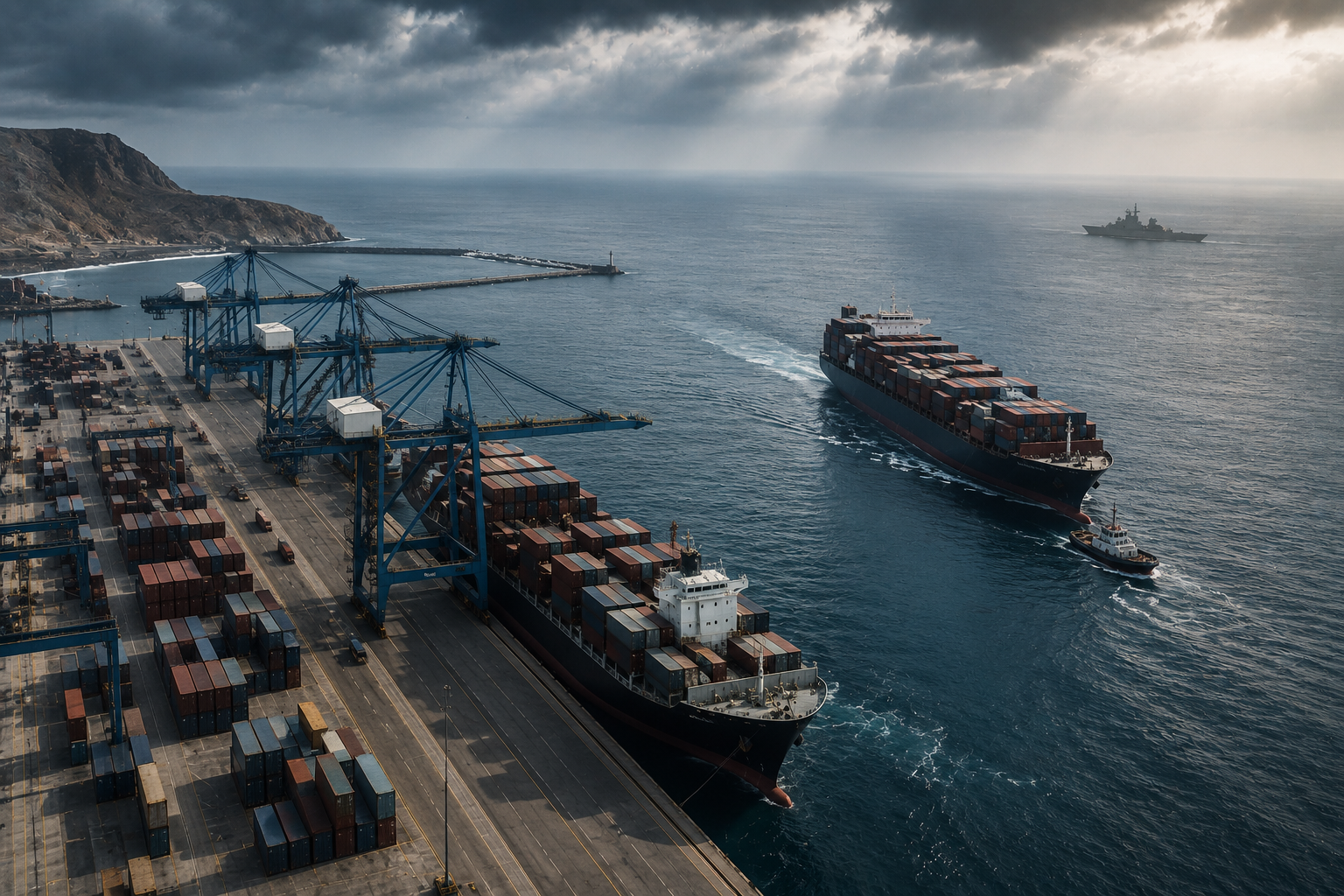
- For the last two decades, Beijing has been systematically expanding its footprint in the Indian Ocean through a network of ports, infrastructure projects, logistics facilities, energy corridors and diplomatic alliances.
- China is steadily building the logistical infrastructure for long-term naval hegemony in the Indian Ocean.
- China’s growing footprint is more than a naval challenge for India. It directly relates to the established role of New Delhi as the principal security provider in the region.
- The Indian Ocean, once a commercial waterway, has become the geopolitical centre of gravity of the twenty-first century.
More than just water for centuries, the Indian Ocean has been a highway. It has been the world’s busiest commercial highway linking Asia, Africa and Europe through maritime trade. The Indian Ocean Region (IOR) today accounts for some 80 per cent of the world’s seaborne oil trade and some 40 per cent of global commerce. Control of these sea lanes impacts world trade, the flow of energy and strategic stability. It is not surprising, therefore, that the Indian Ocean has become one of the main theatres of geopolitical competition in the twenty-first century. This is a competition with a focus on China. For the last two decades, Beijing has been systematically expanding its footprint in the Indian Ocean through a network of ports, infrastructure projects, logistics facilities, energy corridors and diplomatic alliances. While these investments are described as commercial and developmental under the Belt and Road Initiative (BRI), the cumulative strategic impact of these investments has shifted the maritime balance in the immediate neighbourhood of India. The discussion is often boiled down to the phrase “String of Pearls” – a chain of Chinese-backed ports from the South China Sea to the Horn of Africa. This description is a useful summary but no longer describes the complexities of China’s ambitions. Beijing is building not just ports but an integrated geopolitical architecture that links economic influence, infrastructure finance, energy security and, when needed, military access.
This transformation needs to be understood because the Indian Ocean is no longer a sideshow in international politics. It is fast emerging as the critical maritime space where the strategic interests of China, India, the United States and other middle powers converge. Geography plays an important role in China’s maritime strategy. Despite economic growth, Beijing is still highly vulnerable to disruptions in maritime trade. Nearly all of China’s oil imports from West Asia and Africa pass through the Strait of Hormuz, then cross the Indian Ocean and the narrow Strait of Malacca. This dependence is long known to Chinese strategists as the “Malacca Dilemma,” the danger that global conflict could disrupt vital naval lines of communication. Reducing vulnerability has become a central feature of Chinese foreign policy. The Belt and Road Initiative (BRI), launched in 2013, should therefore be understood not just as an economic project, but also as a strategic response to China’s maritime insecurity. Ports, industrial parks, railway corridors and energy pipelines all contribute to forging new trade channels and increasing Beijing’s political influence in the participating countries. Perhaps the most obvious example of this technique is the Gwadar Port in Pakistan. Gwadar, a component of the China-Pakistan Economic Corridor (CPEC), provides Beijing with direct access to the Arabian Sea and enhances its strategic partnership with Pakistan. Economic activity is still below original estimates. But the port’s strategic importance is related to its closeness to the Strait of Hormuz, through which much of the world’s oil shipments pass. Further south, Sri Lanka’s Hambantota Port has become one of the most prominent symbols of Chinese infrastructure diplomacy. Sri Lanka’s huge debt problems have led to the port being leased to a Chinese state-owned company for ninety-nine years. The Hambantota situation is often painted with broad strokes when people talk about “debt-trap diplomacy,” but the experience showed how infrastructure investments can lead to long-term strategic leverage. This is just one piece of the overall picture of China’s activities in South Asia. Beijing has been pushing for infrastructure projects in Myanmar, investing in the Kyaukpyu deep-sea port and energy pipelines running the length of the country from the Bay of Bengal to Yunnan Province. These projects allow China to completely circumvent the Strait of Malacca for some of its oil and gas imports, reducing reliance on vulnerable maritime chokepoints. The base in Djibouti, across the western Indian Ocean, was China’s first military support base outside its borders and a major departure from a long-standing policy of steering clear of permanent foreign military outposts. Although the base is officially for anti-piracy and humanitarian operations, it also improves the ability of the People’s Liberation Army Navy to maintain long-distance deployments.
Individually considered, these undertakings may seem commercially justified. Together they point to something much bigger. China is steadily building the logistical infrastructure for long-term naval hegemony in the Indian Ocean. It marks a broader shift in Chinese strategy. Beijing has spent decades strengthening its continental borders and extending its reach in East Asia. As China’s economy becomes more reliant on international trade, the security of its seas has become more important. China’s national security now includes keeping open the maritime lines of communication, ensuring energy imports and protecting international investments. Infrastructure has become a tool for achieving these goals. Ports are not only business assets anymore. Today, ports are increasingly used for dual purposes, handling civilian ships and military logistics. Fuel storage, maintenance infrastructure, container facilities and increased harbour capacity could support commercial boats in peacetime and operational flexibility for navy deployments if strategic conditions change. This ambiguity has implications for regional security assessments. China says its investments are commercially driven and are of mutual benefit. Recipient governments likewise emphasise job creation, improved connectivity and infrastructure upgrading. The program is needed by many participating countries for such expenditures, and they have few financing options for large-scale infrastructure. Nevertheless, there are still strategic issues. Large countries rarely finance infrastructure without a political agenda. The Indian Ocean is a case in point.
China’s growing footprint is more than a naval challenge for India. It directly relates to the established role of New Delhi as the principal security provider in the region. India’s geography has been a strategic advantage historically. India’s location on the Indian Ocean has historically allowed it dominance over major sea routes linking the Persian Gulf, East Africa and Southeast Asia. India’s geographic centrality has influenced its strategic thinking since independence. The increasing involvement of China adds a new factor in the calculation. Instead of confronting India in a direct military competition, Beijing is slowly expanding its political, economic and logistical influence over neighbouring countries. Today, influence depends more and more on financing infrastructure, on development partnerships and on long-term economic commitment, not on naval power. India has taken cognisance of the changing scenario. The efforts to increase India’s regional footprint include the Indo-Pacific Oceans Initiative, SAGAR (Security and Growth for All in the Region) and expanded defence partnerships with island states and increased participation through the Quad. Simultaneously, India has increased investment in strategically critical infrastructure. Chabahar Port in Iran provides India with connectivity to Afghanistan and Central Asia, compensating in part for Gwadar. Cooperation with Mauritius, Seychelles, the Maldives and Sri Lanka in maritime surveillance, coastal security and humanitarian assistance has increased significantly. The naval modernisation drive has also been stepped up.
The Indian Navy is placing greater emphasis on mission-based deployments, marine domain awareness and interoperability with like-minded allies. Malabar and other exercises show the increasing operational partnership among the democracies of the Indo-Pacific. But understanding competition in the Indian Ocean is not a matter of military capability alone. Economics’ strategic influence is ever growing. Many of the smaller Indian Ocean Republics have vast infrastructural needs but inadequate domestic resources. For them, Chinese investment is frequently an attractive prospect rather than a choice of geopolitics. With no viable alternatives on the table from India and its partners, Beijing’s economic stranglehold is expected to tighten. And this is where the Indo-Pacific strategy gets more relevant. Countries such as Japan, Australia, France, the United States and the European Union are increasingly viewing the Indian Ocean as vital to the sustainability of a free, open and rules-based maritime system. Their increasing investment is a sign of the realisation that infrastructure, connectivity and resilient supply chains have become key weapons in geopolitical competition. The struggle unfolding in the Indian Ocean is therefore quite different in essence from the naval conflicts of the twentieth century. It is being shaped as much by aircraft carriers and submarines as by ports, pipelines, fibre-optic cables, industrial corridors, undersea data infrastructure and financial investment. Power is exercised more and more through communication.
A sensible response from India will likely not be to match every Chinese investment dollar for dollar. Instead, New Delhi’s comparative edge comes from its mix of democratic ties, transparent development financing, maritime capacity building and regional diplomacy backed by credible security guarantees. Neighbourhood bonds are not held together by historical ties alone. They need sustained economic participation, institutional collaboration and regular infrastructure provision. The Indian Ocean is likely entering a period of strategic contest for influence, rather than direct confrontation.
China’s growing footprint is part of a long-term geopolitical strategy to protect trade routes, safeguard overseas interests and shape regional connectivity around its economic rise. India’s challenge is also a long-term one. Its purpose is not only to challenge China’s dominance, but also to preserve a maritime order that allows smaller states to maintain strategic autonomy, ensures the freedom of international sea lanes, and keeps regional security from being hijacked by great-power rivalry. Finally, no single port, pipeline or naval base will define the future of the Indian Ocean. It will depend on whichever image of regional order is the most attractive. China’s connectivity is infrastructure-based, and supported by financial resources and long-term strategic planning. India seeks to build an Indo-Pacific based on openness, sovereignty and equitable partnerships. The fight between these two competing visions is already underway. The Indian Ocean, once a commercial waterway, has become the geopolitical centre of gravity of the twenty-first century. In this new maritime era, Ports are no longer commercial hubs, Pipelines are no longer energy conduits, and Naval presence is no longer the sole indicator of power. These have become, taken together, the instruments by which influence, security and the future balance of power in Asia will be increasingly decided.

Anusreeta Dutta is a columnist and climate researcher with experience in political analysis, ESG research, and energy policy. Views expressed are the author’s own.
 Archita Gaur
  Hridbina Chatterjee
  Divyanka Tandon