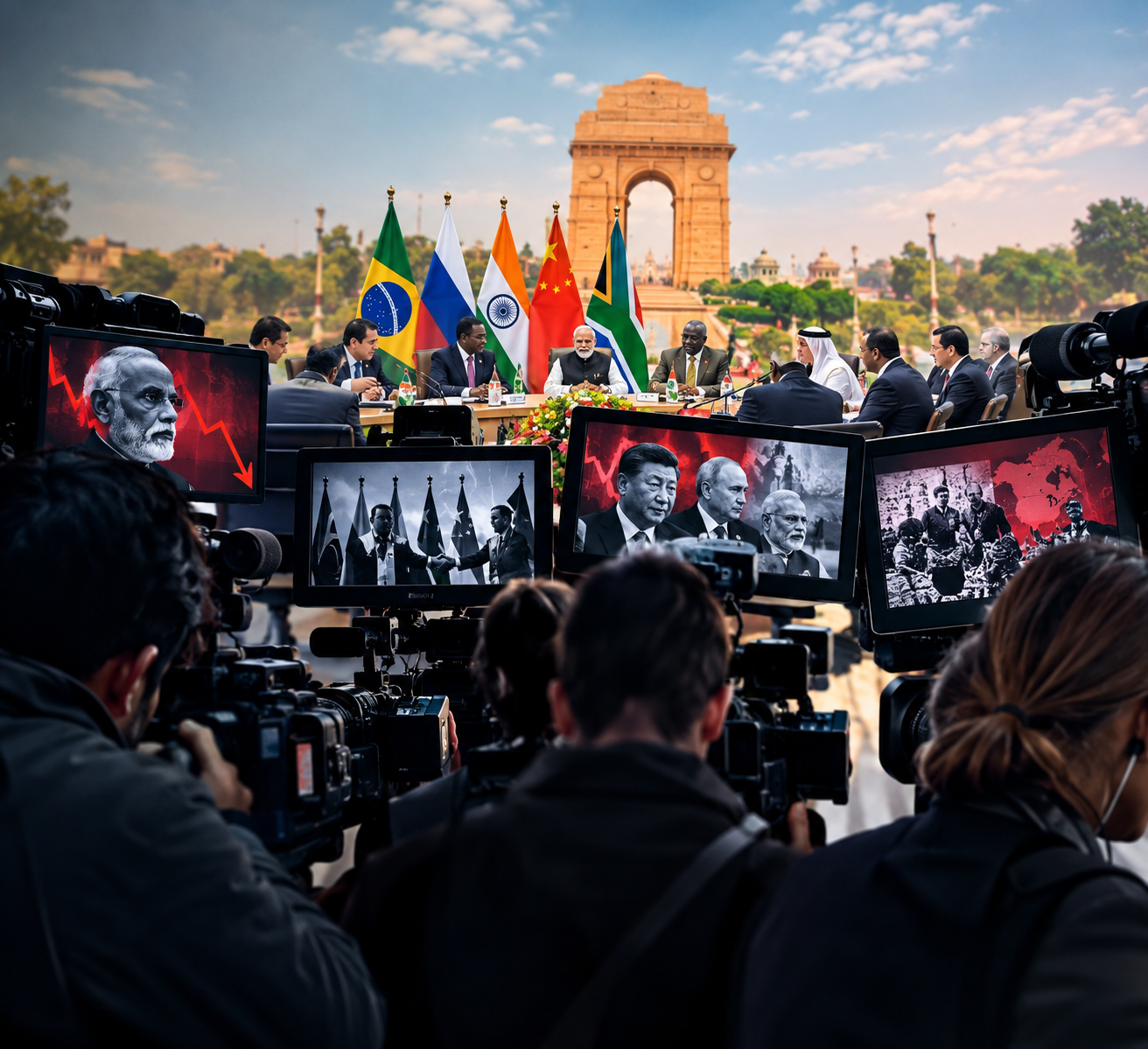
- For much of the West-led foreign press, the summit that actually took place seemed to matter less than the summit they had already decided to write about.
- Cooperation was not the exception to the rivalry; it was the story the rivalry frame was built to obscure.
- What that reading missed was that the achievement was the consensus itself: an eleven-member group, spanning genuinely opposed interests, agreeing on a single text at all.
- BRICS 2026 was not only covered differently in different corners of the world; it showed that the global narrative itself is turning multipolar.
When the leaders of eleven nations representing roughly 40 per cent of global GDP and half the world’s population gathered in New Delhi for the 18th BRICS Summit, the event should have been a straightforward story to tell. India, as chair and host, held together an expanded and politically diverse bloc — Brazil, Russia, India, China, South Africa, Egypt, Ethiopia, Indonesia, Iran, Saudi Arabia and the United Arab Emirates and steered it, by consensus, to a nearly 140-point, 45-page New Delhi Declaration. Yet for much of the West-led foreign press, the summit that actually took place seemed to matter less than the summit they had already decided to write about. What emerged instead was a study in framing: a reminder that in international journalism, the choice of headline, photograph and angle can quietly overwrite the facts on the ground.
The story before the story
The pattern was set well before a single leader landed in Delhi. Much of the Western reporting in the run-up clustered around a recurring vocabulary: division, rivalry, war, strain, and unity under pressure. On September 2, Foreign Policy asked bluntly, “Is BRICS Losing Its Mojo?” — and while the article beneath was measured and even acknowledged the bloc’s achievements, the headline had already set the terms. Reuters followed on September 10 with “India hosts BRICS summit as Iran war tests bloc unity.” A day later, the Associated Press led with “BRICS leaders gather in New Delhi as wars and rivalries strain the expanded bloc.” Deutsche Welle offered “India looks to steer BRICS away from anti-Western turn.”
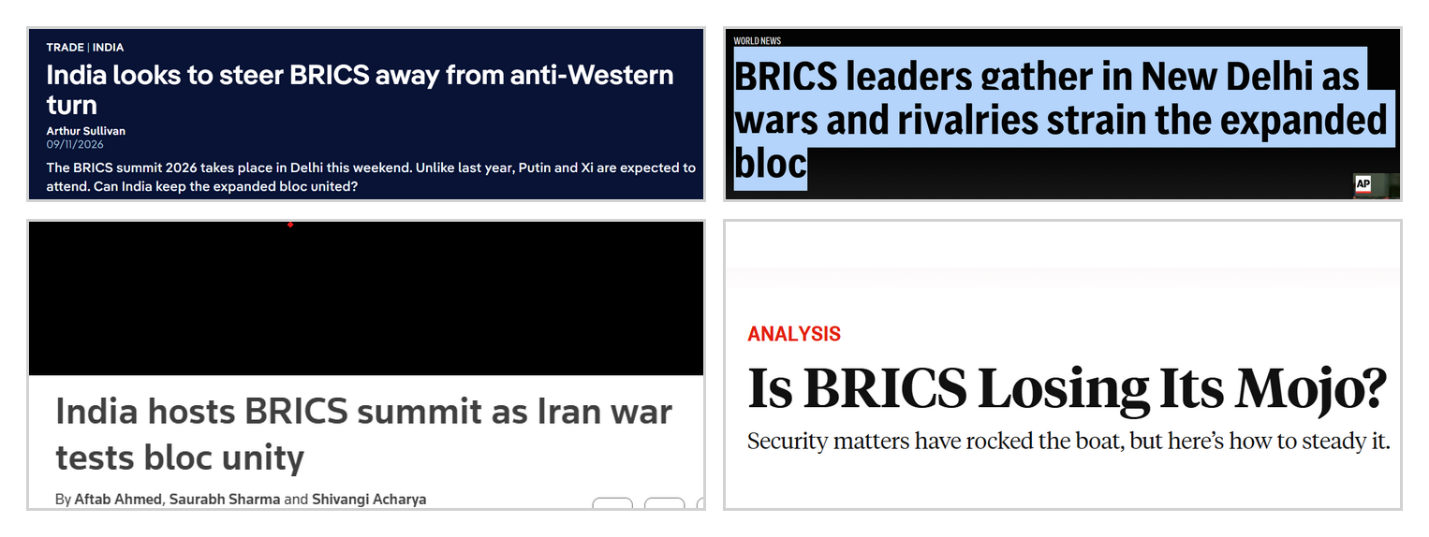
Taken one at a time, each of these was a defensible editorial choice. BRICS genuinely does contain competing interests, and the conflicts touching its member states were real news. But read together, they reveal something more telling. The dominant pre-summit question in Western newsrooms was not “What will BRICS deliver?” It was “Can BRICS hold together?” And that distinction is not cosmetic. Headlines are not neutral summaries; they are the interpretive doorway through which an audience enters a story. Frame the summit as a test of survival, and every compromise reads as a crack, every diplomatic silence as a failure of nerve.
The scepticism ran through the establishment titles too. As News18 catalogued in its survey of international coverage, the Washington Post framed its reporting around whether BRICS could act cohesively as its membership expanded, foregrounding the wars in Ukraine and the Middle East and US-China tensions as forces testing the group. Al Jazeera took a broader angle but pointed it the same way, asking whether the enlarged bloc could “genuinely challenge a Western-dominated world”, the challenge itself treated as the doubtful proposition. The South China Morning Post, meanwhile, built its coverage around internal divisions that “could slow BRICS progress,” dwelling on differences among members and the difficulty of converting economic weight into concrete cooperation.
Veteran journalist and Padma Shri awardee Alok Mehta observed that Western coverage was biased and appeared to expect the summit would fail.
Trump’s shadow, everyone else’s summit
Once proceedings began, a second habit took over: the tendency to read BRICS entirely through the prism of Western geopolitics. As commentator Vinod Janardhanan noted, the BBC’s headline announced that “Trump shadow looms large over BRICS as Modi hosts Putin and Xi” as though the central drama of a Global South summit were how its members intended to manage an American president. Much of the analysis slotted the event into a US-centric grid. The BBC quoted the Atlantic Council’s Michael Kugelman predicting that India “cannot afford to have a joint statement that rails against Washington,” and that any criticism of US policy would stay “vague and indirect.” The New York Times, citing the Stimson Center’s Yun Sun, framed even the Modi-Xi thaw as a function of American power; Beijing’s real concern, in this telling, being India’s alignment with the United States rather than anything happening in the room in Delhi.
Even the more generous coverage carried a sting in the tail. Bloomberg credited Prime Minister Narendra Modi with forging consensus in the shadow of the worsening Iran war and conceded that Delhi had pulled off a diplomatic coup before pivoting straight back to the claim that the Modi-Xi thaw merely “concealed deeper divisions.” The Financial Times, The Independent and others played up internal frictions, such as the differences between Iran and the Gulf members, and openly questioned how much the summit could really deliver. Some outlets seemed to treat BRICS as though it had been convened to end the Ukraine and West Asia wars single-handedly, then judged it a disappointment when it did not.
There was a quiet irony in this. Ukraine’s president, who commands prime airtime at practically every Western-led summit, barely figured in the New Delhi Declaration or the talks around it. On West Asia, the language was deliberately measured, calling for restraint without explicitly naming Iran, the US or Israel. To much of the Western press, those omissions read as weakness, evidence that the bloc lacked the spine to speak clearly. What that reading missed was that the achievement was the consensus itself: an eleven-member group, spanning genuinely opposed interests, agreeing on a single text at all. And the geopolitical certainties underpinning the coverage looked shakier by the day; despite all the anti-China rhetoric emanating from Washington, Trump was himself due to meet Xi Jinping within days.
The India–China angle on repeat
If there was one frame the foreign press could not resist, it was India versus China. Outlet after outlet foregrounded competition over cooperation and nitpicked the “limits” of the thaw between the two. Deutsche Welle centred its reporting on India’s “balancing act” between Russia and China; the New York Times trained its lens on the two Asian giants competing for influence across the Global South. Reuters placed the Iran conflict and its strain on bloc unity at the heart of its coverage, highlighting India’s challenge in bridging Iran and the UAE though it also reported the more substantive news that India was pushing to link central bank digital currencies across the bloc for cross-border payments, a genuine cooperation story that sat awkwardly inside the rivalry frame.
Brushed aside in much of this was the striking fact that Xi was visiting a country with which China had clashed at Doklam and in the Galwan Valley only a few years earlier, his first trip to India in seven years and that bilateral trade had kept growing throughout the tensions. Also underplayed was that, this supposed rivalry notwithstanding, the summit spoke with one voice on terrorism, Global South representation, UN and IMF reform, local-currency payments, digital infrastructure and artificial intelligence. Cooperation was not the exception to the rivalry; it was the story the rivalry frame was built to obscure.
The picture that says “poor”
Perhaps the most revealing bias was not written at all. It was photographed. A section of the foreign press advanced its narrative less through argument than through image selection, what the outlet termed “juxtapositional photojournalism.” The New York Times, running a piece headlined “As Oil Prices Rise, BRICS Leaders Have What U.S. Doesn’t: Iran at the Table,” illustrated it with a Reuters frame of a moped rider passing BRICS signage. France24’s report on Putin’s arrival used an AFP image of a bicycle rider gliding past a hoarding bearing Modi’s face. Al Jazeera reached for a near-identical shot of a cyclist beside a BRICS poster. Germany’s DW chose a picture of a man resting near summit signage in the heat.
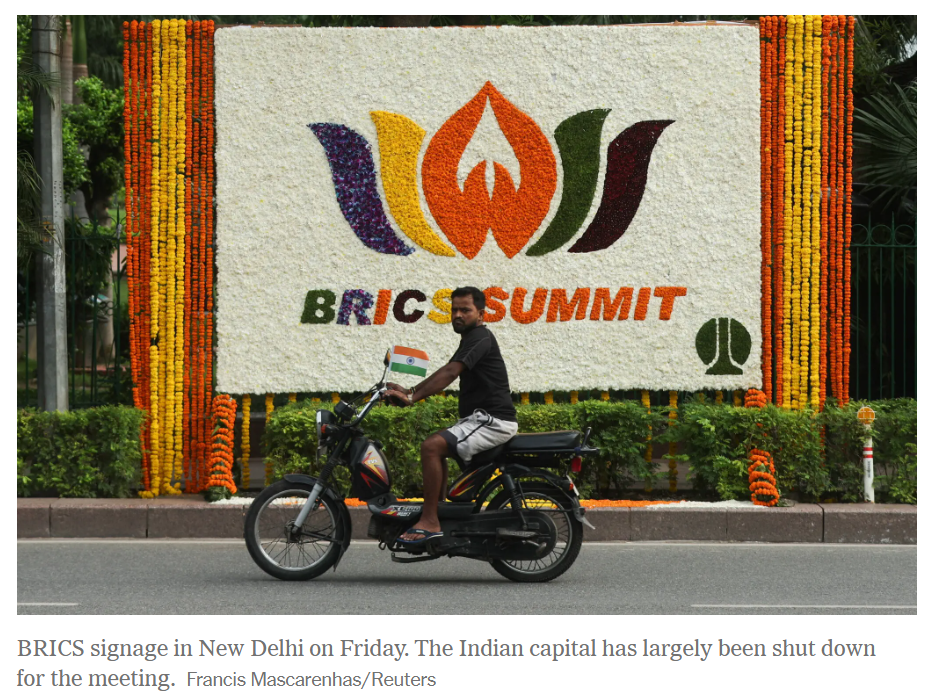
Figure 1Credits: https://www.nytimes.com/2026/09/12/world/asia/brics-summit-china-india-russia-iran.html
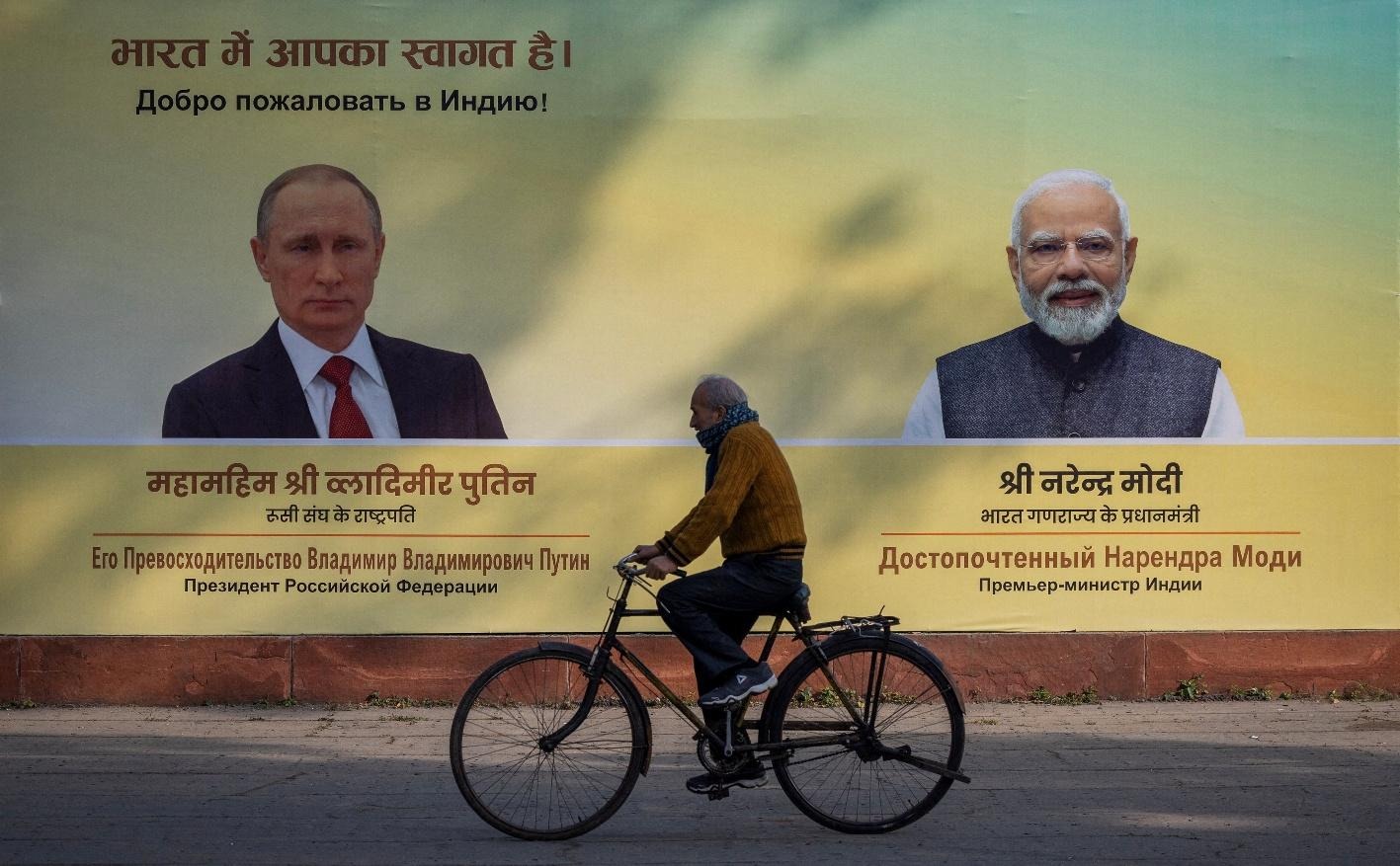
The composition repeated itself with almost mechanical regularity: the glossy billboard of global ambition, and beneath it the auto-rickshaw, the hand-cart, the moped, the street worker. These were not random snapshots of a city being itself. Photojournalists hunt for such juxtapositions, and editors then choose which of dozens of available frames- the illuminated Bharat Mandapam, the motorcades, the modern infrastructure becomes the image that travels the globe. Selecting the bicycle beside the hoarding is an editorial act, one engineered to produce a reading of “ambition versus reality,” of a country punching above its weight.
The lineage runs deep. From the colonial-era cliché of a “land of snake charmers” to the New York Times’ notorious 2014 cartoon mocking India’s Mars mission with a dhoti-clad farmer leading a buffalo to the door of an “Elite Space Club,” to a 2025 report on Tesla’s Mumbai showroom illustrated with a passing auto-rickshaw, the visual grammar has stayed remarkably consistent even as its subject changed from turbans to satellites. India is now too large and too obviously rising to be called poor outright, so the imagery is left to say it instead: satellites next to cows, slums next to malls, Teslas next to auto-rickshaws, summit signage next to cyclists. The backlash in India was predictable, with critics branding the pattern “poverty porn dressed up as photojournalism.”

The near-blackout, and the frame that broke
Where outlets did not distort, some simply diminished. BRICS was frequently relegated to wire copy or analytical sidebars rather than front pages and prime-time leads, given far less prominence than a bloc of its scale would ordinarily command. And because global wire services like Reuters and AP feed hundreds of newspapers and broadcasters, a single framing — AP’s “wars and rivalries strain the expanded bloc,” for instance could ripple across the international news cycle intact, magnifying its reach far beyond any one masthead. That is the quiet power of wire-service framing: it sets the terms for outlets that never sent a reporter to Delhi at all.
Yet the coverage did not hold its shape. Once the summit closed with a joint declaration, the Financial Times ran a markedly different assessment: “‘Trumpism’ spawns rare unity at Brics summit.” The frame had been forced to move because the outcome refused to fit the pre-written script. More striking still was the shift in Chinese state media, which spoke the language of partnership and “shared growth.” People’s Daily cast China and India as natural partners, Xinhua stressed shared growth, and China Daily heralded a new “golden decade.” China’s Global Times framed a “Greater BRICS” as a more united and pragmatic force opening space for the common development of the Global South. This genuinely was the most remarkable media story of all: for the first time, Chinese coverage of India ran warmer and more positive than the Western press managed.
When the West cannot halt the rise of BRICS, it changes the question, magnifying every disagreement into dysfunction, every compromise into weakness, and every ambition into rhetoric, while missing the real story: a growing refusal by much of the Global South to accept an order designed without it.
That may be the summit’s most durable lesson for media watchers. BRICS 2026 was not only covered differently in different corners of the world; it showed that the global narrative itself is turning multipolar. The bloc did not try to build a NATO-style alliance or an explicitly anti-Western front. It set out to prove that nations with competing interests could still agree, and it did. The foreign press spent weeks insisting that it could not happen. In the end, an increasingly diverse bloc agreed to agree, and the framing prepared for its failure was left with nothing to describe.

Diksha Bharti is currently pursuing a Master’s program in Russian studies. She has previously worked as a Research Associate at Politika and the Consilium Research Institute. She has a keen interest in geopolitics and has contributed to several reputed platforms. Views expressed are the author’s own.
 Archita Gaur
  Hridbina Chatterjee
  Divyanka Tandon