
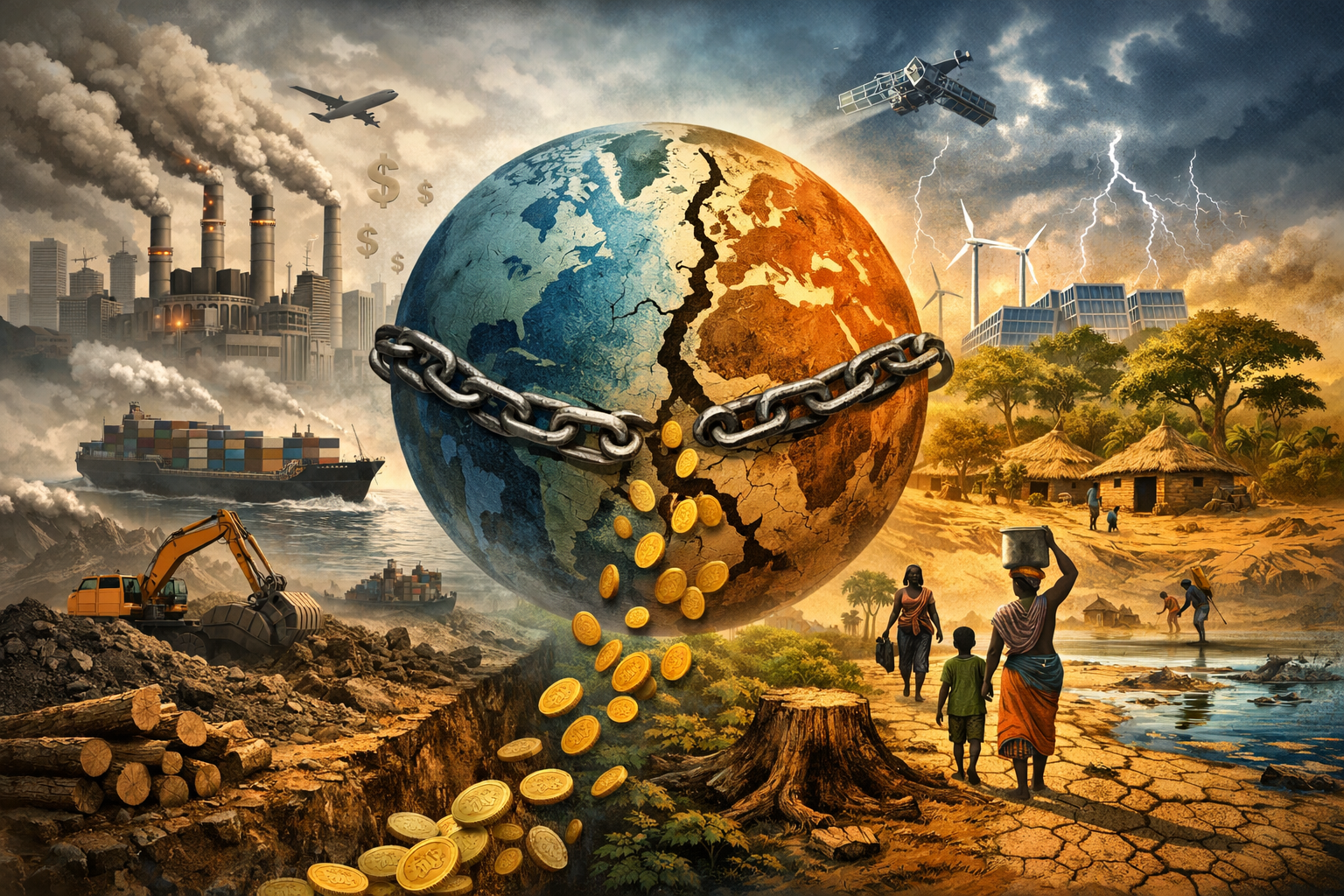
- The industrialised countries of the Global North have generated an ecological debt toward the countries of the Global South since the period of the colonial conquest.
- The United Nations Framework Convention on Climate Change (UNFCCC) (1992) laid the foundation of climate debt.
- Despite experiencing economic growth and periods of prosperity, countries of the Global South continue to face significant constraints on their economic development due to a lack of finance.
The concept of ecological debt first appeared in 1985 in an ecofeminist book by Eva Quirstorp and was employed for the first time as a political and analytical term in 1992 during the Rio de Janeiro Earth Summit by Maria Luisa Robelto and Wilfredo Marcelo. It emerged from social and environmental movements that developed in response to growing ecological awareness and the historical consequences of colonial exploitation. In recent years, the concept of ecological debt has gained importance in academic discourse. The term “ecological debt” refers to the ecological damage caused over time by one country to other countries through its production and consumption patterns. It also denotes the long-term exploitation or use of ecosystem goods and services by a country at the expense of the equitable rights of other countries or individuals to access and benefit from these ecosystems and their service
The industrialised countries of the Global North have generated an ecological debt toward the countries of the Global South since the period of the colonial conquest. This debt is rooted in a historical process of resource extraction, wealth appropriation, environmental destruction, and ecological degradation, carried out to maximise economic gains for the Global North at the expense of the Global South. With the expansion of globalisation and the emergence of the neoliberal economy, transnational corporations entered into developing countries with comparatively open or vulnerable market systems, enabling the Global North to benefit from access to cheap labour, raw materials, and natural resources. As a result, natural resources and ecosystem services that sustain human life have been commodified and subjected to market-based valuation, rather than being oriented toward collective human welfare, which has contributed to the rise of environmental and social movements worldwide.
Globalisation has also further extended nations’ dependency on institutions such as the IMF and the WTO. Although these institutions are formally mandated to provide economic assistance, their policies have often facilitated the concentration of economic power and resources in the hands of a limited number of actors. Consequently, the people of the global South continue to bear a heavy external debt burdenand frequently lack access to essential resources, as domestic resources are primarily directed toward export-oriented production to generate foreign exchange. Despite the utilisation of available natural resources for economic returns, unequal exchange between the Global North and the Global South has reinforced financial dependency and created structural constraints on sustainable economic development in the Global South.
Major Initiatives to Address the Ecological Debt
The United Nations Framework Convention on Climate Change (UNFCCC) (1992) laid the foundation of climate debt. This agreement acknowledges the historical emissions of Global North countries and advises them to take the lead through the principle of “Common but Differentiated Goals.” This recognition provided the basis for understanding climate responsibility as a form of ecological debt.
The Kyoto Protocol (1997) was a legally binding agreement that focused on the reduction of emissions by developed countries. It recognised the historical emissions and environmental degradation caused by these nations and introduced mechanisms such as the Clean Development Mechanism (CDM), which emphasised technology transfer and financial support to developing countries.
The Copenhagen Accord (2009), adopted at COP15, involved a pledge by Global North countries to contribute USD 100 billion per year by 2020 to support developing nations. However, this commitment was not legally binding, and the promised amount was not fulfilled within the stipulated timeframe, eventually being completed only in 2022.
The Cancun Agreements (2010), adopted at COP16, led to the establishment of the Green Climate Fund (GCF) to channel climate finance. These agreements also resulted in the creation of the Technology Executive Committee (TEC) and the Climate Technology Centre and Network (CTCN) to facilitate technology development and transfer.
The Paris Agreement (2015), adopted at COP21 and enforced in 2016, reaffirmed the historical responsibility of Global North countries for emissions. It emphasised the obligation of developed nations to provide financial assistance and technology transfer to developing countries and reiterated the target of providing USD 100 billion per year.
The Glasgow Climate Pact (2021), adopted at the 26th United Nations Climate Change Conference in Glasgow, called on developed nations to double adaptation finance for developing countries by 2025 and to fulfil the long-standing goal of mobilising USD 100 billion per year.
Hindrances in the Economic Development of the Global South
Despite experiencing economic growth and periods of prosperity, countries of the Global South continue to face significant constraints on their economic development due to a lack of finance. The growing debt burden of the Global South has further impeded progress toward achieving the 2030 Sustainable Development Goals. The dependency on the Global North has created an unequal economic relationship in which developing and underdeveloped countries remain reliant on core economies primarily for the export of raw materials. Moreover, the historical extraction of resources and raw materials from the Global South during colonial rule has contributed to continued reliance on international financial institutions such as the IMF, the WTO and Structural Adjustment programs (SAPs), which often require extensive economic reforms in exchange for loans. These conditionalities have frequently resulted in increased poverty levels and reductions in public spending on essential social services.
Another major hindrance faced by the Global South is the issue of climate justice, as these countries are among the most vulnerable to the impacts of global change despite contributing least to global greenhouse gas emissions. Countries in the Global South, therefore, demand greater contributions from the Global North in the form of climate finance and technology transfer, as wealthier nations bear primary responsibility for greenhouse gas emissions due to their historical patterns of industrialisation and economic growth.

Antara Deka is a student of Political Science at North Eastern Hill University and History at Indira Gandhi National Open University. Her interests include political awareness and civic engagement, and she has been actively involved in initiatives promoting informed participation among youth. Views expressed are the author’s own.
 Joy Aditya Phookan
  Anshika Agarwal