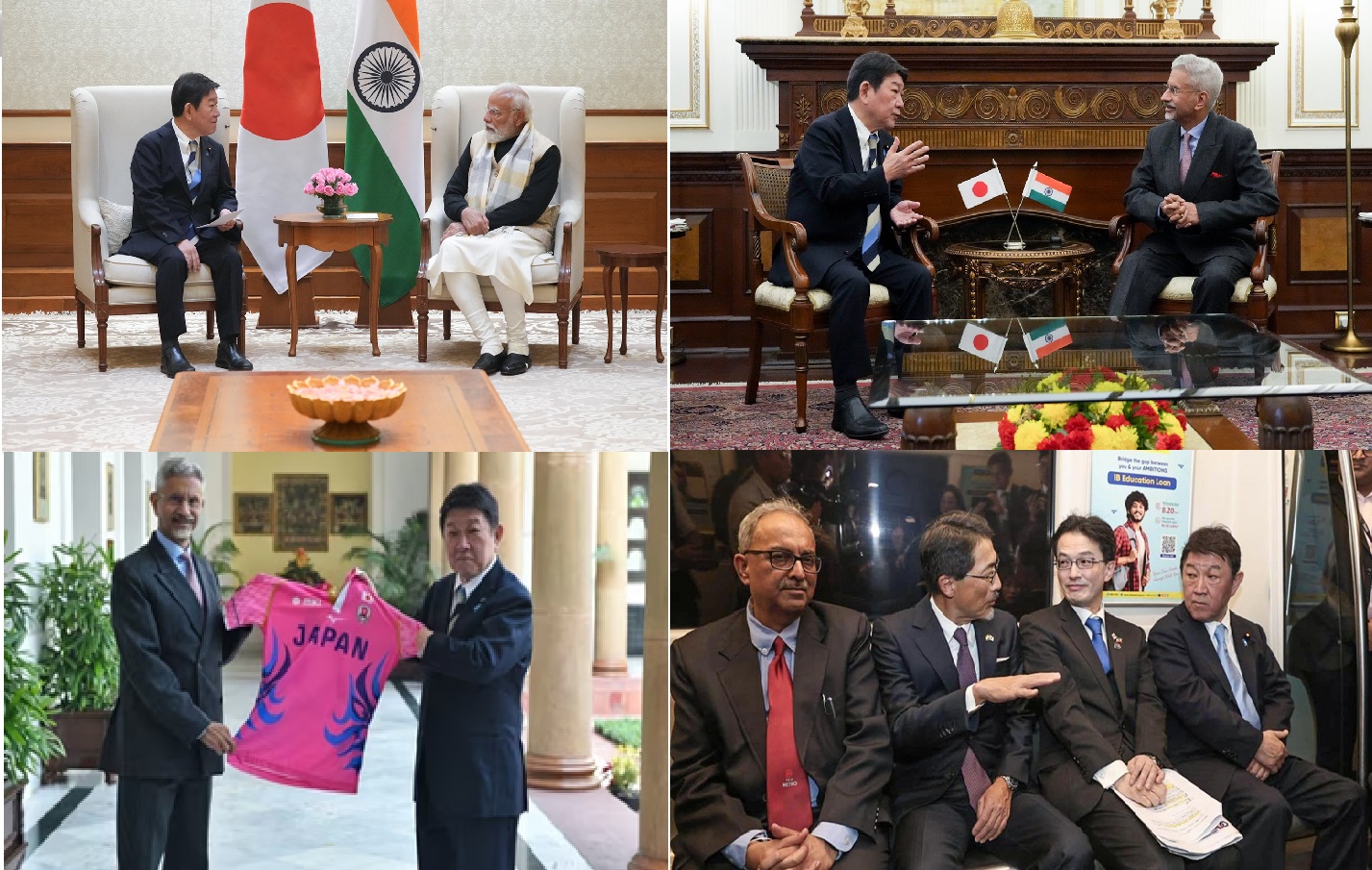
- The three-day visit of Japan’s Foreign Minister Toshimitsu Motegi to India from January 15–17, 2026, highlights the growing strategic convergence between the two Asian democracies at a time of heightened geopolitical churn in the Indo-Pacific.
- At the heart of the ‘18th Japan–India Foreign Ministers’ Strategic Dialogue’ in New Delhi, Japanese Foreign Minister Toshimitsu Motegi and India’s External Affairs Minister S. Jaishankar reviewed the full spectrum of bilateral cooperation encompassing defence, economic security, people-to-people exchanges and technological innovation.
- The dialogue resulted in concrete plans to launch a Japan–India Private-Sector Dialogue on Economic Security to translate strategic cooperation into business-driven outcomes, focusing on semiconductors, information and communication technology, clean energy and pharmaceuticals.
The three-day visit of Japan’s Foreign Minister Toshimitsu Motegi to India from January 15–17, 2026, highlights the growing strategic convergence between the two Asian democracies at a time of heightened geopolitical churn in the Indo-Pacific. The engagement reaffirmed the centrality of the ‘India–Japan Special Strategic and Global Partnership’, reflecting shared concerns over regional security, economic resilience and the evolving balance of power in Asia. Both sides took stock of multifaceted ties and reiterated their commitment to broadening cooperation under frameworks established in previous high-level engagements.
This renewed momentum comes against the backdrop of recent high-profile India–Japan engagements, including the adoption of a Joint Vision for the Next Decade and Tokyo’s announcement of a 10 trillion yen investment commitment in India over the coming years. These developments signal Japan’s long-term strategic and economic confidence in India and elevate the bilateral partnership to a more outcome-oriented phase.
Strategic, Economic and Regional Dimensions
At the heart of the ‘18th Japan–India Foreign Ministers’ Strategic Dialogue’ in New Delhi, Japanese Foreign Minister Toshimitsu Motegi and India’s External Affairs Minister S. Jaishankar reviewed the full spectrum of bilateral cooperation encompassing defence, economic security, people‑to‑people exchanges and technological innovation. Based on the Japan–India Joint Vision for the Next Decade, agreed in 2025, both sides resolved to deepen collaboration in security, defence, economy, investment and innovation, with special emphasis on resilient supply chains, critical minerals and advanced sectors like artificial intelligence.
The dialogue resulted in concrete plans to launch a Japan–India Private-Sector Dialogue on Economic Security to translate strategic cooperation into business-driven outcomes, focusing on semiconductors, information and communication technology, clean energy and pharmaceuticals. A Joint Working Group on Mineral Resources was also agreed upon to enhance supply chain resilience in strategic materials. Under the Japan–India AI Cooperation Initiative (JAI), both sides committed to a Japan–India AI Strategic Dialogue and Japan announced it would invite 500 skilled Indian AI professionals by 2030 to strengthen collaborative research.
The visit also carried symbolic and practical significance. Mr Motegi’s meetings, including a courtesy call on Prime Minister Narendra Modi, reiterated that India and Japan are “natural partners” sharing fundamental values and a common strategic outlook. The dialogue reviewed supply-chain resilience in critical sectors, technology and innovation, investment, trade, defence and cultural ties.
In addition to national‑level agreements, states and cities are emerging as important nodes of India–Japan cooperation. In Gujarat, the Hamamatsu Chamber of Commerce and Industry (HCCI) and the Gujarat Chamber of Commerce and Industry (GCCI) signed a Memorandum of Economic Cooperation to formalise the Sister City partnership between Ahmedabad and Hamamatsu City, with an aim to foster exchanges in economic, cultural and tourism fields. The delegation attending the signing was led by Mr Hiraki Sho, Vice‑Governor of Japan’s Shizuoka Prefecture and included senior business leaders from both sides, highlighting growing sub‑national economic linkages.
Northern India is witnessing similar momentum in bolstering India–Japan economic ties. The Yamuna Expressway Industrial Development Authority (YEIDA) is actively promoting a “Japanese City” project in the Yamuna City area near the upcoming Noida International Airport, aiming to establish a specialised industrial hub that caters to Japanese investors. Designed as a comprehensive facility for manufacturing and allied services, the project targets key sectors such as electronics, semiconductors, automotive, green hydrogen and clean energy technologies. The initiative seeks to create a business‑friendly ecosystem with ready industrial land, logistics connectivity and streamlined policy support to attract both large Japanese corporations and small and medium enterprises. Discussions with the Japan External Trade Organisation (JETRO) aim to formalise Japan’s participation and ensure strategic alignment with Japanese companies’ global investment plans, illustrating the expanding geographical footprint of bilateral economic engagement beyond traditional centres.
The partnership has also expanded its people‑to‑people dimension. India and Japan have set an ambitious target to enhance exchanges of up to 5,00,000 personnel over five years, including employment pathways for skilled workers and opportunities for students and researchers.
A notable development within this framework is the emerging Hokkaido–Maharashtra human resource exchange initiative, where senior representatives from Japan’s Hokkaido prefecture met with Maharashtra officials to explore collaborations spanning talent mobility, trade, regional development and food security, along with significant placement opportunities for Indian professionals in Japan. As part of this dialogue, the Maharashtra Skill Development Minister, Mangal Prabhat Lodha and the Hokkaido Vice‑Governor, Mr Takayuki Kano, discussed scaling up exchanges, with plans to place tens of thousands of skilled Indian workers in Japanese sectors such as IT, manufacturing and healthcare over the coming years.
These human resource initiatives align with broader bilateral targets to expand personnel movement between India and Japan, enabling India’s skilled professionals to help address workforce shortages in Japan while deepening cross‑cultural and economic ties.
Way Forward and Conclusion
Looking ahead, the India–Japan strategic partnership is positioned to expand both in scope and substance. Defence and security cooperation, particularly in maritime domain awareness, joint exercises and technology sharing, will continue to underpin regional stability, while economic and industrial initiatives, such as the Japanese City near Noida and investment in Gujarat, reflect a growing focus on tangible outcomes.
To sustain momentum, both nations must focus on operationalising these agreements through tangible outcomes: industrial joint ventures, collaborative research and development projects, academic and talent exchanges and strengthened frameworks for private‑sector engagement. Institutionalising mechanisms for regular review, implementation and policy coordination will be critical to ensuring that strategic dialogues yield practical dividends.
Looking ahead to 2027, which will mark the 75th anniversary of the establishment of diplomatic relations between India and Japan, both countries have agreed to designate it as the “75th Anniversary of the Establishment of Diplomatic Relations between Japan and India.” This milestone provides an opportunity to further deepen exchanges, strengthen people-to-people ties and celebrate decades of friendship and cooperation.
Ultimately, the recent visit and associated agreements, including sub‑national partnerships and human resource exchange initiatives, reflect a broader strategic recalibration in Asia, where middle powers like India and Japan are playing active roles in shaping regional and global norms. Their evolving partnership demonstrates how shared democratic values, converging economic interests, and sustained cooperation can provide a durable foundation for long‑term engagement, contributing to a stable, inclusive and rules‑based Indo‑Pacific order in the years ahead.
References:
- https://www.mofa.go.jp/s_sa/sw/in/pageite_000001_00008.html
- https://www.mea.gov.in/bilateral-documents.htm?dtl/40063
- https://timesofindia.indiatimes.com/india/india-japan-decide-to-ramp-up-dialogue-on-economic-security/articleshow/126591768.cms
- https://indianexpress.com/article/cities/ahmedabad/hamamatsu-gujarat-chambers-of-commerce-ink-pact-for-economic-cooperation-10472064/
- https://timesofindia.indiatimes.com/city/mumbai/hokkaido-and-maharashtra-to-boost-human-resource-exchange/articleshow/126777565.cms
- https://timesofindia.indiatimes.com/city/noida/yeida-to-pitch-japanese-city-in-yamuna-city-plan-to-trade-body/articleshow/126591102.cms

Megna Devkar is a Ph.D. Research Scholar at K.C. Law College with research and writing expertise in social, political, and legal issues. Views expressed are the author’s own.
 Pranav S
  Ajith Shetty Heranje
  Atri Patel