
- Humanity’s fascination with the action genre presents an interesting contradiction. We devote much of our lifetime to maintaining health, safety, and security.
- Before an audience is shown an action hero’s destructive behaviour, it is first given a justification for it. A loved one has been harmed. Innocent people are threatened. Revenge appears deserved. Justice seems impossible by any other means.
- When we choose to engage with violence, revenge, conflict, or destruction—even through imagination—we generate a similar quality of energy within ourselves.
- Perhaps this is the deeper lesson action cinema unintentionally conveys—our fascination may not actually be with explosions, fights, or impossible escapes.
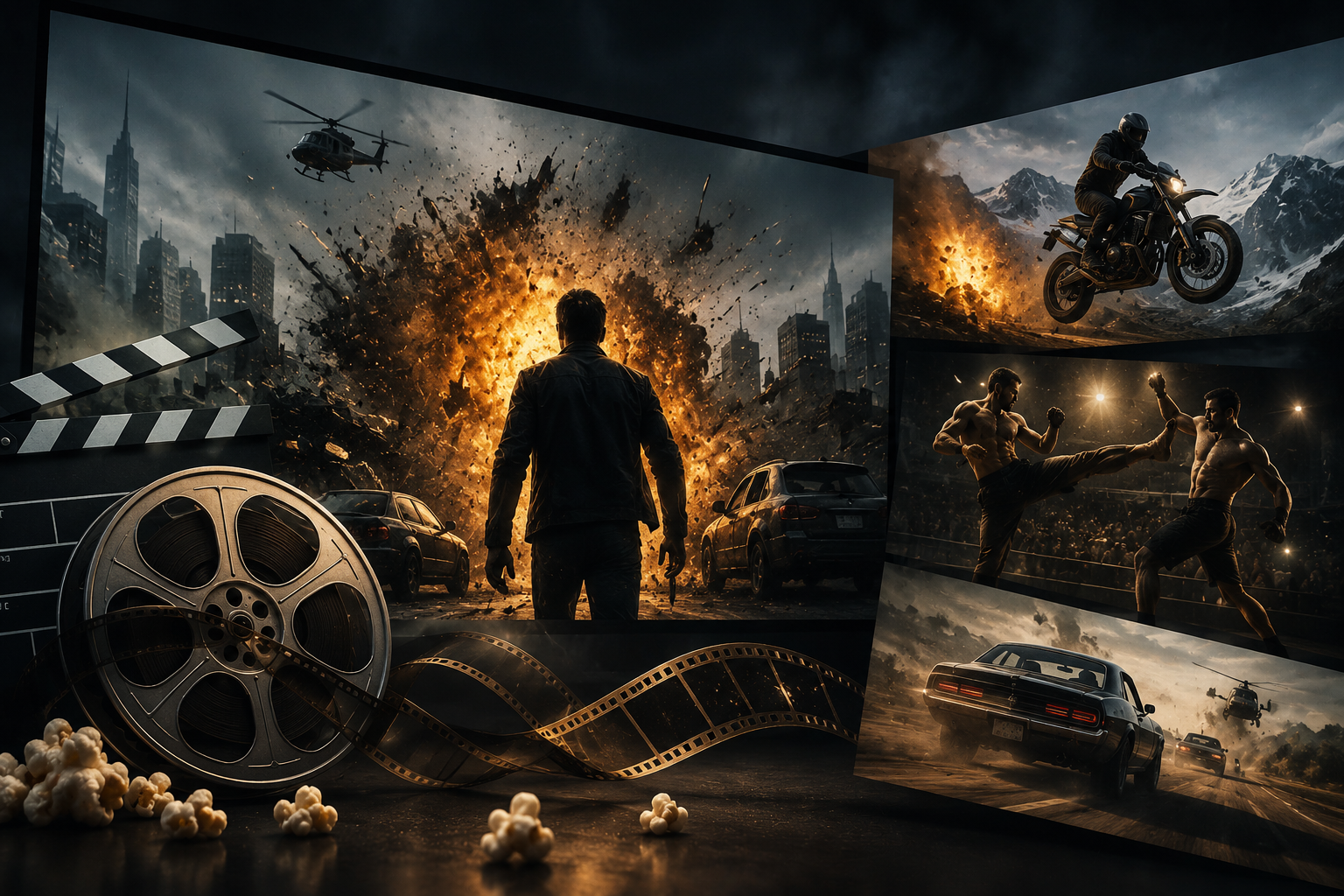
Action cinema is among the world’s most popular forms of entertainment. Audiences remain captivated by stories filled with car chases, explosions, hand-to-hand combat, daring escapes, and extraordinary acts of survival. Similar themes play out across web series, animated narratives, and many of today’s most popular video games.
Humanity’s fascination with the action genre presents an interesting contradiction.
We devote much of our lifetime to maintaining health, safety, and security. Naturally, we avoid injury, danger, and unnecessary risk. Yet the very situations we work hardest to safeguard ourselves from become the ones we willingly engage with for entertainment.
This same attraction to risk extends beyond cinema. Millions participate in high-speed racing, organised fighting, extreme sports, dangerous stunts, and countless other thrill-seeking adventures despite the possibility of serious injury or even death.
This paradox deserves closer examination.
Our body accompanies us throughout this lifetime, yet it is neither something we created nor something we shall possess forever. It is, in many ways, on loan to us, entrusted to our care. If responsibly caring for the body is among our foremost duties, why are we so fascinated by stories that repeatedly place it in harm’s way?
Would thrill-seeking adventures remain equally compelling if every element of danger were removed?
Probably not.
The possibility of harm is not merely part of the experience—it is often what gives it its intensity. The rush comes because something valuable is placed at risk.
Action cinema illustrates this repeatedly. Heroes jump between buildings, survive explosions, exchange gunfire, overcome impossible odds, and escape situations from which ordinary people would almost certainly never return. Audiences mentally participate in these events while remaining physically unaffected.
This leads to another important observation.
Before an audience is shown an action hero’s destructive behaviour, it is first given a justification for it. A loved one has been harmed. Innocent people are threatened. Revenge appears deserved. Justice seems impossible by any other means. Once that reasoning has been established, actions that would ordinarily be condemned are suddenly portrayed as courageous, admirable—even normal.
For a short time, audiences identify with the protagonist, imagining themselves in their place. They experience the temporary high of negative choices without facing the immediate or long-term consequences such actions would ordinarily bring.
Cinema allows us to imagine crossing boundaries we instinctively know we never should.
Upon closer examination, something important is often missing from most action narratives. The people injured, families affected, destruction left behind, and the long-term consequences of violence are rarely exposed. The story moves forward, the hero is celebrated, and the audience leaves the theatre exhilarated while remaining insulated from the repercussions the character’s choices would inevitably bring in real life.
Perhaps we are not merely watching violence. We may instead be briefly satisfying our thirst for the temporary highs negative choices provide while believing ourselves unaffected by the consequences those choices would ordinarily bring.
If so, then perhaps our attraction is not really to action cinema itself, but to the negative choices its stories invite us to experience.
This raises an important question.
Is there ever a justification for negativity or violence when positive and peaceful alternatives remain available?
We always have a choice. Life continually presents us with both positive and negative ideas. We may not control which ideas come to us, but we always choose which ideas we focus on and accept.
Our intent is the foundation of every choice. It determines which ideas we energise through our focus. Accepted ideas become thoughts. Thoughts become words and actions. Thinking is therefore not separate from physical action—it is where all action begins.
Every choice made through intent, focus, thought, word, and action generates energy—positive or negative. That energy is transmitted from us, attracts similar energy, and eventually returns to us through our future experiences.
Entertainment is therefore far more than casual recreation. Every film, story, and game invites us to focus on either positivity or negativity. There is no in-between.
When we choose to engage with violence, revenge, conflict, or destruction—even through imagination—we generate a similar quality of energy within ourselves. We should therefore be very careful where we place our focus, as the energy we generate attracts similar energy that returns to us manyfold.
Interestingly, action cinema rarely explores the energy that inevitably returns to those who justify harming others, or the harsh lessons which follow negative intentions and actions. The excitement is shown. But the accountability is not.
Negative choices offer the quickest high, yet positivity always produces more beneficial, long-lasting results. While the exhilaration of negativity quickly vanishes, positive choices, which require more patience, discipline, and self-restraint, cultivate something far more enduring over time—peace, stability, and lasting happiness.
These principles of living science extend far beyond cinema. Each day presents countless crossroads of choice where we must choose between patience or anger, understanding or revenge, cooperation or conflict, forgiveness or retaliation, selfless service or self-interest.
The choices we make deeply affect our environment and the trajectory of our lives. Collectively, they influence our families, communities, and nations.
If humanity continually engages with violence, revenge, destruction, and conflict as forms of entertainment, should it then surprise us when those same negative responses become increasingly chosen in everyday life?
Perhaps this is the deeper lesson action cinema unintentionally conveys—our fascination may not actually be with explosions, fights, or impossible escapes. Perhaps it is really with the temporary high negative choices offer, while concealing the painful consequences that eventually follow. Entertainment therefore does not create our attraction to negativity—it simply reveals it. Once we truly understand this, we have the tools to choose differently.
Seen in this light, the real question is no longer why action cinema fascinates us, but where every action begins.
The greatest hero, then, may not be the one who defeats the most enemies or survives the greatest battles, but the one who governs their intent, chooses wisely what deserves their focus, carefully weighs every choice, and uses their lifetime to protect, uplift, and serve others.

Ananda Mathews, known professionally as Matthew David DOP, is a Mumbai-based cinematographer and author currently residing in Goa. He engages in psycho-spiritual counselling and social service throughout Bharat alongside his Guru Ji, Divine Colonel – Ashok Kini Ji. His first book In Quest of Guru and forthcoming Living Science explore the journey of human transformation. Views expressed are the author’s own.