
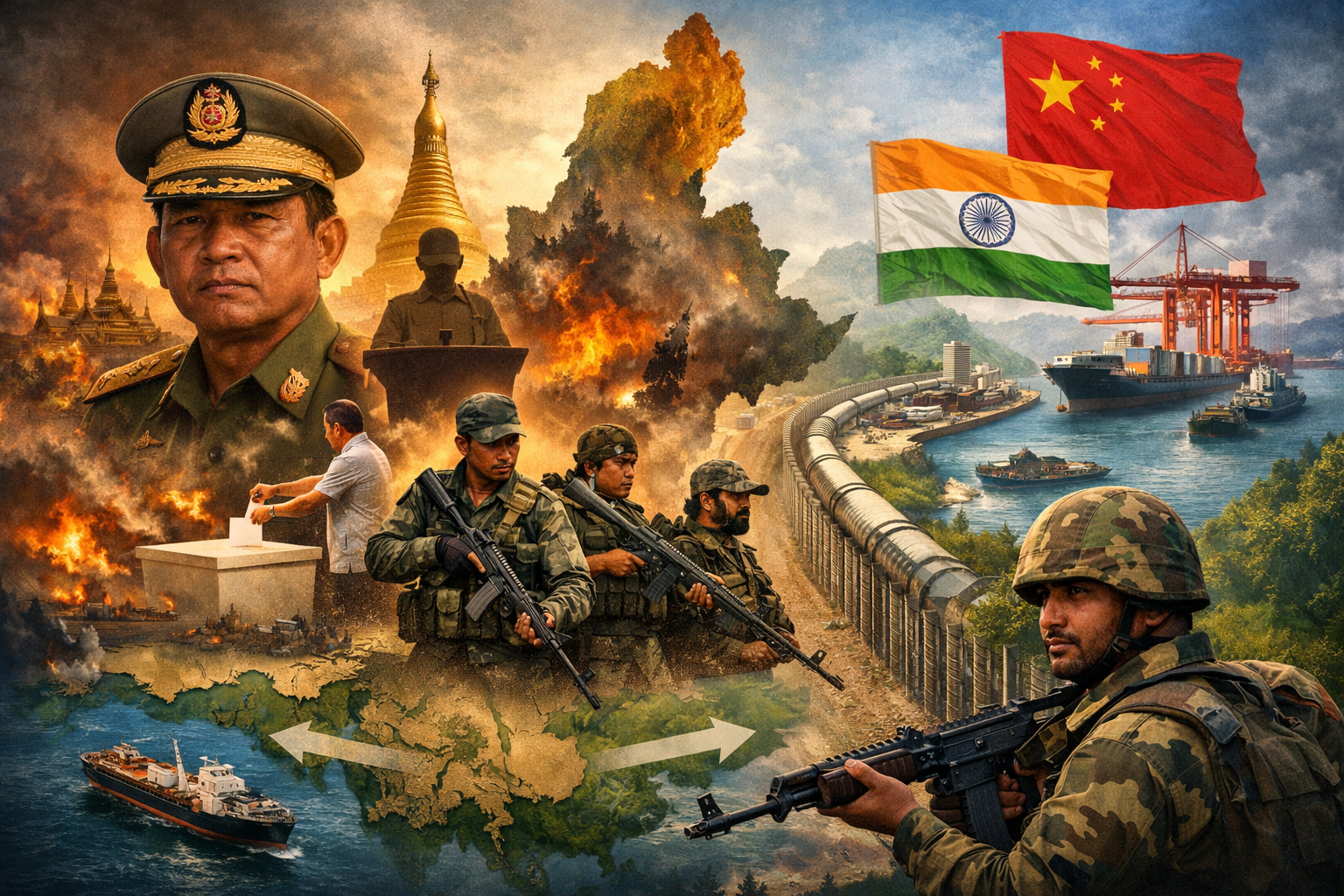
- Myanmar, a country that has been engulfed in civil war for the past five years, occupies a critical geopolitical position as a bridge between the Indian Subcontinent and Southeast Asia.
- While the election process appeared democratic externally, it represents a strategic shift in governance, where the military operates through a civilian political façade without relinquishing real control.
- China’s dual approach of maintaining ties with both the military and certain ethnic groups allows it to preserve leverage over all sides.
Myanmar, a country that has been engulfed in civil war for the past five years, occupies a critical geopolitical position as a bridge between the Indian Subcontinent and Southeast Asia. It shares a porous and sensitive border with India and holds significant importance for India’s strategic and geopolitical aspirations. Since February 2021, Myanmar has been under the control of a military junta that seized power from the National League for Democracy government led by Aung San Suu Kyi. The military justified its takeover by accusing her of constitutional violations and mishandling emergency provisions during the COVID-19 pandemic.
Since then, Myanmar has faced deep political and diplomatic isolation. Western sanctions, regional distancing, and its gradual transformation into a pariah state have severely impacted its global standing. At the same time, the internal situation deteriorated rapidly as ethnic resistance organisations across Myanmar intensified their struggle, seeking autonomy and, in some cases, secession from the military-controlled state. This marked the beginning of a prolonged and complex civil war that further destabilised the country.
Ballots Under Military Oversight
However, developments in 2025 introduced a limited shift in the situation. The military junta managed to consolidate its position and regain certain territories from ethnic resistance organisations. This relative stabilisation created conditions for the three-phase elections that began on 28 December 2025 and concluded on 26 January 2026. These elections were projected as an attempt to restore democratic processes and reduce Myanmar’s diplomatic isolation.
In reality, the electoral process remained tightly controlled by the military. The National League for Democracy was not allowed meaningful participation, and the elections resulted in a landslide victory for the Union Solidarity and Development Party, a political entity backed by the military. The structural dominance of the junta remains intact, as 25 per cent of parliamentary seats are constitutionally reserved for the military, effectively granting it veto power over legislative and constitutional changes. While the process appeared democratic externally, it represents a strategic shift in governance, where the military operates through a civilian political façade without relinquishing real control.
China’s Dual Strategy
China has played a crucial role in shaping recent developments in Myanmar. It engaged with ethnic resistance organisations in northern Myanmar and facilitated arrangements that led to reduced hostilities in certain areas. Some territories previously held by these groups were returned to the military, contributing to the junta’s consolidation. Strategic interests drive China’s involvement. Myanmar is a key component of China’s Belt and Road Initiative and provides a vital corridor to the Indian Ocean. It offers Beijing an alternative maritime route, access to natural resources, and a platform to expand influence across both Southeast Asia and the Indian Subcontinent. China’s dual approach of maintaining ties with both the military and certain ethnic groups allows it to preserve leverage over all sides.
Among opposition forces, the Arakan Army emerged as a significant actor in 2025. It expanded its operational control across much of Rakhine State, except for key strategic locations such as Sittwe and Kyaukphyu. At the same time, a notable political development occurred in November 2025 with the formation of the Spring Revolution Alliance, a coalition of 19 resistance groups. This alliance aims to build control from the grassroots level, in contrast to the top-down approach of the National Unity Government, which operates in exile and is largely composed of elected representatives from the 2020 elections. Despite these efforts, opposition forces have remained fragmented.
India’s Security-Driven Myanmar Policy
India’s role in Myanmar has been guided by pragmatism. Unlike its traditional hesitation to engage with non-democratic regimes, India has maintained consistent communication with the military junta over the past five years. This approach is driven by national security concerns. Myanmar is critical not only as a neighbouring state but also due to its direct impact on India’s northeastern region. The instability in Myanmar has led to increased cross-border movement and has, at times, intersected with insurgent activities in India’s Northeast, including during the Manipur crisis in 2023. A stable Myanmar is therefore essential for maintaining internal security and preventing the spillover of insurgency.
Additionally, recent developments have further highlighted these concerns. The National Investigation Agency of India recently detained American Matthew VanDyke, alongside six Ukrainian nationals, in a case involving alleged drone warfare training, illegal border crossings, and links to armed groups operating near India’s northeast. Investigations suggest that such networks were involved in providing training within Myanmar, taking advantage of weak state control and ongoing conflict conditions. This underscores how Myanmar’s instability is linked to transnational security threats.
Myanmar is equally important for India’s regional connectivity, economic interests, and geopolitics. At a time when India has been facing challenges in SAARC due to the presence of Pakistan, it has diversified its focus towards BIMSTEC, a regional grouping through which India seeks to continue diplomatic engagement, expand its influence, and strengthen its interests. More importantly, Myanmar serves as a key land bridge through which India can connect to other Southeast Asian countries, making it highly significant. Therefore, the return and strengthening of Myanmar is a win-win situation for India.
Myanmar – The regional pariah
Myanmar, for years, has proved troublesome for Southeast Asia, a region known for its economic and political commonalities. It is a bloc that shares immense potential and is considered the next big force in global politics. Amid this, the diplomatic isolation of Myanmar goes against the very idea of ASEAN connectivity, because the foundation of ASEAN lies in political unity.
The prolonged conflict has also led to the emergence of illicit economic activities. Scam centres operating along the Thailand border and in northern Myanmar have expanded significantly, turning parts of the country into hubs of organised criminal activity.
A democratic return in Myanmar also allows the country to stabilise its economic situation, as the prolonged conflict has pushed it into famine, poverty, and widespread destruction. Myanmar has what it takes to emerge as a rising country. It has abundant natural resources, a young and vibrant demography, and is situated in a highly critical geopolitical location. More importantly, it shares proximity with regional giants like India and China.
Therefore, a democratic return in Myanmar provides it with an economic lifeline, which, if utilised effectively, can contribute to the country’s betterment while addressing the many problems it has been facing.

Aayush Pal is a freelance writer on contemporary geopolitical developments. The views expressed in his work are entirely his own.
 Amit Dasgupta & Uma Sudhindra
  Divyanka Tandon
  Faareha Usmani