
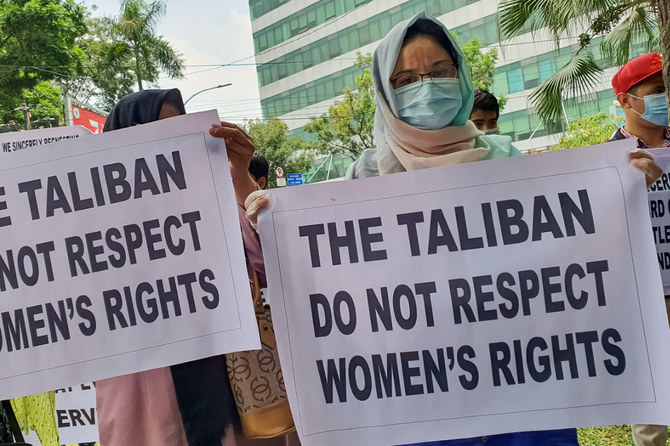
- This article argues that Islam did not directly influence the establishment of gender apartheid in Afghanistan. The understanding of Islam played a major role in the situation. The interpreter’s social and cultural background influences his or her interpretation of Islam.
- All of these factors demonstrate that the Pashtunwali code reinforces patriarchy and excludes women from public spaces.
- The Taliban is a Pashtun and Islamic movement in Afghanistan, and its ideology is based on both Islam and Pashtunwali. Bette Dam contended that the Taliban’s worldview, which originated in Kandahar and Haji Ibrahim, included the exclusion of women from the public realm.
- It may be inferred that the patriarchal Pashtunwali code, rather than Islam, is the primary cause of women’s exclusion from public spaces. Islamic customs and practices have never been troublesome for women in public spaces.
Moreover, four years have passed since the Taliban took over Afghanistan in 2021. What distinguishes the Taliban’s rule in Afghanistan is “gender apartheid.” The Afghan Taliban has been effective in implementing a legislated and institutionalised erasure of Afghan women from public life. Afghan women are not only excluded from public decision-making, but they are also denied access to basic education. The Taliban successfully institutionalises patriarchal standards that exclude women in the name of Islam. Many non-Muslim observers agree that Islam is to blame for Afghan women’s low position in their country.
However, this article argues that Islam did not directly influence the establishment of gender apartheid in Afghanistan. The understanding of Islam played a major role in the situation. The interpreter’s social and cultural background influences his or her interpretation of Islam. To prove the premise, the article delves deeply into Pashtunwali’s social and cultural code. The second theme analyses the Taliban’s interpretation of Islam and the rights granted to women under true Islam.
Pashtunwali Code: The Way of the Pashtuns and Its Impacts
The Pashtuns constitute the world’s largest tribally structured community today. They follow the ‘Pashtunwali’ socio-cultural code. It symbolises the Pashtun people’s collective vision and consists of various components. Melmastia symbolises hospitality to all guests, regardless of religion, colour, or nationality. Nanawaty, which means protection, is provided to anyone who requests it against their adversaries. This could be the reason why the Taliban refused to hand over Osama bin Laden when Washington demanded it following the September 11 terrorist strike on the United States. Zemaka advocates for the protection of the territory from foreign encroachment. Badal is about avenging wrongs, as the popular saying goes, “A Pathan can wait a hundred years to take his revenge.” All of these components are viewed as individual and collective responsibility among the Pashtuns.
Another important component is “nang,” which means safeguarding the honour of the family and protecting women in terms of religious and cultural traditions. The concept of Nang focuses on safeguarding the family and its honour by defending the women within it. A lady strolling down the street without a veil, exposed to other males, poses a danger to the family’s honour. It’s not just about burqas; they usually stay indoors and rarely leave their houses from a young age. The Nang left them exposed to physical abuse, social exclusion, and emotional control.
The Pashtun society has an institution called the ‘Jirga’ to handle its collective issues, and women are not allowed to participate in it. The exclusion of Afghan women from the Jirga caused them to suffer, as offenders were forced to hand over their female relatives to the aggrieved party. These weddings heal family issues, but women are not asked about their choices. This is due to the exclusion of women from the jirga. All of these factors demonstrate that the Pashtunwali code reinforces patriarchy and excludes women from public spaces.
Islam and Taliban
According to French political scientist Mariam Abou Zahab, there are only culturally specific versions of Islam that are informed by their respective social circumstances, not a single universal Islam. Similarly, Islam arrived in Afghanistan around 700 A.D., and Pashtunwali was much older than Islam in the country. The spread of Islam in the Pashtun region was sluggish and gradual. It was stated that the Pashtuns accepted Islam on the condition of not interfering with the Pashtunwali code. According to one account, ‘Pashtun embraced half of the Koran.’ They changed Islam to reflect Pashtunwali traditions. As a result, women’s seclusion from public spaces was justified under the banner of Islam. For example, the mullahs of Afghanistan supported local khans to oppose the communist Saur revolution of 1978, which attempted to bring about land reforms and women’s empowerment.
The Taliban is a Pashtun and Islamic movement in Afghanistan, and its ideology is based on both Islam and Pashtunwali. Bette Dam contended that the Taliban’s worldview, which originated in Kandahar and Haji Ibrahim, included the exclusion of women from the public realm. They are unsure how to interact with women in public. They do not see women as equals to men in society. This worldview has a profound impact on their interpretation of Islam. They are also affiliated with Deobandi Islamic Madrassas on the Pakistan-Afghanistan border. Deobandi Islam was a puritan Islamic movement in India that talked about the return of Muslims to the traditional tenets of Islam. The flood of Saudi money and Wahhabi doctrine against the Soviets during the Afghan Jihad reinforced this interpretation of Islam among the Taliban. For the Taliban, Islam traditionally confined women to four walls.
However, this interpretation of Islam contradicts the ideas of equity and equality that Islam promotes. Islam not only enabled women to receive a basic education but also to pursue their careers. Many examples from the Prophet and verses from the Koran support this point.
Prophet Muhammad’s first wife, Khadija, was a successful businesswoman in that community. As Dr Shadaab observed, this indicates that the woman was the earner in the partnership. They both chose to reside at Khadija’s home following their marriage, which was unusual in that era. Hazrat Aisha (the Prophet’s wife) accompanied Muhammad on his
military campaign to Uhud. She was also instrumental in narrating several hadiths about the Prophet’s life. In addition to protecting his wives’ rights, the Prophet played an important role in providing women the right to inherit their father’s property. Women were also liberated from forced weddings, as a woman’s assent is required for the legality of a Nikah, or marriage, in Islam. All of these were revolutionary when seen in the context of 7th-century Meccan society. So it is evident that Islam does not exclude women from public spaces but rather provides them with a respectful space.
In all Muslim societies, including Afghan society, the hijab is associated with female modesty. The Koran addresses the topic of hijab twice, as Allah tells women in ‘Surah an-Nur’ to cover their chests from non-mehram (unrelated) men. With Surah Al-Ahzab, Allah commands the Prophet’s wives, daughters, and believing women to wrap themselves with Jalabib (a large outer garment) whenever they go outside. This plainly indicates that women are not forbidden from leaving their houses. A Moroccan feminist writer on Islam stated that the Koran’s verses on hijab are contextual. It was intended to protect women from abuse in Medina, a very patriarchal and unsafe city. She went on to argue that Muslim elites and monarchs adopted the hijab to exclude women from public life.
Conclusion
Finally, it may be inferred that the patriarchal Pashtunwali code, rather than Islam, is the primary cause of women’s exclusion from public spaces. Islamic customs and practices have never been troublesome for women in public spaces. Women’s exclusion from public spaces is the result of Muslim male leaders’ patriarchal attitudes and vested interests, such as those of the Taliban.
Dr Mohammad Rizwan holds a PhD in political science from Jamia Millia Islamia. His doctoral research focuses on Pakistan’s relations with major global powers. Views expressed are the author’s own.
 Aayush Pal
  Anusreeta Dutta
  Preeti Bora