
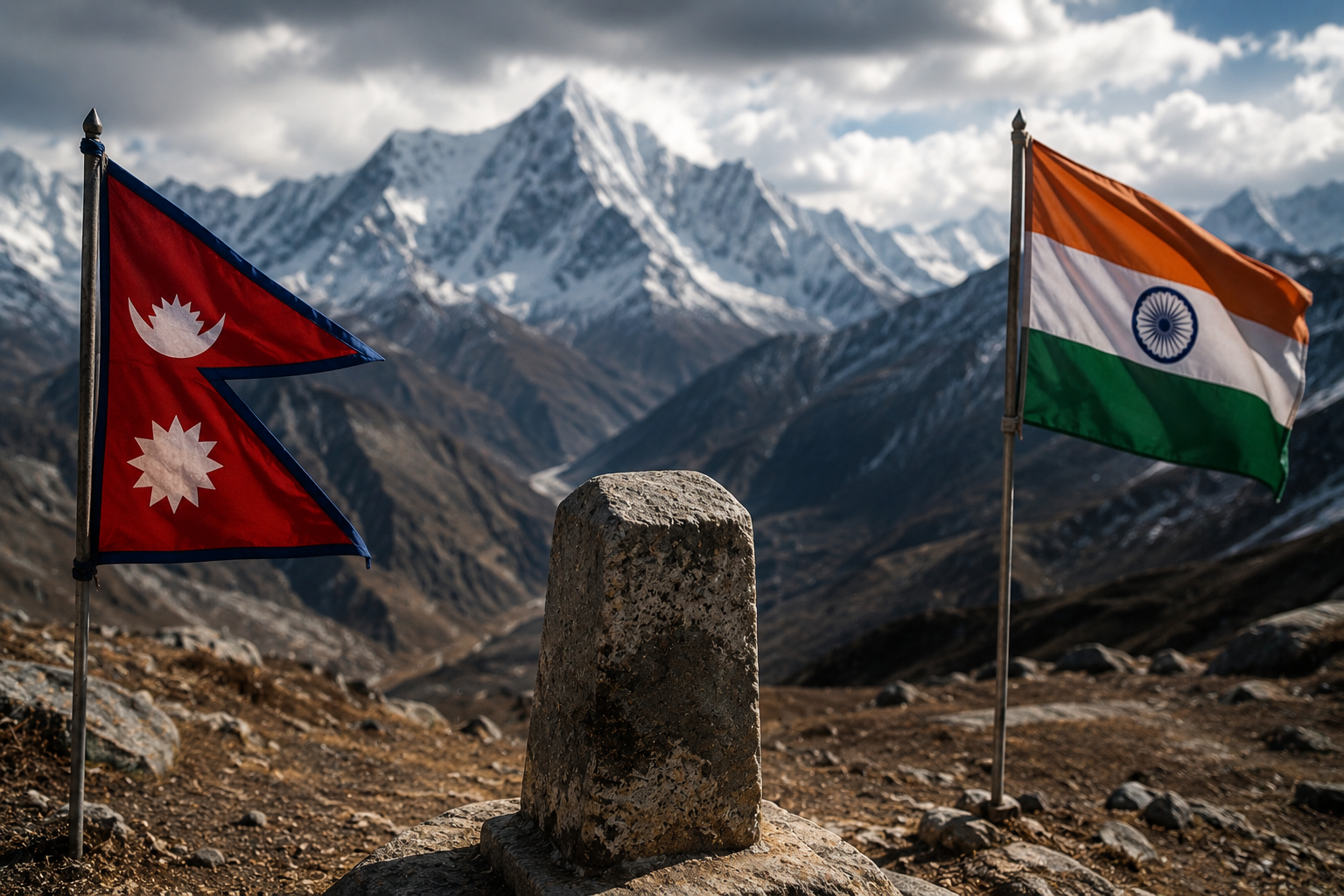
- The Kalapani issue is not just about maps and historical treaties. Now it’s a portal into the geopolitical competition playing out across the Himalayas.
- Nepal has historically pursued a policy of balancing relations with larger countries. Caught often between India and China, Kathmandu has sought to maintain strategic autonomy by diversifying its diplomatic and economic ties.
- India’s opposition to third-party intervention is not confined to Nepal. It is a broader foreign policy philosophy that has guided New Delhi’s regional diplomacy for decades.
- It reflects Nepal’s desire for more diplomatic freedom, China’s expanding regional footprint and India’s struggle to maintain strategic autonomy in an increasingly tense geopolitical climate.
A long-running territorial dispute between India and Nepal has been reignited after Balen Shah said that China and the United Kingdom could help settle the Kalapani-Limpiyadhura-Lipulekh dispute. While New Delhi was quick to reiterate its position that all unresolved disputes with Nepal should be settled bilaterally, the episode is important not because mediation is possible, but because it reflects the changing geopolitical realities in the Himalayan region.
At first, the idea may look like another chapter in a familiar border dispute. It is, in fact, reflective of larger trends in Nepal’s foreign policy calculus, China’s growing footprints in South Asia and India’s desire to preserve a regional order of bilateral engagement, rather than external intervention. The Kalapani issue is not just about maps and historical treaties. Now it’s a portal into the geopolitical competition playing out across the Himalayas.
History of the dispute
The Kalapani-Limpiyadhura-Lipulekh dispute is about a 370-square-kilometre area at the trijunction of India, Nepal and China. It dates back to the 1816 Treaty of Sugauli, signed between the Kingdom of Nepal and British India after the Anglo-Nepalese War. The treaty made the Kali River the western boundary of Nepal. The argument is founded on opposing theories about the origins of the river. Nepal maintains that the Kali originates at Limpiyadhura and therefore Kalapani and Lipulekh belong to Nepal. India claims the river starts farther downstream and the area in dispute is in Uttarakhand.
Much of the conflict lay dormant for decades. Tensions erupted in 2020 when India opened an 80-kilometer road from Dharchula to Lipulekh Pass, a strategically important route that provides access to Kailash Mansarovar in Tibet. Nepal protested vehemently, saying the road passed through territory under its control. In response, Kathmandu released a new political map including Kalapani, Limpiyadhura and Lipulekh as part of Nepal’s territory, and amended the country’s constitution to formalise the claim. Since then the matter has evolved from a dispute over a technical boundary to a politically charged symbol of sovereignty and national identity in Nepal.
Significance of the proposal
India’s position is unlikely to change with the idea that other parties can help resolve the dispute. But it provides vital facts about the strategic location of Nepal. Nepal has historically pursued a policy of balancing relations with larger countries. Caught often between India and China, Kathmandu has sought to maintain strategic autonomy by diversifying its diplomatic and economic ties. This balancing strategy has become more evident as Chinese investment, infrastructure projects and political engagement in Nepal have grown over the past decade.
Domestic politics are also very important. Nepal’s political discourse is heavily laced with territorial disputes, and governments have to always be seen to be taking strong positions on issues of sovereignty. Calls for stronger action on Kalapani often come from nationalist constituencies and young voters. The United Kingdom reference is an acknowledgement of the historic roots of the dispute. Some Nepalese say Britain is partly to blame historically because the Sugauli Treaty was negotiated during British colonial rule. But from a legal and diplomatic point of view, modern border disputes are settled by sovereign successor states, not former colonial powers. This makes British involvement highly improbable. But the reference to China is far more strategic.
India’s bilateral Doctrine
India’s opposition to third-party intervention is not confined to Nepal. It is a broader foreign policy philosophy that has guided New Delhi’s regional diplomacy for decades. This approach is based on India’s commitment to resolving conflicts through direct negotiations. The concept gained significance after the Simla Agreement of 1972 between India and Pakistan, which laid stress on bilateral dialogue as the way forward to resolve outstanding issues. Nepal is not a signatory to the accord, but since then, bilateralism has been an important feature of India’s ties with its neighbours.
New Delhi says there will be a number of difficulties in allowing outside mediation. First, it could open the door to similar demands by other regional issues. India has historically not internationalised bilateral issues, whether they are border-related, security-related or political conflicts. Second, bringing in third parties could diminish India’s strategic autonomy by giving outside countries a formal role in issues that New Delhi views as integral to the region. Third and most importantly, involving China in a territorial dispute with India would be strategically indefensible. India and China continue to have unresolved border disputes along the Line of Actual Control. Beijing’s addition to a separate India-Nepal border dispute will make an already fraught security situation even more complicated. Kalapani is not only a matter for India. The question is to keep up a diplomatic framework that constrains foreign interference in South Asian affairs.
The China Factor
The episode’s geopolitical importance lies chiefly in its allusion to China. China’s footprint in Nepal has grown in the last decade through infrastructure investment, linking projects, development assistance and political engagement. Nepal’s involvement in the Belt and Road Initiative has further strengthened the economic relations between the two countries. China plays a significant role in the Himalayan area for Nepal. It acts as a buffer against Tibet, helps to meet regional connectivity goals and enables Beijing to expand its influence in South Asia.
India has become more aware of these changes. New Delhi is Nepal’s largest trading partner with strong cultural, religious and people-to-people ties, but the Chinese presence has added new geopolitical variables in the bilateral relationship. Given this, any semblance of Chinese involvement in a territorial spat between India and Nepal is not likely to be viewed merely in terms of a diplomatic move. Rather, it is read against the background of strategic contests and power shifts in the Himalayas. But that does not mean Nepal is giving up its traditional ties with India. Kathmandu continues to be heavily dependent on India for trade, energy cooperation, job creation and transportation links. “The engagement with China is not about replacing existing partnerships, but about expanding them,” Nepal said. However, the growing role of external actors has changed the strategic context within which the India-Nepal relationship operates.
What the Episode Tells Us About South Asia
The mediation controversy is symptomatic of a larger transition underway in South Asia. India’s position in the regional order during the entire post-independence period was a pre-eminent one. But today neighboring countries have more diplomatic options. The economic rise of China has offered strategic options for countries such as Nepal, Sri Lanka, Bangladesh and the Maldives.
This does not mean India’s influence is declining. Instead, it suggests that regional diplomacy is becoming more competitive and multi-dimensional. Nepal has more flexibility to engage with many partners. Meanwhile, fears of external involvement in India are rooted in a desire to avoid strategic encirclement and to remain the main security player in the region. This is likely to have long-term ramifications for South Asian geopolitics.
Conclusion
Mediation by China or the United Kingdom in the Kalapani-Limpiyadhura-Lipulekh conflict is highly improbable. India’s strong belief on bilateral resolution of conflicts will guarantee continued resistance to third-party interference in issues involving its close neighbors. But the importance of the episode extends beyond the debate itself. It reflects Nepal’s desire for more diplomatic freedom, China’s expanding regional footprint and India’s struggle to maintain strategic autonomy in an increasingly tense geopolitical climate.
The border question remains unsettled, and neither side seems willing to change its fundamental position. Thus, the only way to find a solution is through bilateral negotiation. More importantly, the experience is a warning that the future of India-Nepal relations will be shaped not only by the historical issues of boundaries but also by the larger strategic changes taking place across the Himalayas.

Anusreeta Dutta is a columnist and climate researcher with experience in political analysis, ESG research, and energy policy. Views expressed are the author’s own.
 Anjali Singh
  Archita Gaur