
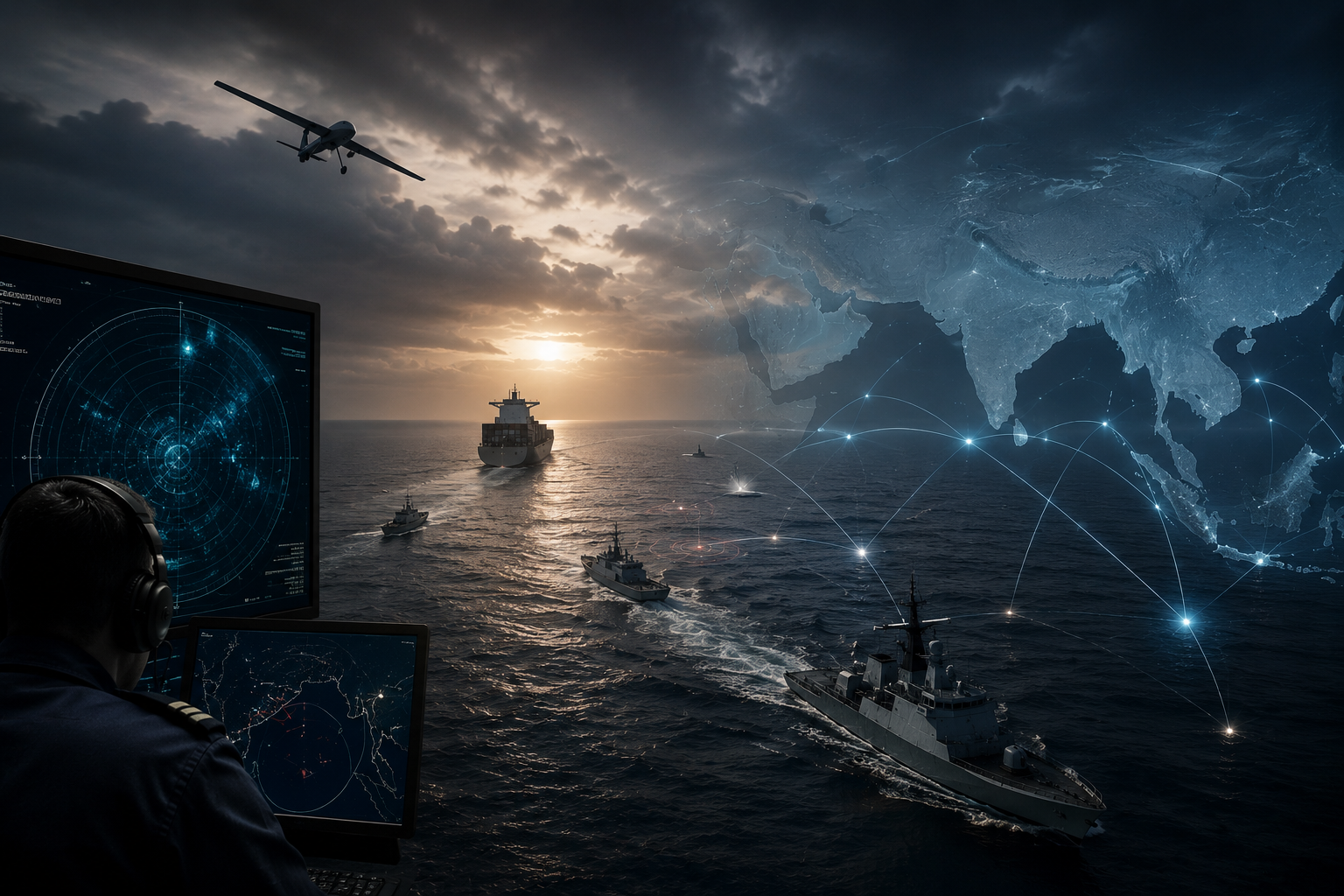
· NWNP (No-War-No-Peace) reconceptualizes the entire maritime security architecture, involving a series of tactical deadlocks that define a race for claim assertion, working on ‘Maintaining An Advantage’ logic without actually triggering a full-scale conflict threshold.
· Maritime spaces are thus transitioning from a zone of episodic crises to a permanent NWNP strategic environment where competition is continuous, multidimensional, and below the threshold of war.
· The strategy has incorporated exclusive chapters on ‘Strategy to Prevail in Situations below Threshold of Conflict’ (chapter 7) and ‘Enablers’ (chapter 3), reflecting a whole-of-nation approach to legally counter state-backed proxies without inciting a full-scale escalation.
· We need a ‘Distributed Future Command Architecture’ (DFCA). It means a decentralised architecture powered by AI technology, spanning multiple domains, and relying on networks for maritime security.
Today, the most decisive battles at sea are those that never officially began, yet are instrumental in shifting the principles of maritime warfare. Selective Blockades in the Strait of Hormuz (2026)[1], Baltic Sea Cable Incidents (2023-25)[2], Houthis’ Attacks on Commercial Shipping[3], Nord Stream Pipeline Sabotage (2022)[4], Kerch Strait Incident (2018)[5], and a prolonged militarization of the South China Sea[6] via artificial islands demonstrate the blueprint for future gray zone tactics in the maritime domain. Traditionally, maritime strategy from ‘Decisive Battle’ to ‘Naval Warfare’ was grounded on the premise that conflict would only lead to identifiable maritime engagements, preferably involving fleets. Contemporary maritime geopolitics, as seen in the ‘Hormuz Crisis’, however, departs from this assumption. Conventional warfare follows a clear threshold for the endgame. Contrastingly, NWNP (No-War-No-Peace)[7] reconceptualises the entire maritime security architecture, involving a series of tactical deadlocks that define a race for claim assertion, working on ‘Maintaining An Advantage’ logic without actually triggering a full-scale conflict threshold. The output is what we are noticing in forms of geography weaponisation, maritime lawfare, economic coercion, and the disruption of maritime chokepoints.
Present Trap: Invisible Battlefield
The greatest dilemma is who are we fighting? What constitutes the fleet? Where is the battlefield? Should we actually prepare to fight? What should be our strategy? Unlike conventional warfare, which has a clear mandate to address the above questions, the primary battlefield that gray-zone tactics/warfare must refer to is the legal legitimacy of the invisible battlefield. The incorporation of ‘Calibrated Selectivity’[8] of AI or otherwise in maritime security doctrine must direct Indian geographical theatre prioritization. Moreover, the Hormuz crisis culminates in a strategic geopolitical grammar concerning the possible future lockdown of the Southwest Indian Ocean if maritime strategy/doctrine excludes NWNP/gray-zone tactics. However, Gray-zone warfare necessitates a constant and exhausting maritime presence to monitor chokepoints and deter shadowy vessels. NWNP is often characterised by tactical stalemates that, if left unaddressed, gradually lead to what we call ‘Salami Slicing’ or ‘Cabbage Tactics’, encouraging incremental shifts in the status quo. Further, it leverages ambiguity, deniability, and legal loopholes in international maritime law, so the victim state cannot clearly justify a conventional military response. This places immense structural strain on the Indian Navy’s Mission-Based Deployments (MBD) strategy. Maritime spaces are thus transitioning from a zone of episodic crises to a permanent NWNP strategic environment where competition is continuous, multidimensional, and below the threshold of war.
What is INMSS-2026?
INMSS-2026 stands for Indian Navy Maritime Security Strategy 2026, officially unveiled by the Chief of the Naval Staff on 17th April 2026, during the Naval Commanders’ Conference. It symbolises a Strategic Continuum of the past maritime security strategy (2007,2015), while incorporating the changed geopolitical challenges.[9] The strategy has incorporated exclusive chapters on ‘Strategy to Prevail in Situations below Threshold of Conflict’ (chapter 7) and ‘Enablers’ (chapter 3), reflecting a whole-of-nation approach to legally counter state-backed proxies without inciting a full-scale escalation.[10] To date, we have not had a working mechanism to address ‘Denying Deniability’, which, in NWNP conditions, leads to refusing to claim responsibility for actions such as cutting an undersea cable or a drone strike on a commercial vessel, using adversaries’ attribution shields. INMSS-2026 has underlined a four-step sub-strategy in chapter 7, viz-a-viz (1) Develop Continuous Situational Assessment and Refinement; (2) Develop and Integrate Diverse and Scalable Naval Capabilities; (3) Pursue Integrated Multi-Stakeholder Frameworks with Multi-Domain Integration; and (4) Sustained Readiness for Decisive and Swift Response. Therefore, by institutionalising NWNP, INMSS-2026 underlines that modern conflicts are a subject matter of international interpretation grounded on ‘Intelligence and Information Superiority’, not just military might.
The Solution: “Distributed Future Command Architecture”
We need a ‘Distributed Future Command Architecture’ (DFCA). It means a decentralised architecture powered by AI technology, spanning multiple domains, and relying on networks for maritime security. In such an architecture, decision-making, intelligence gathering, surveillance, and actions will be distributed among the military, civilians, technology, and diplomacy to ensure timely, coordinated, and proportional responses to gray-zone threats. In such an architecture, the Indian Navy is expected to act more as a constabulary and law enforcement entity on the high seas, rather than a purely military fleet. Moreover, IFC-IOR must be positioned not just as a passive data-sharing center, but as a primary weapon of cognitive information warfare, especially in instances where AIS tracing systems are deliberately switched off, going against the ISPS Code (2004) of the SUA Convention[11]. That way, we can strip adversaries of their deniability via verified tracking data. The solution lies in an ‘Integrated Maritime Information Grid’ incorporating data from all the stakeholders (Indian Navy, Coast Guard, Intelligence Bureau, RAW, port authorities, fisheries, customs, commercial satellite operators, etc.). Secondly, we need to transition from a platform-centric to network-centric maritime security. Thirdly, institutionalising grey-zone tactics and NWNP is just a start. We need to establish ‘Maritime Grey Zone Cells’ within the existing security response mechanism to make it a reality. Fourthly, develop deterrence to counter the ‘Deterrence Dilemma’ concerned with NWNP. Fifthly, the creation of a ‘Maritime Attribution Centre’ to arrest the ambiguity attached to the grey-zone warfare and protect critical maritime infrastructure. Lastly, strengthen regional maritime partnerships by institutionalising regional maritime concerns.
Conclusion
In the emerging NWMP maritime order, INMSS-2026 sets a progressive benchmark that can only be achieved if doctrinal foresight is matched with implementation realities, along with KPIs to measure this transition. For India, the future of maritime security lies not in preparing for the next war alone, but in mastering the continuous competition that precedes it through a ‘Distributed Future Command Architecture’ capable of deterring, absorbing, and outmanoeuvring grey-zone coercion.
[1] Kochhar, Rajan. 2026. “Strait of Hormuz Naval Blockade: US Operational Design, Force Posture, and Iranian Counterplay.” Times of India, April 14, 2026.
[2] Braw, Elisabeth. 2025. “How the Baltic Sea Nations Have Tackled Suspicious Cable Cuts.” Issue Brief, Atlantic Council, November 26, 2025.
[3] Ali-Khan, Veena. 2026. “Houthis’ Red Sea Shipping Threat Risks Bigger Oil Shock.” ThePrint, June 11, 2026.
[4] Security Council Report. 2025. “The Nord Stream Incident: Open Briefing.” *What’s In Blue*, August 26, 2025.
[5] International Institute for Strategic Studies (IISS). 2018. “The Kerch Strait Incident.” *Strategic Comments* 24, no. 37 (December).
[6] U.S.-China Economic and Security Review Commission. 2016. “China’s Island Building in the South China Sea: Damage to the Marine Environment, Implications, and International Law.” Research Report, April 12, 2016.
[7] TRT World Research Centre. n.d. “No War-No Peace.” TRT World Research Centre Dictionary. Accessed June 12, 2026.
[8] Fisch, Adam, Tommi Jaakkola, and Regina Barzilay. 2022. “Calibrated Selective Classification.” Preprint, submitted August 25, 2022. https://arxiv.org/abs/2208.12084.
[9] Press Information Bureau (PIB). 2026. “CULMINATION OF FIRST EDITION OF NAVAL COMMANDERS’ CONFERENCE 2026.” Government of India. April 17, 2026.
[10] Indian Navy. 2026. *Indian Navy Maritime Security Strategy (INMSS-2026)*. New Delhi: Integrated Headquarters, Ministry of Defence (Navy).
[11] International Maritime Organization (IMO). n.d. “SOLAS XI-2 and the ISPS Code.” Accessed June 12, 2026.

Preeti Bora is a doctoral candidate in the Department of Political Science at Jamia Millia Islamia. Her doctoral research focuses on India’s maritime diplomacy in the Southwest Indian Ocean and the evolving regional security architecture. Her research interests include maritime security, Indian Ocean regionalism, Global South diplomacy, and strategic affairs.
 Archita Gaur
  Hridbina Chatterjee
  Divyanka Tandon