
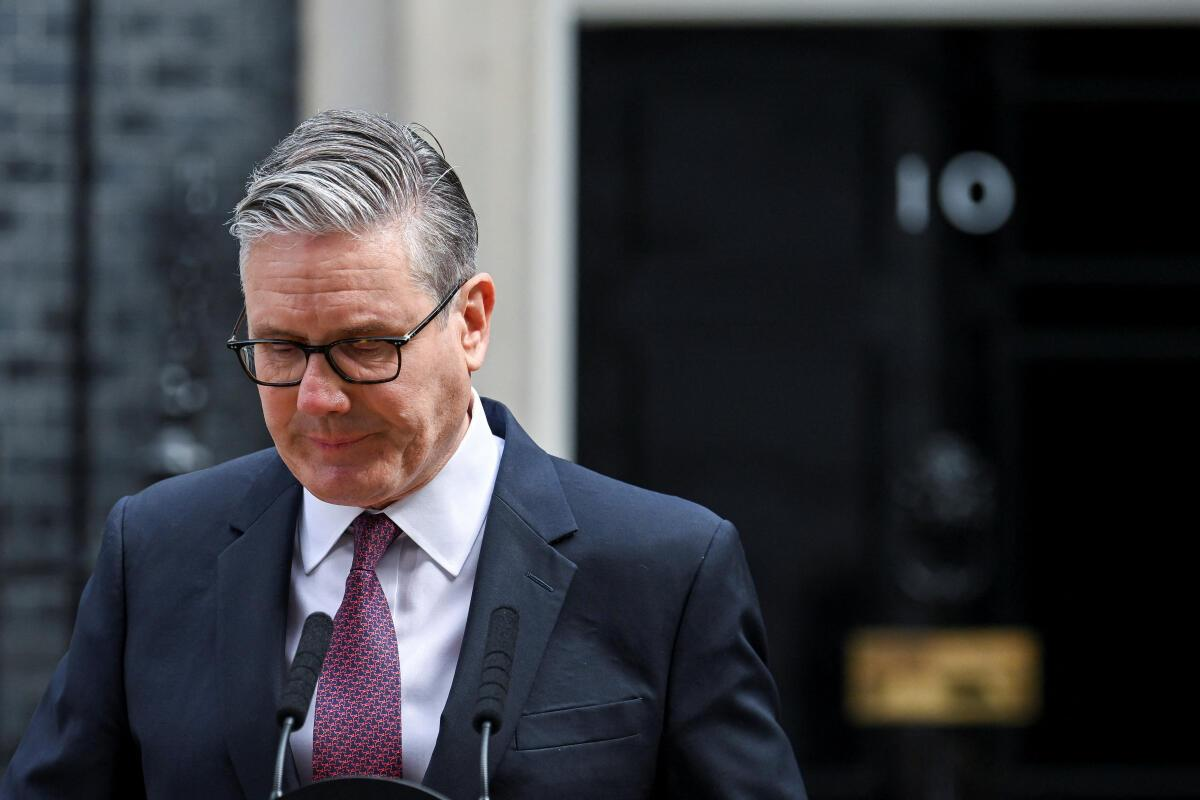
- Keir Starmer’s resignation as Prime Minister of the United Kingdom represents yet another phase in the ongoing political chaos affecting the U.K and further cementing the fact that this will be the seventh Prime Minister to serve in the U.K. in just ten years.
- The origins of British political instability lie in the 2016 Brexit referendum vote that marked the beginning of an entirely new era of politics and economics in the country.
- The diminished level of Labour’s popularity among liberal voters and the rising popularity of right-wing populist alternatives such as Reform UK demonstrate that the British political party has fragmented beyond the Two Parties typically represented.
- The resignation of Keir Starmer is much more than a personal political failure; it is indicative of an overall malaise afflicting the UK’s political environment.
Keir Starmer’s resignation as Prime Minister of the United Kingdom represents yet another phase in the ongoing political chaos affecting the U.K and further cementing the fact that this will be the seventh Prime Minister to serve in the U.K. in just ten years. The announcement was made public from 10 Downing Street. Starmer’s announcement of his resignation provides us with further evidence regarding the depth of the structural and institutional crises facing the Labour Party, along with the power struggle that is part of the reason why Starmer decided to resign.
From an international relations perspective, the events unfolding in Britain can best be understood within a realist approach to power competition between and among political actors, which drives political outcomes. Starmer’s resignation also shows that when domestically the State is experiencing political instability, this makes the State less capable of projecting its power to an outside audience, thus influencing how much power the State has in the world.
A Leader’s Exit in the Context of the Internecine Struggle for Power
Unlike other resignations, that of Mr Starmer was not a spontaneous move, but rather the result of increasing internal pressures within the Labour Party. The admission of Mr Starmer that he may no longer be the “best-placed” leader is a clear example of the classic внутрапартийная power struggle, which undermines the leader’s legitimacy through his/her lack of political authority.
Andy Burnham’s appearance on the political stage after winning the by-election constitutes a direct threat to the leadership of the current Labour leader. From the realist perspective, it is the struggle for the control of political resources: power, party mechanisms, and public opinion. Leadership races in parliamentary regimes are often viewed as zero-sum games.
The situation is further complicated due to the decreasing popularity and ideological fragmentation of the party.
Brexit: An Agent of Political Instability
The origins of British political instability lie in the 2016 Brexit referendum vote that marked the beginning of an entirely new era of politics and economics in the country. Since then, all the following prime ministers from David Cameron to Rishi Sunak have been dealing with the implications of the Brexit decision.
The impact of Brexit is not limited to Britain’s relationship with the European Union but rather created the conditions for systemic uncertainty in the country. The constant change of leaders is a consequence of systemic instability in which institutions cannot adjust to shocks.
The costs in terms of declining investments, decreased productivity, and weak economic growth are added to political discontent, which results in a lack of trust in government and thus provides opportunities for alternative leaders.
Increasing Populism has Upset the Balance of Power in Politics
Emerging alternative political parties are another aspect of the struggle for power. The diminished level of Labour’s popularity among liberal voters and the rising popularity of right-wing populist alternatives such as Reform UK demonstrate that the British political party has fragmented beyond the Two Parties typically represented.
In theory, today’s diffusion of power as analysed through international relations means that power is increasingly diminished from established authorities and distributed over many different competing players. Nigel Farage demonstrates how populist leaders can use an economic grievance to mobilise citizens behind a national identity against mainstream parties.
Governance becomes a much more difficult task for leaders as they try to govern from a fractured constituency base, regardless of maintaining coherent policy via their respective party. This may cause many governments to become short-lived or lead to many changes to an already established government, thus leading to inconsistent policy.
Demographic and Economic Pressures: A Structural Constraint
Apart from politics and competition, Britain is facing some structural constraints that are making things difficult for Britain, due to which the power struggle will remain intensified in the coming years. The country will face problems in terms of an ageing population and low birth rates in future.
Moreover, low immigration will be another challenge that Britain will face in future. Low immigration means that the country will not be able to cope with the demographic problem. Thus, a policy problem will arise for the future leaders of the country.
According to realism, such constraints decrease the capabilities of the state.
Implications for Britain’s International Standing
There are implications for Britain’s standing in the international community because of leadership instability and domestic chaos. Instability of this kind has the potential to affect investor confidence, diplomatic effectiveness, and the ability to plan strategically for the future.
In a highly competitive international environment, stability is one of the elements of national power. The unstable state of affairs in Britain threatens the country’s standing on the world stage and its effectiveness in international organisations and negotiations, especially considering the emergence of new powers on the international scene.
That is why the election of a new leader, who is most likely to be Andy Burnham, will be of great interest to the entire international community.
Conclusion
The resignation of Keir Starmer is much more than a personal political failure; it is indicative of an overall malaise afflicting the UK’s political environment. Ten years on from Brexit, the UK continues to be mired in a spiral of instability caused by internal power struggles, economic pressures, and changing political landscapes.
However, as the Labour Party prepares itself to elect a new leader, the main question remains whether Britain is able to get out of this spiral of instability. The lack of stability and policy direction might lead to further loss of governance and geopolitical influence.
In conclusion, the current power struggle in Britain is only symptomatic of a wider change that will shape Britain’s political future.

Anjali Singh is a postgraduate student of Political Science and International Relations, a Social Media Analyst, and a former Research Intern at the Indian Council of World Affairs. Views expressed are the author’s own.
 Aayush Pal
  Archita Gaur