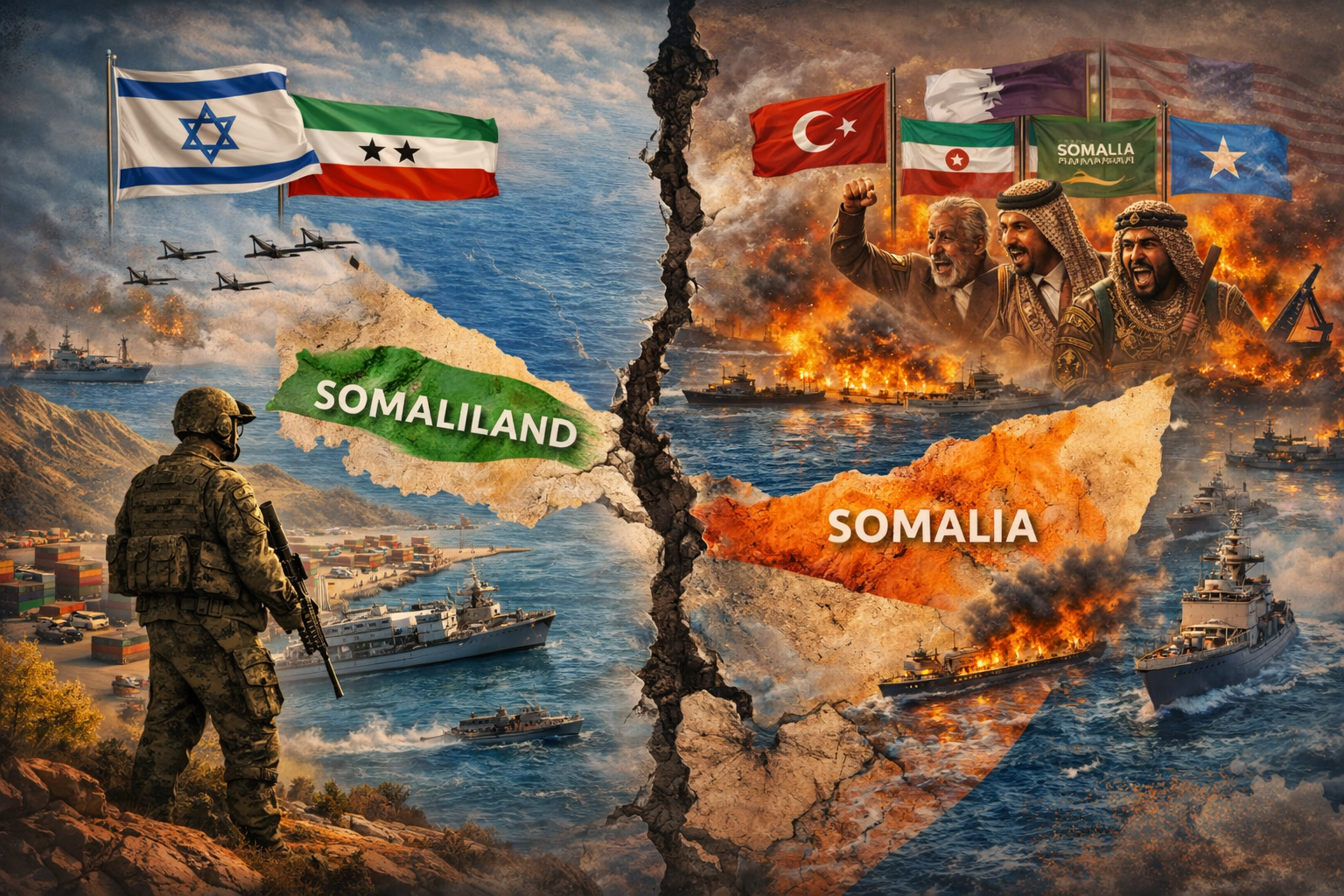
- Israel, under a prime ministerial executive order, has declared and recognised the independence of Somaliland in the spirit of the Abraham Accords.
- One of the primary reasons is Somaliland’s strategic location, as it lies near the Gulf of Aden, which connects the Red Sea to the Indian Ocean.
- The Somali President has described Israel’s action as a blatant violation of Somalia’s sovereignty. Arab partners, including Qatar, Saudi Arabia, and Iran, have also opposed the decision.
A significant geopolitical development has unfolded in the Horn of Africa, triggering considerable regional reverberations, as Israel has become the first country in the world to unilaterally recognise the sovereignty of Somaliland. Somaliland is a self-proclaimed entity in the northwestern part of Somalia that declared its independence in 1991 following the collapse of the Siad Barre regime. The territory’s independence was declared by the Somali National Movement in 1991. Since then, the territory has functioned as a de facto state. It possesses its own government, currency, armed forces, and conducts regularly organised elections.
Israel, under a prime-ministerial executive order, has declared and recognised the independence of Somaliland under the spirit of the Abraham Accords. Israel has further agreed to expand cooperation across multiple domains, including defence collaboration and broader security relationships between the two sides. Somaliland President Abdirahman Abdullahi hailed the recognition and thanked Israel, whereas Israeli Prime Minister Netanyahu acknowledged the efforts of the Foreign Ministry and Mossad.
The Regional Backlash
The recognition has led to a significant backlash from Arab African regional and Islamic countries, all opposing the recognition of Somaliland. Immediately after the recognition, the Egyptian Foreign Ministry held talks with the Somali President, as well as with the Turkish and Qatari administrations, rejecting the move and stating that it violates international norms and undermines the territorial integrity of Somalia. The Somali President has described Israel’s action as a blatant violation of Somalia’s sovereignty. Arab partners such as Qatar, Saudi Arabia and Iran have also opposed the decision. Additionally, the President of the United States, Donald Trump, has stated that the United States has no intention of recognising Somaliland.
One of the key questions that emerges is what led Israel to recognise Somaliland. One of the primary reasons is Somaliland’s strategic location, as it lies near the Gulf of Aden, which connects the Red Sea to the Indian Ocean. It is also situated near the Bab el Mandeb Strait, which provides access to the Suez Canal. This area constitutes a critical global maritime choke point, as nearly 12% of global maritime trade passes through this route. The majority of Asian to European trade transits through this corridor.
The Houthi factor
Another important reason is that Israel’s heightened concern over the Yemeni Houthis, who are based in Yemen and have been posing a serious security threat to Israel, especially since October 7 2023, when Israel escalated its war in Gaza. The Houthis openly challenged Israel and targeted commercial maritime vessels linked to Israel. This led to a major decline in maritime movement and raised grave concerns regarding maritime security in the Red Sea region. Consequently, trade activity along this corridor was substantially reduced.
With Israel potentially establishing a strategic presence, multiple reports indicate that Mossad has already surveyed critical infrastructure and important military locations in Somaliland. These sites could subsequently be utilised by Israel to establish military infrastructure, granting Israel enhanced operational visibility and a strategic edge over the Houthis.
Tumultuous past of Somaliland
This is not the first time that Somaliland has drawn international attention. Previously, an agreement was signed between Ethiopia and Somaliland under which Ethiopia agreed to lease access to the strategically significant port of Berbera for economic and military purposes, in exchange for specified economic incentives for Somaliland. This move was strongly opposed by Somalia and led to heightened tensions in the region.
It is important to note that two distinct power blocs are operating in the Horn of Africa. One major bloc is led by Ethiopia and is supported by the United Arab Emirates. The other bloc is led by Egypt, which supports Somalia over the issue of Somaliland, with Djibouti also involved. There is an ongoing power rivalry between Ethiopia and Egypt in the region.
The Regional powerplay
One of the major challenges for countries such as Somalia and Egypt is the entry of Israel into the region. These countries perceive Israel’s involvement as a serious security threat, as it reduces their regional influence. More importantly, it grants Israel high-stakes visibility and strategic access within the militarised waters of the Red Sea. This provides strong maritime deterrence to the Israeli military and disrupts the existing regional status quo. This development also poses a major challenge for Turkey, which considers Israel as its adversary. This is one of the key reasons why countries like Saudi Arabia, Egypt, and Turkey are firmly opposing this move.
Somalia has faced prolonged instability since 1991 following the collapse of the Siad Barre regime, as authority became largely confined to southern Somalia. In this power vacuum, the Somali National Movement declared the independence of Somaliland. Since then, southern Somalia has continued to experience a chronic governance vacuum, which has facilitated the rise of the terrorist group Al Shabab. This organisation has sought to expand its control across Somalia, resulting in prolonged civil conflict between the Somali National Army and militant forces.
The US conundrum
The United States of America has been aiding Somalia in counterterrorism efforts by supporting the Somali National Army. This is one of the key reasons why the United States would not recognise Somaliland, as it already has a strategic presence in Somalia. If the United States were to recognise Somaliland, it would contradict its long-standing interests and could result in the erosion of its strategic position in Somalia.
Conclusion
By recognising Somaliland, Israel has further extended its influence into Eastern Africa, a move that has generated major security concerns. It remains noteworthy to assess whether this decision conflicts with the interests of the United States, particularly as American regional partners such as Saudi Arabia, Egypt and Turkey may pressure Washington to rebalance the power dynamics in the region. This development has deepened divisions within the already fragmented East African geopolitical landscape.

Aayush Pal is a freelance writer on contemporary geopolitical developments. The views expressed in his work are entirely his own.
 Ajith Shetty Heranje
  Anusreeta Dutta
  Hridbina Chatterjee