
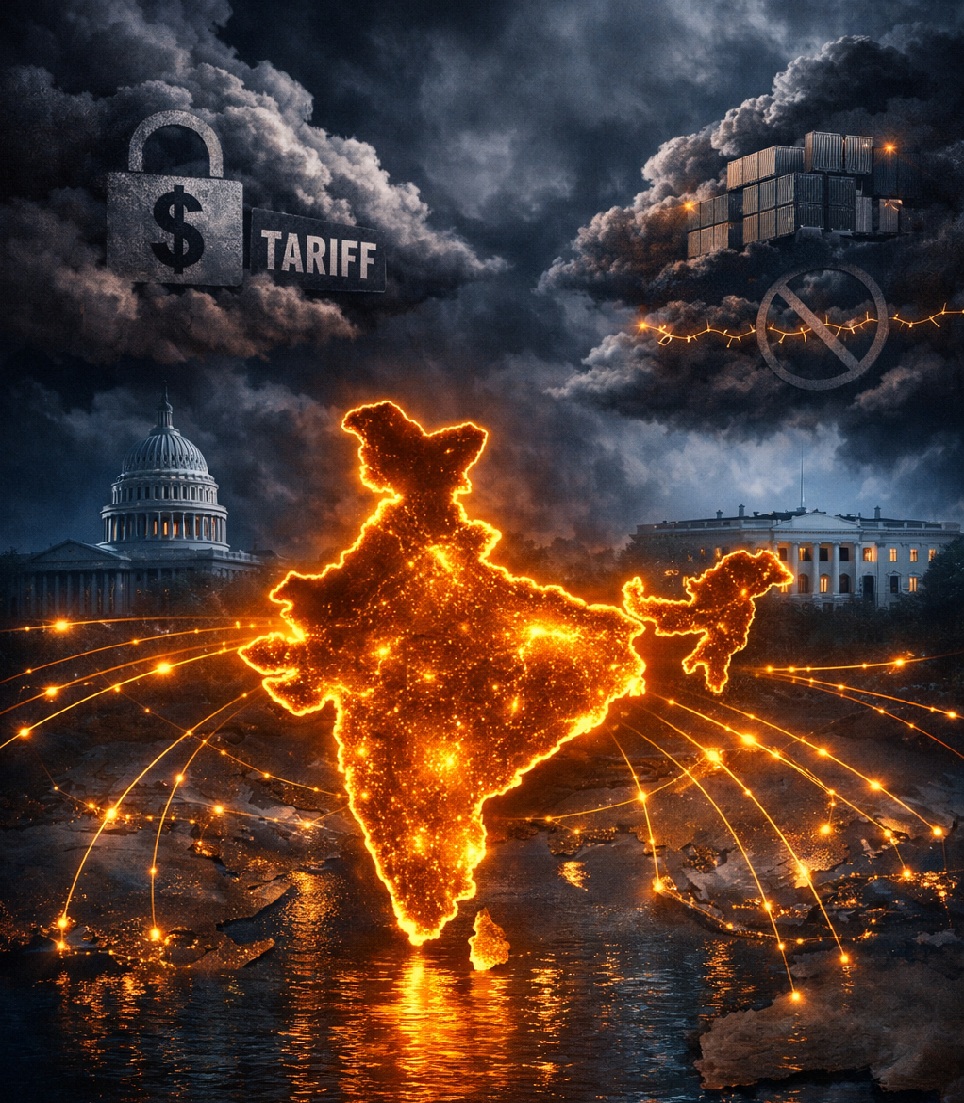
- India, a booming economy and one of the fastest-growing economies in the G20, has emerged as a bright spot amid global economic turbulence.
- India’s economic performance is particularly notable at a time when India is among the worst tariff-hit countries due to the United States trade actions.
- In response to Trump tariffs, India adopted a market diversification strategy aimed at substituting American demand with other global markets.
- Washington has demanded that India open its agriculture and dairy sectors, a move India cannot afford, as it would severely damage domestic farmers and the dairy industry.
India, a booming economy and one of the fastest-growing economies in the G20, has emerged as a bright spot amid global economic turbulence. Despite global headlines dominated by United States tariffs and broader geo-economic instability imposed against India, the country continues to stand out as one of the few major economies showing resilience, as also highlighted by the IMF. This strength is evident in India’s economy grew by a robust 8.2% in the second quarter (July-September) of the fiscal year 2025-26, and India’s industrial production saw a strong rebound to 6.7% growth in November 2025, as per the data released by the Ministry of Statistics and Programme Implementation (MoSPI), These two parameters are among the most critical indicators of economic momentum.
This performance is particularly notable at a time when India is among the worst tariff-hit countries due to the United States trade actions. The expectation in Washington that India’s economy could be cornered or significantly pressured did not materialise. At a time when global protectionism is at its peak, India has faced both international pressure and domestic challenges. Yet the Indian government appears to have quietly executed a well-calibrated strategy, successfully reducing tariff-related pressure while simultaneously setting long-term economic targets.
US Tariff Impact On Indian Sectors
The American tariffs imposed on India cover roughly 50 to 60 per cent of India’s total exports to the U.S. market, placing 66 to 75 billion dollars of India’s annual exports under direct pressure. This could lead to 4 to 5 billion dollars in export losses and a potential 0.3 to 0.5 per cent impact on GDP. The worst hit sectors have been gems and jewellery, whose exports to the U.S. fell by around 44 per cent, while textiles and garments declined by about 11 per cent. All these figures are based on data released by USTR trade statistics and Indian export bodies.
In response, India adopted a market diversification strategy aimed at substituting American demand with other global markets. The objective was to reduce the damage caused by the United States tariffs to negligible levels. This silent but effective approach has allowed India, in technical terms, to gradually neutralise the impact of American tariffs.
This has been possible because India identified alternative markets. West Asia and Europe have emerged as key destinations. Even as United States tariffs remained in place, India concluded free trade agreements with the United Kingdom and Oman. The impact of these trade negotiations extends well beyond headline numbers. In the case of the United Kingdom, India has significantly expanded exports of IT services and other high-value sectors. Additionally, the Trade and Economic Partnership Agreement signed with Norway, Switzerland, Iceland, and Liechtenstein under the European Free Trade Association includes an investment commitment of 100 billion dollars over the next fifteen years. This not only provides alternative markets but also opens new investment channels, substantially reducing the pressure created by American tariffs.
The agreement with Oman should not be evaluated solely by trade volume, which currently stands at around 12 billion dollars annually. Its real value lies in reduced energy and shipping costs, which act as hidden taxes on imports. Given Oman’s strategic location, this agreement lowers logistical costs and enhances supply chain efficiency. India has also concluded a free trade agreement with New Zealand, a country rich in dairy and agricultural production. Indian consumer price inflation is highly sensitive to food prices, and access to New Zealand’s agricultural exports provides India with greater flexibility. At the same time, it creates an alternative export destination to the United States.
India’s Strategic Logic Behind FTA
India’s free trade agreements with the United Kingdom, New Zealand, and Oman together can generate up to 35 to 45 billion dollars in additional exports over the next 8 to 10 years, thereby reducing dependence on the U.S., which currently absorbs about 87 billion dollars of India’s annual exports. As per projected estimates, the FTA with the United Kingdom alone can add 20 to 25 billion dollars in trade, mainly across services, pharmaceuticals, engineering goods, and textiles, sectors that are presently exposed to U.S. tariff pressure.
India’s free trade agreement with Oman can raise bilateral trade from 12 billion dollars to around 20 billion dollars, giving India a net export gain of nearly 8 billion dollars. Taken together, these agreements can redirect roughly 15 to 18 per cent of India’s incremental export growth away from the U.S., significantly reducing tariff vulnerability.
This is also the reason India has not rushed into diplomatic trade negotiations with the United States. Washington has demanded that India open its agriculture and dairy sectors, a move India cannot afford, as it would severely damage domestic farmers and the dairy industry. India has maintained its position despite political messaging and pressure from the United States administration and the United States Secretary of Commerce, Howard Lutnick.
India’s Domestic Resilience
Beyond external strategy, domestic reforms have played an equally critical role in absorbing external shocks. One of the most significant reforms has been the strengthening of the GST framework, which has increased domestic demand by improving cash flow, reducing compliance friction, and lowering the effective cost of doing business, which directly supports consumption and higher investment during periods of external trade pressure. Faster input tax credit refunds, quarterly simplified returns for MSMEs, and rationalisation of tax slabs have reduced working capital blockage, allowing companies to pass on cost savings through stable prices and higher production.
Private consumption now accounts for nearly 57 per cent of India’s GDP. Public capital expenditure has increased by nearly 30 per cent, reinforcing internal economic momentum. This expansion of domestic demand has enabled the Indian economy to absorb the shock created by tariffs.
Another major reform has been the Production-Linked Incentive scheme. Strategic investments under this program have strengthened manufacturing capacity across critical sectors. Alongside this, India’s import substitution and self-reliance strategy has reduced dependence on external suppliers. The pharmaceutical sector is a strong example, with nearly 70 per cent of production now domestically manufactured.
All that India has been doing with regard to free trade agreements is likely to deliver strong results in the coming years, but one key limitation remains that FTAs take time to translate into real trade flows. Non-tariff barriers continue to exist, and U.S. pressure may gradually shift from tariffs to technology and export controls. This is where India must remain vigilant and continue sustained diplomatic engagement with the United States of America.
References
- https://www.newindianexpress.com/amp/story/business/2025/Dec/18/india-accelerates-free-trade-agreements-to-counter-us-tariffs-and-expand-exports
- https://www.pib.gov.in/PressReleasePage.aspx?PRID=2195990®=3&lang=1
- https://www.ibef.org/news/india-s-industrial-production-hits-two-year-high-with-6-7-growth-in-november
- https://www.thehindu.com/business/Economy/india-to-grow-at-72-in-2025-26-with-overall-us-tariff-impact-to-be-offset-un-body-predicts/article70486031.ece

Aayush Pal is a freelance writer on contemporary geopolitical developments. The views expressed in his work are entirely his own.
 Anjali Singh
  Anusreeta Dutta