
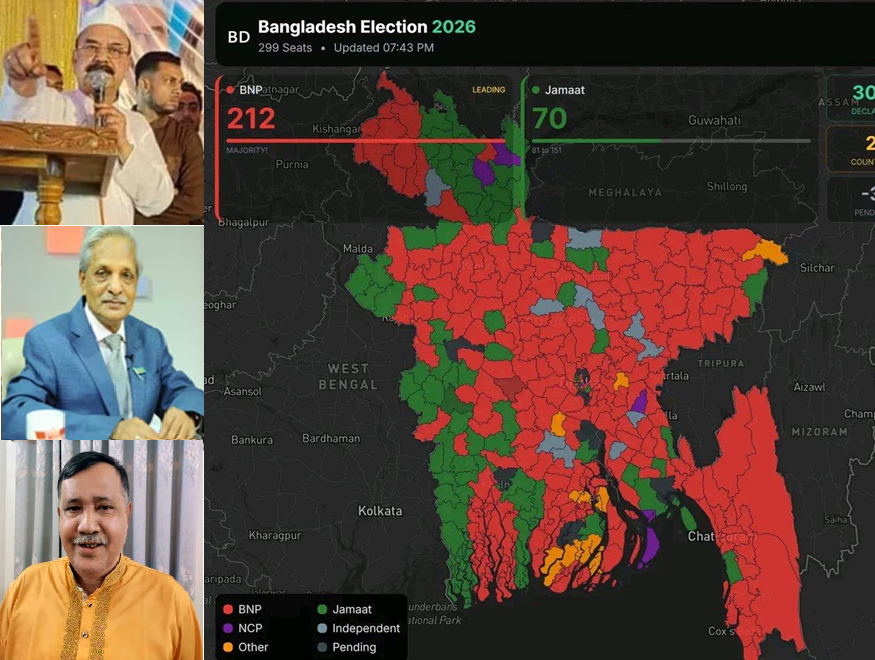
- The election of three Hindu candidates on the party’s ticket received special notice amid this landslide triumph, especially in light of recent communal tensions and minority vulnerability.
- Beneath the national mandate lies a more complex border-security picture shaped by the electoral gains of Jamaat-e-Islami, which secured 76 seats, including a cluster of constituencies along Bangladesh’s frontier with India.
- Several of these districts lie adjacent to sensitive Indian regions such as West Bengal and Meghalaya, making their political alignment strategically relevant.
- For New Delhi, minority safety in Bangladesh remains a core diplomatic concern, and the presence of Hindu MPs within the ruling Bangladesh Nationalist Party is being read as a stabilising signal of institutional inclusion.
The 13th parliamentary election in Bangladesh gave the Bangladesh Nationalist Party, led by Tarique Rahman, a resounding mandate. The party won more than 200 seats, marking its comeback to power after almost 20 years. India has praised the Bangladesh Nationalist Party’s (BNP) resounding win in the country’s general election of 2026, and Prime Minister Narendra Modi reaffirmed India’s backing for a “democratic, progressive, and inclusive Bangladesh.” After years of strong cooperation with Sheikh Hasina’s previous government, the message suggested diplomatic continuity.
The election of three Hindu candidates on the party’s ticket received special notice amid this landslide triumph, especially in light of recent communal tensions and minority vulnerability. Their accomplishments are seen as both diplomatically and politically significant, indicating the BNP’s efforts to reassure minority populations and project inclusivity while also conveying a larger message about communal representation during a politically sensitive transitional phase.
Senior Bangladesh Nationalist Party leader Gayeshwar Chandra Roy secured victory from Dhaka-3, defeating a rival from Jamaat-e-Islami by a notable margin, reinforcing his standing as one of the party’s most prominent Hindu figures. In Magura-2, BNP Vice Chairman Nitai Roy Chowdhury registered a comfortable win, while Advocate Dipen Dewan captured the Rangamati seat, defeating an independent contender. Another minority BNP leader, Saching Pru, triumphed in Bandarban, further strengthening minority representation within the ruling bloc. In contrast, the lone Hindu nominee backed by the Jamaat alliance, Krishna Nandi in Khulna-1, was defeated, leaving the Islamist camp without minority representation on its ticket.
According to election records, 10 women were among the 79 minority candidates who ran as independents and beyond party lines. In contrast to Bangladesh’s population diversity, actual parliamentary representation is still quite small, despite comparatively high participation levels. Of the 60 recognised parties in the nation, 22 nominated minority candidates, with the majority of nominations coming from left-leaning groupings, according to political analysts. Four of the six minority candidates that the BNP itself proposed were successful.
However, beneath the national mandate lies a more complex border-security picture, shaped by the electoral gains of Jamaat-e-Islami. The party and its allies secured 76 seats, including a cluster of constituencies along Bangladesh’s frontier with India. Several of these districts lie adjacent to sensitive Indian regions such as West Bengal and Meghalaya, making their political alignment strategically relevant.
The 4,096-kilometre border between India and Bangladesh is one of the longest in the world and is typified by riverine landscape, unfenced areas, and a high population density with strong familial relationships across the border. Indian security authorities have previously identified weaknesses in this area related to irregular extremist movement, illegal migration, and smuggling. Changes in the political power of constituencies across borders are closely watched in this context.
According to security evaluations referenced in Indian discourse, Jamaat’s victories are more likely to stem from rural religious networks, especially madrassas and mosques, than from the mobilisation of urban protests. Even in the absence of overt militant aims, analysts warn that these social ecosystems have the power to shape local administration practices and police priorities, possibly fostering permissive environments. Officials claim that long-term radicalisation processes are more of a concern than sudden acts of violence.
Intelligence reports indicate a changing threat profile known as “selective infiltration,” which involves digital operators, financial couriers, and trained ideologues rather than massive migratory surges. Cross-border familial ties, encrypted messaging platforms, sermons, and informal religious education are thought to be recruitment avenues. Enforcement incentives may change as a result of Jamaat MPs’ local political influence, even while there is no concrete proof that they are supporting this kind of behaviour.
Following the 2024 uprising that overthrew Sheikh Hasina’s government, the election results come after a violent and chaotic political period. During the political change, attacks on Hindu residences, temples, and businesses were reported in numerous ways. Officials in India and international rights organisations expressed alarm about the vulnerability of minorities, but interim authorities in Bangladesh blamed many occurrences on criminal activity or local conflicts rather than planned communal targeting. Approximately 8% of Bangladesh’s population is Hindu, and because of strong cross-border cultural and family ties that heighten security and humanitarian concerns during times of political unrest, Hindus continue to be politically sensitive in bilateral diplomacy.
India’s assessment of the threat is also influenced by Jamaat’s ideological history. Jamaat opposed the independence of Bangladesh and groups supporting Pakistan’s military rule during the 1971 Liberation War; collaborator militias were implicated in atrocities recorded in court cases. Even though no recent court decision labels Jamaat as an externally controlled organisation, allegations of ideological or financial ties between hardline Bangladeshi networks and Pakistan’s security establishment occasionally appear in regional news.
Beyond internal politics, the election of Hindu parliamentarians from the ruling BNP has ramifications. For New Delhi, minority safety in Bangladesh remains a core diplomatic concern, and the presence of Hindu MPs within the ruling Bangladesh Nationalist Party is being read as a stabilising signal of institutional inclusion. India has consistently urged Dhaka to ensure visible protections for vulnerable communities, with such representation potentially easing immediate bilateral anxieties. Globally, the new leadership is also seeking legitimacy after political upheaval, using minority electoral victories to project pluralism to Western governments and multilateral observers tracking religious freedom.
In a diplomatic sense, the return of the BNP brings both reassurance and reorientation. Under Sheikh Hasina, India and Bangladesh had a strong counter-insurgency partnership that helped to stabilise the Northeast region of India. One crucial strategic concern is whether that cooperation is consistently strong, especially in areas that are currently represented by Islamist lawmakers.
The interim government, headed by Nobel laureate Muhammad Yunus, will be replaced by the new Bangladesh Nationalist Party government, which will take over a more divided nation and a struggling economy. For both domestic stability and the credibility of foreign policy, it will be essential to ensure the protection of minorities. Intercommunal violence might heighten tensions with India, undermine border cooperation, and draw more international attention. In contrast, the election of Hindu legislators as a sign of continued inclusivity could strengthen Bangladesh’s diplomatic standing as it negotiates the intricate regional geopolitics between China and Pakistan.
Although the three Hindu BNP candidates’ success is small in terms of numbers, it has political ramifications. Given the recent violence and long-standing fears of minorities, their achievement presents the new government with a chance to reassure friends outside and strengthen pluralism at home, a balancing that will influence Bangladesh’s regional alliances in the coming months.
At the same time, the electoral gains of Jamaat-e-Islami in strategically sensitive border constituencies introduce a parallel layer of concern, compelling India to pursue a dual-track approach of engagement with Dhaka’s central leadership and heightened vigilance along politically shifting frontier zones. How the BNP manages minority protection at home while sustaining robust counter-insurgency and border-security cooperation with India will ultimately determine whether its return to power becomes a stabilising transition or a source of renewed regional uncertainty.

Anjali Singh is a postgraduate student of Political Science and International Relations, a Social Media Analyst, and a former Research Intern at the Indian Council of World Affairs. Views expressed are the author’s own.
 Parag Gilada