- India and Vietnam have agreed to elevate their relationship to an Enhanced Comprehensive Strategic Partnership, marking an important milestone, with cooperation expanding in trade, critical minerals, etc.
- Defence and security cooperation has emerged as a new pillar of the relationship, while one of the biggest common concerns between India and Vietnam has been China.
- For India, strengthening relations with Vietnam is part of boosting engagement with Southeast Asia under the Act East Policy, while for Vietnam, engagement with India is strategically advantageous as India is emerging as one of the next major forces in the global economy.
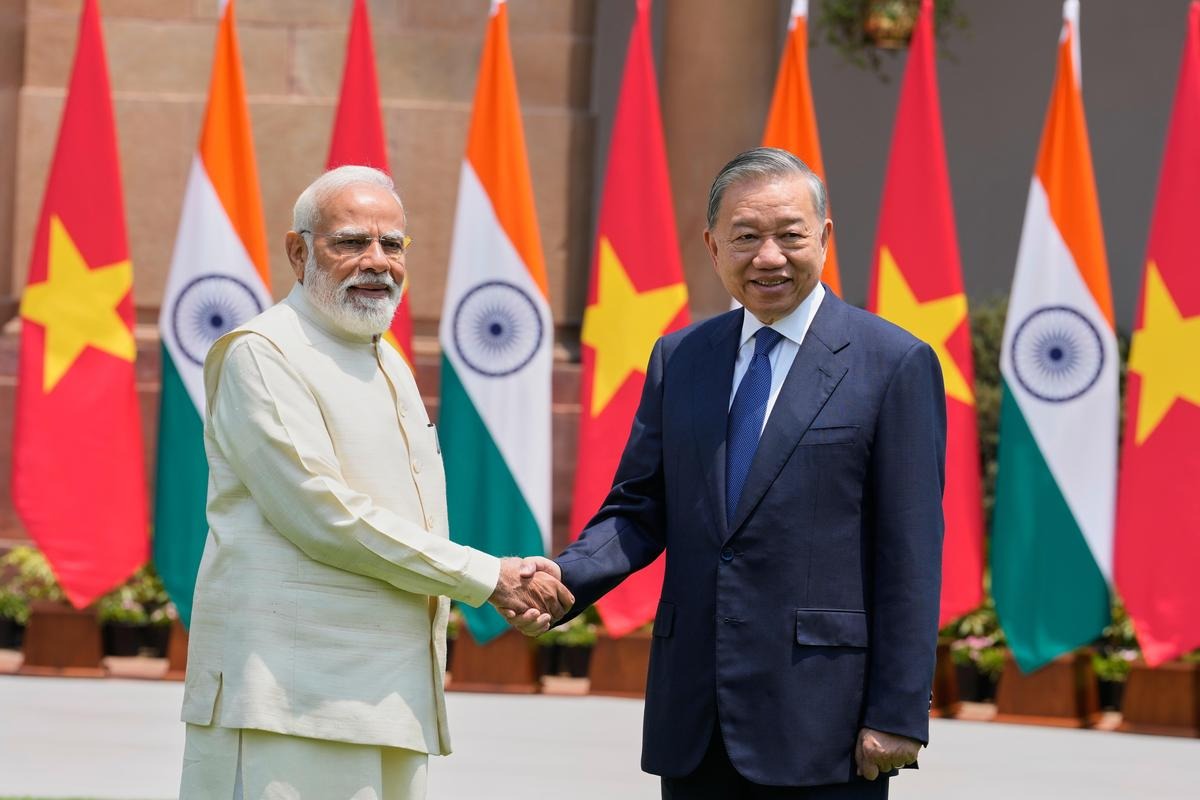
In a significant development, India has hosted the Vietnamese President and General Secretary of the Communist Party of Vietnam, To Lam. It is an important visit and comes at a time when India is trying to further increase its accessibility, diversify its relations, and expand its influence and engagement with Southeast Asian nations. Indian foreign policy under Prime Minister Narendra Modi has viewed Southeast Asia as a critical junction and has often referred to it as India’s extended neighbourhood.
At this important and crucial moment, both India and Vietnam have agreed to uplift and elevate their relationship to an Enhanced Comprehensive Strategic Partnership, marking an important milestone between the two countries. Prime Minister Modi stated that Southeast Asia, particularly Vietnam, is a major pillar of India’s Act East Policy and Vision MAHASAGAR. Prime Minister Modi further highlighted that both India and Vietnam share a common understanding and aspirations in the Asia-Pacific region.
Prime Minister Modi also highlighted that bilateral trade between India and Vietnam has reached $16 billion, and both countries aim to increase it to $25 billion within the next four years. In another important development, both India and Vietnam signed several major Memorandums of Understanding, including cooperation in critical minerals, a memorandum of understanding between the Reserve Bank of India and the State Bank of Vietnam on digital payments and payment systems, cooperation on artificial intelligence, and cooperation on radioactive and rare earth minerals.
Defence and security cooperation has emerged as a new pillar of cooperation between India and Vietnam, as India has greatly accelerated its relationship with the Southeast Asian nation. A major move was made in 2022 when India provided a massive $400 million defence Line of Credit to Vietnam. Both countries also expressed satisfaction regarding the implementation of the Mutual Logistics Support Agreement, the Memorandum of Understanding on submarine search and rescue support and cooperation, and the Letter of Intent on strengthening defence industrial cooperation.
In terms of security cooperation, it has further been decided that Vietnam will increase its cooperation with India’s National Security Council Secretariat. The strengthening of relations between India and Vietnam is advantageous for both countries, as both stand to gain significantly from this win-win partnership. Southeast Asia is important for India because India shares direct land connectivity with Southeast Asian nations. India and Southeast Asia also share strong historical and cultural commonalities, and India believes this commonality can work to its advantage. The geographical proximity between India and Southeast Asian nations further strengthens these efforts, which is why India has lately been boosting its relations with the region.
The Asia-Pacific has become a new frontier of geopolitical confrontation, where countries across the region are deeply interested in maintaining influence and strategic space. It is important for like-minded countries such as India and Southeast Asian nations to maintain common engagement and shared interests while avoiding any sort of concentration of power. One of the biggest common concerns between India and Vietnam has been China, as both countries have suffered from Chinese belligerence. Vietnam has long accused China of violating its maritime boundaries, and China’s increasing presence in the Asia-Pacific region is viewed as a major threat by Vietnam.
India’s policy towards Southeast Asian nations has also been highly strategic, as India has selectively boosted relations with countries that have historically shared differences with China. This is visible in India’s relationship with countries such as the Philippines and Vietnam. The Philippines is particularly significant because India has supplied BrahMos supersonic cruise missiles to the country, making the Philippines the first nation to receive such a sophisticated weapon system from India. India is also steadily increasing its defence cooperation with Vietnam, as both Vietnam and the Philippines continue to face Chinese pressure in the Asia-Pacific region.
For Vietnam, engagement with India is strategically advantageous because Vietnam understands that India is emerging as one of the next major forces in the global economy, with its GDP growth remaining significantly strong compared to many major economies. Vietnam has increasingly placed its strategic trust in India and wants to diversify and deepen its engagement with New Delhi in order to maintain a balance of power in the Asia-Pacific region.

Aayush Pal is a freelance writer on contemporary geopolitical developments. The views expressed in his work are entirely his own.
 Anjali Singh
  Archita Gaur