
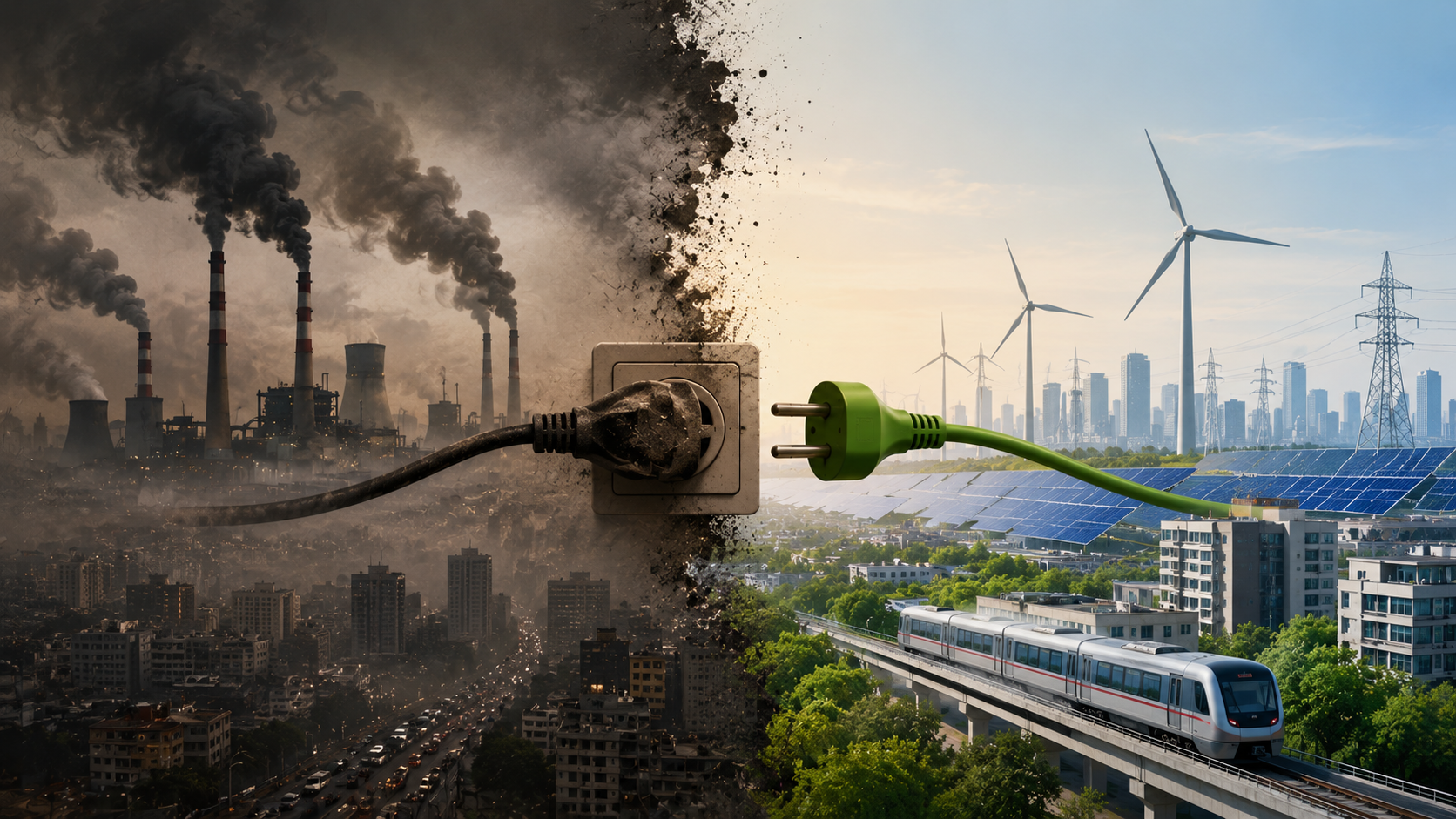
- Indian cities are suffering because the country’s power grid relies too much on coal.
- Urban India needs a steady supply of electricity, but the electricity that comes in often makes life in cities worse.
- India needs to close down its dirtiest power plants faster, keep a closer eye on emissions, enforce the rules more strictly, and make a real push for renewable energy along with storage, grid reform, and demand management.
- The real choice is between a future with less sickness and one with cleaner, more reliable energy. India needs to stop linking progress with coal dependence if it wants its cities to breathe.
Indian cities are suffering because the country’s power grid relies too much on coal. The country requires more electricity to run homes, factories, transport, and digital growth, but the way it is made pollutes the air, especially in cities and industrial areas where there are a lot of people.
People often talk about India’s energy story in terms of growth: more homes getting electricity, more businesses being inaugurated, and lights staying on longer. But there is a harder truth behind this success. The air in the country’s cities is still defined by a coal-heavy system that sees pollution as collateral damage and public health as a last resort.
Coal is an important part of India’s energy mix because it’s plentiful, well-known, and easy to work with politically. According to official information about the coal sector, coal is the main source of India’s energy needs and will continue to be as demand grows. That reasoning might explain why coal is still around, and it doesn’t make the cost any less. Every tonne that is burned releases a chain of pollutants that includes sulfur dioxide, nitrogen oxide, and carbon dioxide. These pollutants can travel far beyond the power plant’s boundaries.
The damage is most clear in and around cities. Recent reports say that coal plants near Delhi have gone years without strict emissions monitoring, even though the city is still dealing with severe air pollution. This is the main flaw in India’s development model. Urban India needs a steady supply of electricity, but the electricity that comes in often makes life in cities worse. Even though a city may seem to use clean electricity, the pollution is actually moved to coal belts, thermal corridors, and neighbourhoods downwind, where workers, children, and low-income people suffer the health effects. For a lot of people, the smoke is out of sight, but it never really goes away. The load is not shared equally. Communities in coal-mining regions are plagued by dust, fires, soil degradation, and unsafe working conditions, while urban populations suffer from the resulting air pollution. Reporting from Jharia, one of India’s most coal-affected areas, depicts a scene where underground fires, dust, and increased extraction continue to pollute the air and risk human lives. In consequence, India’s energy system generates a landscape of sacrifice: one set of communities sacrifices their land and lungs so that another set may keep the lights on.
This paradox is becoming increasingly difficult to conceal on a policy level. India has set a net-zero objective for 2070, although coal consumption and electricity expansion remain the primary focus of near-term planning. There is also evidence that the regulatory response was unequal. According to a recent analysis, most coal-fired power plants located outside of congested metropolitan zones are exempt from tighter emission-control rules, although compliance deadlines in urban areas have been extended for years. This method may lessen industry resistance, but it also means pollution measures arrive late, unevenly, and frequently only after public pressure has risen.
This creates a familiar cycle: cities breathe in bad air, regulators respond in bits and pieces, and coal keeps its structural edge. Renewable energy is growing, but it hasn’t replaced fossil fuels at the right rate yet. A transition on paper is not the same as a transition in the grid. Coal will continue to set energy prices and air quality as long as it has policy priority, transmission dominance, and the benefit of current investments.
There is also an ironic twist in the economy. People often say that coal is the best and cheapest choice. But when you add in pollution, health care costs, damage to the environment, and climate risks, it doesn’t seem so cheap anymore. The important question is not if India can pay for cleaner energy, but if it can pay for dirty power that keeps costing it money. A system that hurts millions of people is not efficient; it is just paid for by the suffering of the public.
It is not a mystery how to get out. India needs to close down its dirtiest power plants faster, keep a closer eye on emissions, enforce the rules more strictly, and make a real push for renewable energy along with storage, grid reform, and demand management. City planners also need to remember that air quality is part of energy planning, not something that can be done separately. A city can’t promise better public health if it keeps breathing in the pollution from coal-fired growth.
India doesn’t have to choose between cleaner air and growth. It needs to stop pretending that coal is the price of progress. The real test of its energy future is whether the country can provide power to its cities without polluting them. India’s energy future will not be determined by the number of megawatts added but by whether those megawatts can power a modern economy without making life worse for its citizens. People have thought of coal as an unavoidable part of development for far too long, even though the real costs have been paid by the lungs of city dwellers, the health of workers, and the environment in areas that are already too full. That deal is no longer possible.
There is a need for political strength instead of technical preparations to allow a real change to happen. India needs to do more than pursue its energy aspirations. It needs to make clean air, public health, and reliable electricity part of one policy agenda. This means an end to worse facilities, putting emissions standards in place as soon as possible, making storage and the grid more flexible, and putting money into energy efficiency so that demand growth doesn’t always mean more pollution. It also means admitting that the costs of doing nothing are going up every year and that urban India can’t keep paying for growth with smog.
We no longer have to choose between growth and reducing carbon emissions. The real choice is between a future with less sickness and one with cleaner, more reliable energy. India needs to stop linking progress with coal dependence if it wants its cities to breathe.

Anusreeta Dutta is a columnist and climate researcher with experience in political analysis, ESG research, and energy policy. Views expressed are the author’s own.
 Anjali Singh
  Archita Gaur