
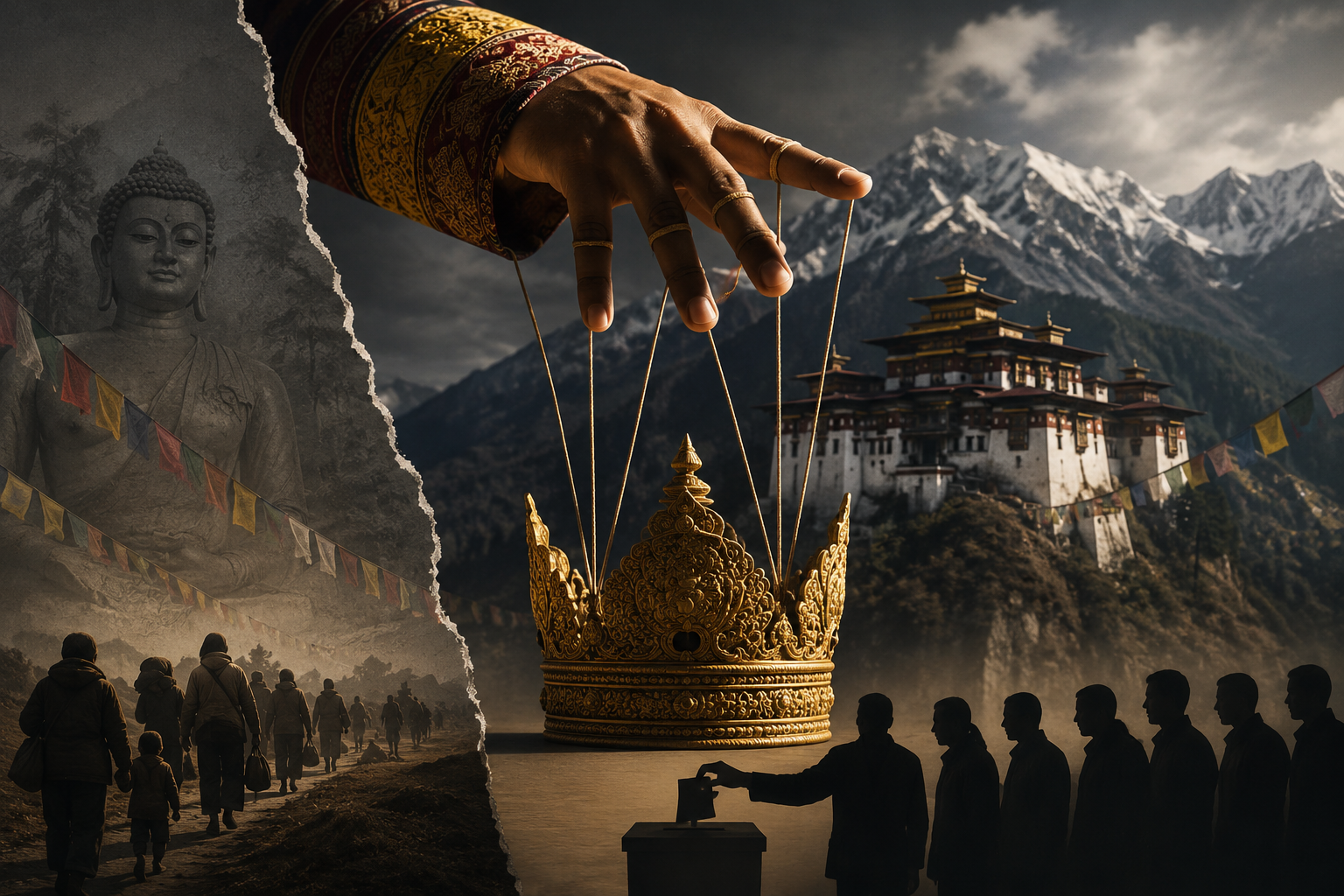
- The “transition” has largely failed even after close to two decades and multiple elections, as the democratic process is non-inclusive, particularly for the Lhotshampa (ethnic Nepali and Hindu) minority.
- Political parties in exile are banned from registering or contesting elections; only “natural born” citizens enjoy full political rights.
- Bhutan continues to promote the Drukpa Buddhist culture as the national norm while making it difficult to build non-Buddhist places of worship.
- Despite Bhutan becoming a constitutional monarchy in 2008, the King retains significant authority that undermines the essence of a parliamentary democracy.
Since the new Constitution came into force in 2008, Bhutan – a landlocked country in the Himalayas – has made a good show to the world of “transitioning to a constitutional monarchy and democracy”.
The “transition” has largely failed even after close to two decades and multiple elections, largely for the following reasons:
Exclusion of the Lhotshampa minority
The democratic process is non-inclusive, particularly for the Lhotshampa (ethnic Nepali and Hindu) minority. Over 1 lakh Lhotshampas were displaced during the 1980s and 90s due to discriminatory citizenship and cultural policies of the Bhutanese royal family-led ruling elite. Their rights and reconciliation efforts have largely been unsuccessful, even after the new constitutional order came into force.
Restrictions on political parties and voting rights
Political parties in exile (especially those representing the Lhotshampas) are banned from registering or contesting elections, ensuring the system remains dominated by pro-monarchy entities, thus reinforcing the majoritarian character of the polity.
Only “natural born” citizens enjoy full political rights, a provision that violates democratic equality and targets those with Nepali/Hindu origins.
Thus, the integrity of the elections held in Bhutan is doubtful.
Emphasis on Buddhist majoritarianism
In the late 1980s, Bhutan introduced policies aimed at cultural unification that have been continued after 2008. Some of those policies are:
- Promotion of only the Drukpa Buddhist culture as the national norm.
- Mandatory dress code with Buddhist origins (‘gho’ for men, ‘kira’ for women).
- Emphasis on the Dzongkha language – a language of the Buddhist majority.
- Bhutan continues to place limits by making it difficult to build non-Buddhist places of worship.
- Too much power in the monarch’s hands
Despite Bhutan becoming a constitutional monarchy in 2008, the King (currently Jigme Khesar Namgyel Wangchuck) retains significant authority that undermines the essence of a parliamentary democracy. He can block bills passed by parliament, dismiss the Prime Minister and the rest of the Cabinet, and nominate 20% of the members of the National Council – the upper house of the Bhutanese parliament. The king remains above the law, enjoying both civil and criminal immunity.
All this, however, does not obscure the impressive fact of economic growth achieved by Bhutan since 2008 – only the fruits of it are almost exclusively enjoyed by the Buddhist majority.
Therefore, it can be safely concluded that the 2008 “transition” was neither genuine nor successful in any sense of the two terms.

Vinay N. Bhushan is an Assistant Professor at Bangalore University and Shilpa D. is the Senior Content Editor of kannadaprabha.com in Bengaluru
 Anjali Singh
  Archita Gaur