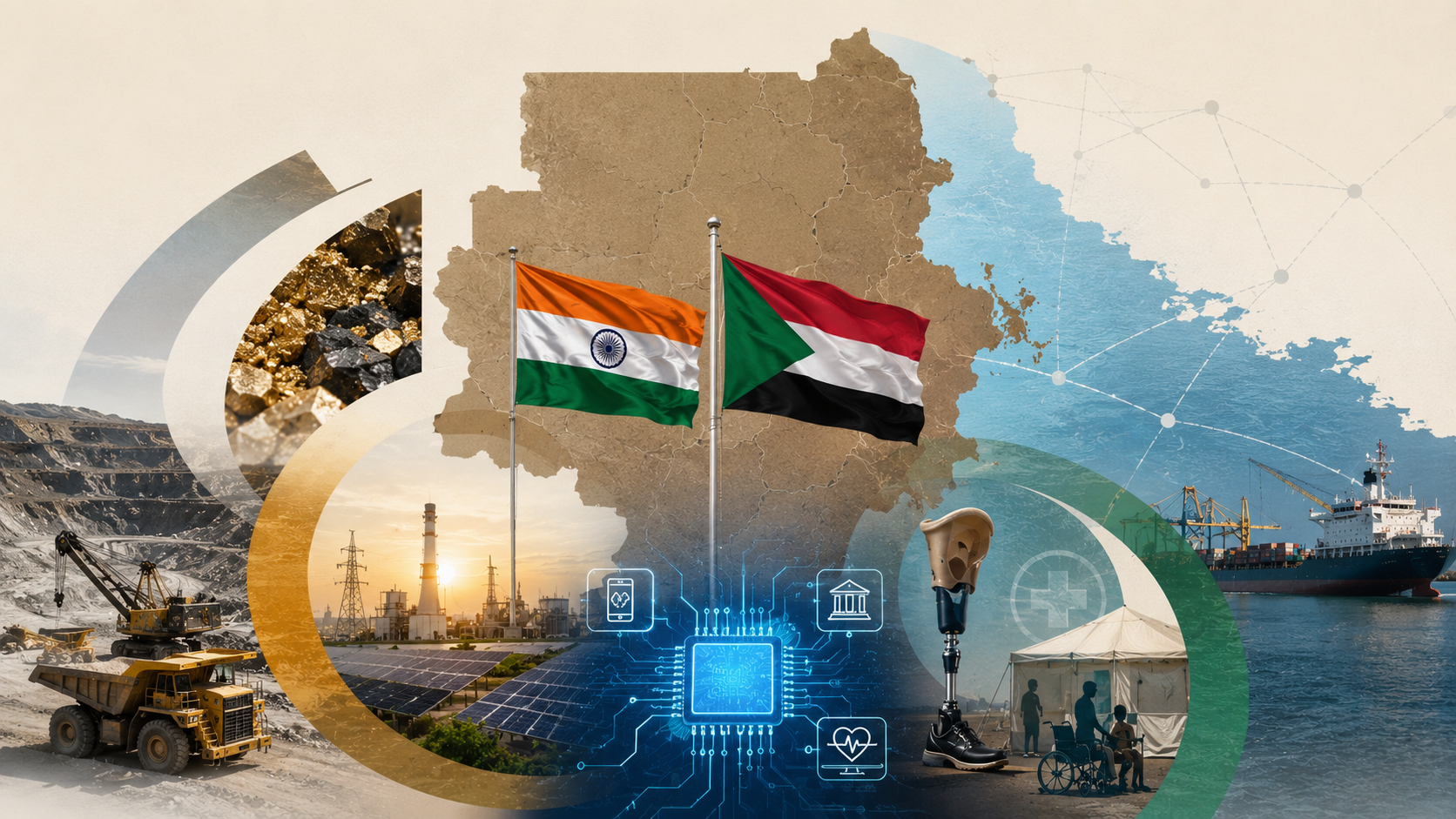
- The 9th Foreign Office Consultations (FOC) between India and Sudan, which took place in Port Sudan on May 4, 2026, were an important step in strengthening the relaunch of diplomatic relations between both countries after a period of hiatus.
- In 2026, one of the major talking points during consultations was the growing bilateral cooperation regarding the extractive industries and energy sectors.
- The addition of Digital Public Infrastructure (DPI) in the 9th FOC reflects the contemporary development of relations between India and Sudan.
- The Port Sudan meeting encompasses more than just bilateral trade; it also encompasses broader geopolitical factors surrounding the Red Sea region’s balance of power.
The 9th Foreign Office Consultations (FOC) between India and Sudan, which took place in Port Sudan on May 4, 2026, were an important step in strengthening the relaunch of diplomatic relations between both countries after a period of hiatus. Given that Sudan is currently in the midst of an extremely complex and challenging internal transition and reconstruction effort, the location of the FOCs at Port Sudan – a strategically located Red Sea port – reflects the strength of the bilateral partnership. The FOCs were presided over by senior officials from both countries and provided for an extensive review of the three main pillars of the India-Sudan bilateral relationship: political, economic and humanitarian. These consultations signified India’s long-term commitment towards the promotion of stability and development in Sudan.
Strategic Economic Interests: Mining and Energy
In 2026, one of the major talking points during consultations was the growing bilateral cooperation regarding the extractive industries and energy sectors. Sudan has a wealth of untapped minerals, such as gold, iron ore and copper, that meet India’s increasing need for critical minerals and other industrial raw materials. In light of these discussions, there was a concerted effort to create formal partnerships to enable Indian companies to use their technical expertise and sustainable practices in the area of mining in Sudan. As for energy, the discussions also progressed beyond the traditional definitions of hydrocarbons (where ONGC Videsh has been involved historically in a substantial way); instead, this portion of the talks focused on renewable energy and power infrastructure projects. An example is Kosti Power Plant, where India has a vested interest (through its participation) that serves as a prototype for how to work together in modernising Sudan’s overall national grid, which is very important for any sustainable economic recovery.
Digital Public Infrastructure and Tech Transfer
The addition of Digital Public Infrastructure (DPI) in the 9th FOC reflects the contemporary development of relations between India and Sudan. As part of its growing use of the “India Stack” for South-South cooperation, India has highlighted its ambition to help Sudan develop a sustainable digital economy by inviting discussions on DPI as part of the recent consultations. Areas for potential cooperation include digital payments, e-governance, and telemedicine – all of which are extremely important for a country that is trying to decentralise its services while providing access to previously underserved populations. Therefore, this ‘tech-diplomacy’ will lead to efficient economic cooperation but will also strengthen the institutional capacity of the Sudanese state during the reconstruction process.
Humanitarian Leadership and the “Jaipur Foot” Legacy
During the meetings, Sudan specifically acknowledged and praised India for its assistance in responding to humanitarian needs. An example cited by Sudan was the “Jaipur Foot” (an Indian humanitarian initiative aimed at addressing the mobility challenges faced by thousands due to conflict) through the establishment of prosthetic limb camps, which have successfully improved mobility for thousands of Sudanese. As such, the camps are not simply a means to receive medical care but are examples of “people-centred” diplomacy and demonstrate how much goodwill can be created at the grassroots level. In addition to providing prosthetics, India’s provision of life-saving medications, as well as being a destination for Sudanese patients to receive advanced medical interventions, has earned it the reputation of being a “first responder” and a trustworthy partner in the health care field.
Regional Stability and Geopolitical Significance
The Port Sudan meeting encompasses more than just bilateral trade; it also encompasses broader geopolitical factors surrounding the Red Sea region’s balance of power. For India, an accessible and amicable Sudan is important for maritime security and providing safe passage to maritime commerce through shipping routes. The consultations addressed additional shared concerns surrounding security (including measures against terrorism) and stability in East Africa (the Red Sea region). By continuing a forward military posture and maintaining active diplomatic engagement at Port Sudan, India reinforces its status as a regionally stabilising power within the Global South. As evidenced by both parties’ reassertion of their commitments at the 9th FOC, both countries regard their relationship as a strategic necessity and their partnership as more than just a transactional exchange.
References :
- Ministry of External Affairs (MEA): India: Ninth round of India-Sudan Foreign Office Consultations
- Sudan Tribune: Sudan, India agree to bolster economic ties and counter-terrorism efforts
- Embassy of India, Khartoum (Historical Context) India-Sudan Political Relations

Hridbina Chatterjee is a final-year postgraduate student in International Relations at Jadavpur University, Kolkata. She has written for newspapers and think tanks, with interests in South Asian politics, India’s foreign policy, and the Indo-Pacific. Views expressed are the author’s own.
 Anjali Singh
  Parag Gilada