
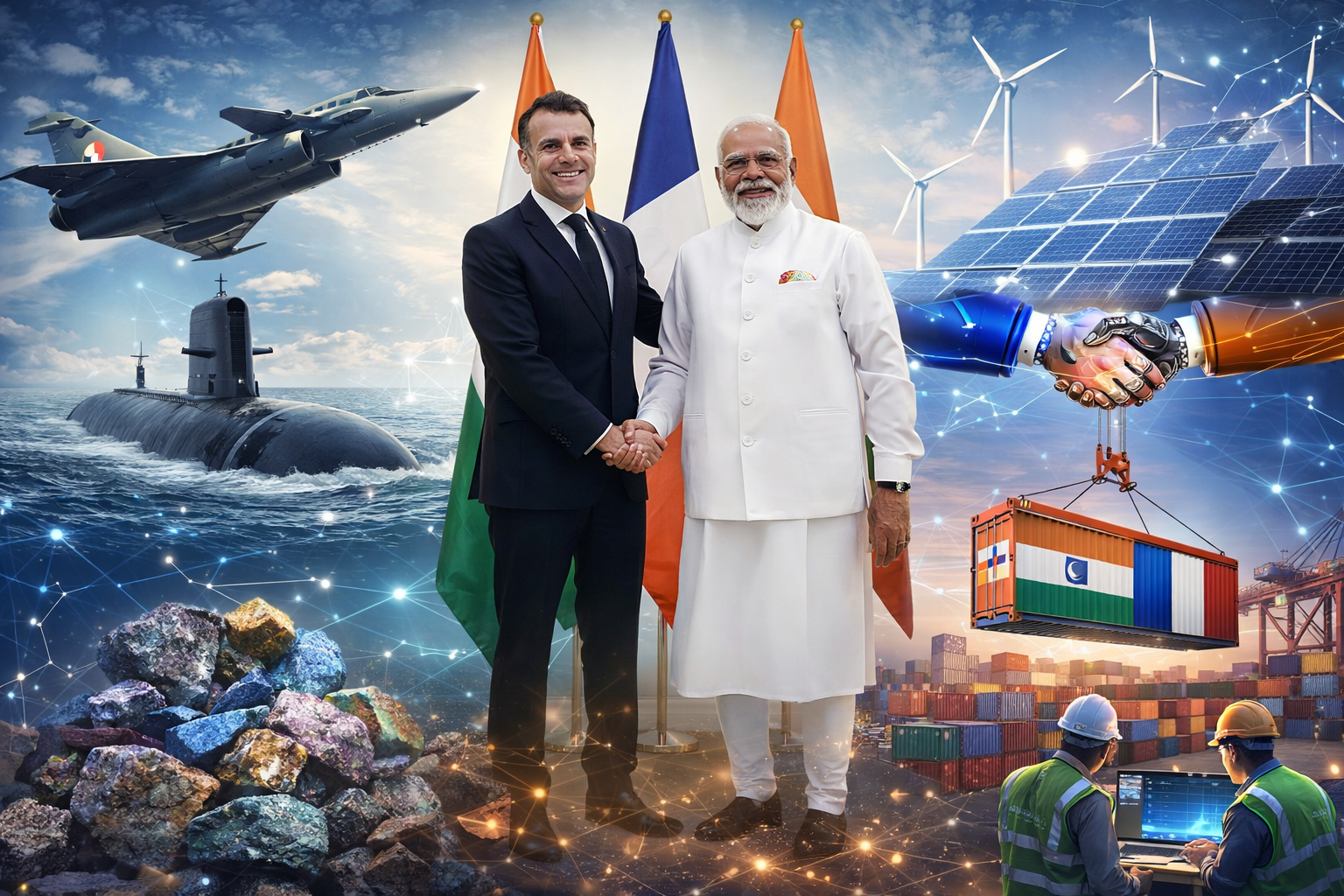
- India and France raised the bilateral relationship to a Special Global Strategic Partnership when President Emmanuel Macron paid a state visit to India.
- The transition to a Special Global Strategic Partnership is an indicator that both nations are interested in making bilateral cooperation institutionalised in the long term based on mutual trust, common values, and convergence of the strategies.
- The partnership undertakes to cooperate in clean energy transitions, such as increased civil nuclear energy co-operation and purchase of supply chains of essential critical minerals to advanced manufacturing and green technologies.
- The fact that India-France relations have been upgraded to a Special Global Strategic Partnership has far-reaching consequences for India’s long-term strategic independence and positioning in the world.
India and France officially raised the bilateral relationship established over a long period of time to a Special Global Strategic Partnership on 17 February 2026 when the French President Emmanuel Macron paid a state visit to India. This milestone is an indication of decades of development of cooperation, which now cuts across traditional diplomatic models into the areas of strategy, technology, economy, and global governance. The upgrade represents a qualitative change of relationships not only between the two countries but also to the wider regional and international strategic structures. India and France have had a cordial relationship stretching to the middle of the 20th century, with official diplomatic relations being established shortly after the independence of India in 1947. India’s first strategic partnership with France and France was the first country to enter into a strategic partnership with India out of the European Union, with the initial strategic partnership launched on 26 January 1998. The relations have since continued to improve in the areas of defence, technology, civil nuclear energy, space, and cultural interaction.
This alliance has endured international geopolitical winds over the years and has moved with new strategic interests of India towards technological competence, developing dynamics of the Indo-Pacific and the Indian involvement in bilateral peace processes through international forums such as the International Solar Alliance. The transition to a Special Global Strategic Partnership is an indicator that both nations are interested in making bilateral cooperation institutionalised in the long term based on mutual trust, common values, and convergence of the strategies.
Elevation 2026: Resulting Outcomes and Framework
The heightening of the relationship was institutionalised amidst the context of multi-faceted accords and collaborative structures that were reached during the visit of President Macron to India between 17 and 19 February 2026. Prime Minister Narendra Modi and President Macron launched the India-France Year of Innovation 2026 in Mumbai and held high-level discussions on defence, technology, climate, and world governance.
- Defence and Co-Production
The relationship continues to be anchored on defence. Both parties accepted the fact that the scope of cooperation has greatly extended beyond mere procurement to the area of co-development and co-production of advanced defence systems. It is planned to jointly produce Rafale fighter jets, expand submarine partnership, and do more joint work on helicopter and missile technologies, including a new assembly line of H-125 helicopters in Karnataka and a JV between Bharat Electronics Limited and Safran in HAMMER missiles. Plans to jointly produce a maximum of 90 out of 114 new Rafales as a joint venture in India were explicitly outlined by President Macron, a move that would fit into the objectives of India to have a local manufacturing capability on its own indigenous defence production and the Make in India vision.
- Innovation, Technology and AI
One of the aims of the partnership is the improvement of joint innovation ecosystems. The goal of the India-France Year of Innovation is to promote partnership in the fields of artificial intelligence (AI), digital sciences, biotechnology and advanced materials. The creation of the Indo-French Centre on AI in Health and networks of new innovations to startups and research institutions are indicators of a move towards a common technological leadership.
- Energy, Climate and Critical Minerals
The partnership undertakes to cooperate in clean energy transitions, such as increased civil nuclear energy co-operation and purchase of supply chains of essential critical minerals to advanced manufacturing and green technologies. This co-operation fills strategic weak points in intercontinental supply chains and contributes to the climate aims of both countries.
- Trade, Economic Security and Connectivity
On top of the usual diplomacy, France had also signed the recently reached India-EU Free Trade Agreement that is likely to enhance economic relationships and provide France a passage to Indian companies in Europe. Macron pointed out areas such as high-speed rail, renewable energy and infrastructure as areas of future cooperation.
- Human-to-human and cultural interaction
Both nations stressed enhancing people-to-people relationships, such as increased educational contacts (e.g. up to 30,000 Indian students a year by 2030 moving to France) and collaborations in the fields of culture research and creative industry. The objectives of these engagement platforms are to create long-term societal connectivity outside the governmental institutions.
Significance for India: Strategic Autonomy and Global Impact
The fact that India-France relations have been upgraded to a Special Global Strategic Partnership has far-reaching consequences for India’s long-term strategic independence and positioning in the world. To begin with, it reinforces the Indian quest to diversify its strategic alliances in a more polarised global system. The further involvement with France as one of the strongest European powers with a tradition of independent foreign policy strengthens the position of India in European strategic schemes without any sacrifice of its doctrine of multi-alignment. This unity will alleviate the overreliance on any one of the global players and will help India to maintain its long-term strategic independence promise. Modes of convergence in geopolitical interests through the focus on defence cooperation, critical technologies, climate action, and Indo-Pacific coordination strengthen the leverage of India in multilateral forums. France, in a way, is a trustworthy European albatross to the global ambitions of the Indian country.
Second, the alliance contributes greatly to the national change objectives of India. This change of defence procurement into co-design and co-production is a direct contribution to the Atmanirbhar Bharat initiative, which reinforces the local manufacturing base, establishes highly skilled jobs, and incorporates the Indian companies into the global defence supply chains. Indian institutions can access cutting-edge research environments through cooperation in artificial intelligence, space, digital infrastructure, and advanced materials to speed up technological leadership and innovation. Along with this, clean energy transitions and critical mineral supply chains contribute to economic resilience and security in the supply chain in the era of geopolitical shocks through collaborative work. Lastly, it is important to note the common values to be responsible as a global citizen by engaging both France and India in multilateralism, democracy, and a rules-based international order. All these dimensions put India in a long-term strategic and economic development.
The Long-Term Implications
Although the partnership is ambitious, its success requires implementation. Issues such as aligning bureaucracy, controlling export regimes in high-technology industries, and handling larger geopolitical uncertainties (e.g. relations with other world powers) are some of the challenges. Moreover, the realisation of the objectives of economic cooperation, including trade expansion, will entail the need to have strong institutions to support cross-border investment and regulatory congruence. That said, the described frameworks indicate that both parties are keen on using political will to overcome these obstacles and make the partnership fulfil its potential.

Lipun Kumar Sanbad has an MA in Politics and International Studies from Pondicherry University. He specialises in global affairs and strategic studies. He has published research in the International Journal of Legal Studies and Social Sciences and presented at various conferences. Views expressed are the author’s own.
 Dr Mohmmad Rizwan
  Parag Gilada
  Archita Gaur