
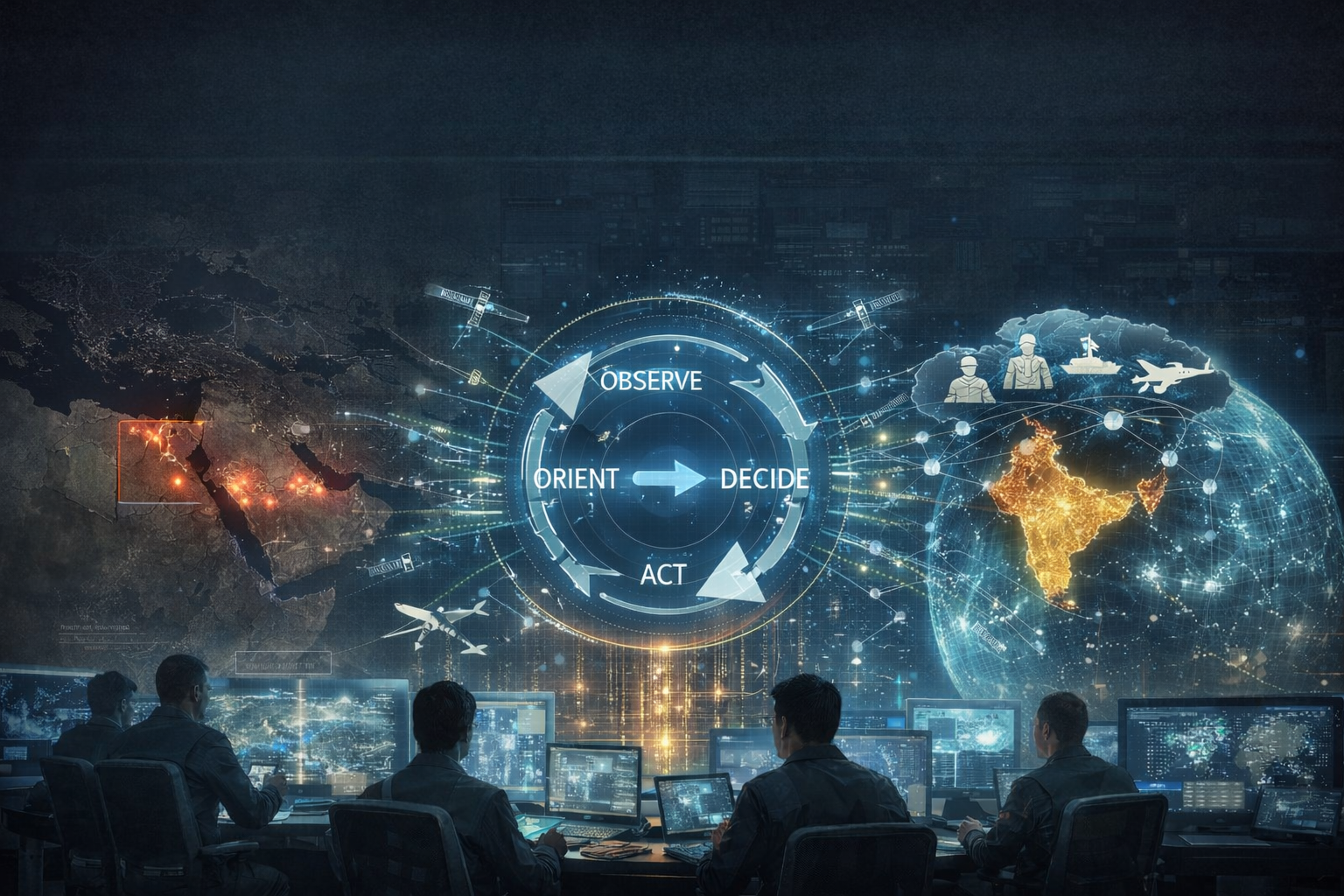
- After the U.S. launched precision strikes on 28th February, middle power nations like India have no choice but to pay more attention towards an invisible architecture behind this operation, i.e. artificial intelligence.
- AI systems compress the Observe–Orient–Decide–Act (OODA) loop, providing commanders with faster and more granular assessments of targets, collateral risk, and adversary intent.
- The world is no longer divided between nuclear and non-nuclear powers, but into AI-empowered and AI-dependent states.
- India needs a unified tri-service AI command architecture that integrates Army, Navy, and Air Force data ecosystems into a shared operational cloud.
As the world’s attention is drawn towards the ongoing escalation, deterrence, and the effects of the regional fallout after the United States and Israel attacked Iran, decapitating its senior leadership, in the background, a development has taken place. In the fog of war, there is now a major development few are talking about, but those who run the power corridors of national security must be paying a lot of attention.
After the U.S. launched precision strikes on 28th February, middle power nations like India have no choice but to pay more attention towards an invisible architecture behind this operation, i.e. artificial intelligence. As more news emerges, it is clear that the U.S. used AI-enabled systems to plan, execute, and conduct Operation Epic Fury over Iran. And with that, AI is now no longer an experimental adjunct to military power. They are now embedded and part of the command chain itself.
When AI was science fiction to many, the U.S government started Project Maven for its military to have an AI ecosystem that matured and is now part of its decision-support backbone capable of ingesting satellite imagery, signals intelligence, drone feeds, and cyber telemetry in real time. The program marked a turning point in operationalising AI for combat support, reducing decision-making time while retaining human oversight.
Project Maven was launched in 2017 by the U.S. Department of Defence as an initiative designed to integrate artificial intelligence into military operations. Its primary aim was to help analysts manage the enormous volume of surveillance drone footage generated in conflict zones. And by the results we have seen, it is clear that the machine learning algorithms, Maven, automatically identify and classify targets such as vehicles and individuals, significantly accelerating intelligence analysis.
However, Maven has evolved and is no longer an ISR (Intelligence, Surveillance, Reconnaissance) optimisation tool, but it has progressively migrated into a broader multi-domain battle network architecture. Already, work has been put to integrate it into wider command-and-control frameworks and aligned with initiatives like Joint All-Domain Command and Control (JADC2), so it can directly contribute to sensor fusion, target prioritisation, cross-domain coordination, and decision-support pipelines. The idea is to have a process in place wherein a real-time picture of the theatre will allow commanders accelerated kill chains.
As of now, AI systems do not have the autonomy to “pull the trigger” in conventional strike operations, but what they do is they compress the Observe–Orient–Decide–Act (OODA) loop, providing commanders with faster and more granular assessments of targets, collateral risk, and adversary intent. The emergence of agentic AI systems—capable of multi-step reasoning, scenario generation, and adversarial simulation—marks a doctrinal shift. These systems can run thousands of war-gaming permutations, stress-test escalation pathways, and generate probabilistic forecasts in near real time. Despite early controversy over private-sector involvement, Project Maven has since expanded into broader multi-domain military AI applications.
That is why the world was surprised by how quickly the U.S., along with Israel, managed to locate and kill so many senior leaders of the Iranian Islamic regime. Every hour, there was a new development wherein one can only make an educated guess that in a theatre as complex as the Gulf, where Iranian proxies operate across multiple domains, speed and informational clarity are decisive for precision strikes.
AI’s ability to fuse disparate data streams allows planners to simulate potential responses and counter-responses within minutes rather than hours. In strategic terms, the U.S. now has total domination when it comes to managing the escalation ladder. Meaning it can be the difference between a limited strike amid the prospect of a war that can go spiralling into a regional war.
Three Principal Functions of AI in Modern Warfare
Situational Awareness: World War two was won on mobility, but there was a problem as they were overwhelmed with information, leading to delayed action. That is why in the modern contemporary battlefield, one cannot afford to be overwhelmed with data. All information, no matter the quantities of data, from drones, satellites, electronic intercepts, cyber sensors, and open-source feeds can now be analysed and passed on to humans to decide action because it is simply not possible for human analysts to process this volume at operational tempo. AI systems have solved this problem as they are capable of identifying anomalies, classifying threats, and creating dynamic common operating pictures for commanders.
Predictive Analytics: By modelling adversary behaviour patterns, logistics chains, and historical escalation patterns, AI helps estimate probable enemy actions. While no algorithm can eliminate uncertainty, predictive modelling sharpens decision-making in a fast and dynamic battle.
Information Warfare and Perception Management: Conflicts are fought not only in the physical domain but also in the digital domain. AI-generated disinformation, synthetic media, and automated bot amplification can distort narratives at scale. In the US–Iran context, online ecosystems were flooded with competing claims, some machine-generated, blurring the boundary between fact and fabrication. The battlefield now includes cognition itself. Deepfakes are weaponised to shape perceptions, overwhelm truth, and create epistemic uncertainty.
The Strategic Divide: AI Haves and Have-Nots, the new Dependency
The Industrial Revolution allowed the West to dominate and subjugate the world. The tech divide, even today, is the Achilles heel of the Global South. Just as the third world countries were getting close to internet technology, the US–Iran episode has again underscored an uncomfortable reality: we are entering an era of AI stratification.
This divide mirrors earlier technological inflexion points—nuclear weapons in the mid-20th century, precision-guided munitions in the 1990s, cyber capabilities in the 2000s. Nations capable of developing, deploying, and securing advanced AI systems will enjoy a structural advantage in deterrence with the power of coercion. Those without indigenous capacity will become dependent and vulnerable to supply chain disruptions, sanctions, and again lose their sovereignty or suffer technological denial.
But AI is more pervasive. It influences logistics, intelligence, targeting, training simulations, electronic warfare, and strategic communications. It is not a single weapons system; it is an enabling substrate across all systems. For a middle power like India, the stakes are existential. Military power is no longer defined solely by weapons platforms like tanks, aircraft carriers, and fighter squadrons—but by the integration of those platforms into AI-enabled networks.
Why India Cannot Be a Spectator
India faces a two-front security challenge in the East and in the West amid persistent grey-zone tactics from adversaries. Drone incursions, electronic warfare, cyber probing, and information manipulation like deepfakes are already realities. In such an environment, lagging in AI integration would impose a systemic disadvantage.
Encouragingly, India has begun building an AI-enabled defence architecture. Systems like Akashteer—an automated air defence control and reporting system—are designed to integrate radar feeds and streamline engagement decisions. The broader defence modernisation push under initiatives such as Atmanirbhar Bharat reflects recognition that strategic autonomy requires technological depth. India produces world-class AI researchers, many of whom contribute to Silicon Valley firms. Retaining and redirecting this expertise toward national security applications is a strategic imperative.
India needs a unified tri-service AI command architecture that integrates Army, Navy, and Air Force data ecosystems into a shared operational cloud. Lieutenant General Raj Shukla (Retd), former GOC-in-C of Army Training Command (ARTRAC) and Member of the UPSC, has strongly advocated for the rapid, structured modernisation of India’s defence capabilities through Artificial Intelligence (AI) and Civil-Military Fusion (CMF). Gen Shukla, in his book Civil-Military Fusion as a Metric of National Power and Comprehensive Security, writes, “Civil-military fusion is not just coordination; it must become the core metric of India’s national power, driving innovation, indigenisation, and comprehensive security.”
Conclusion
Deterrence is now algorithmic in state of play, and those who have the power to calculate adversary intent not merely through human intelligence but through predictive models will be able to shape outcomes as per their desire. Outcomes of conflicts will depend on digital demonstrations of capability,y and the US–Iran confrontation offers a preview of this future. The most consequential element of all the strikes carried out was not the ordnance deployed but the invisible computational layer that informed it. AI is now the command centre.
For India, AI self-reliance will define the next hierarchy of power. Nations that master algorithmic warfare will shape norms, set standards, and control escalation dynamics, and we cannot be at the mercy of others’ decision cycles as we face our jet engines. The world is no longer divided between nuclear and non-nuclear powers, but into AI-empowered and AI-dependent states. India is already a nuclear power, and it simply cannot afford to fall behind in AI.

Balaji is a freelance writer with an MA in History and Political science and has published articles on defence and strategic affairs and book reviews. He tweets @LaxmanShriram78. Views expressed are the author’s own.
 Aayush Pal
  Anjali Singh
  Anusreeta Dutta