
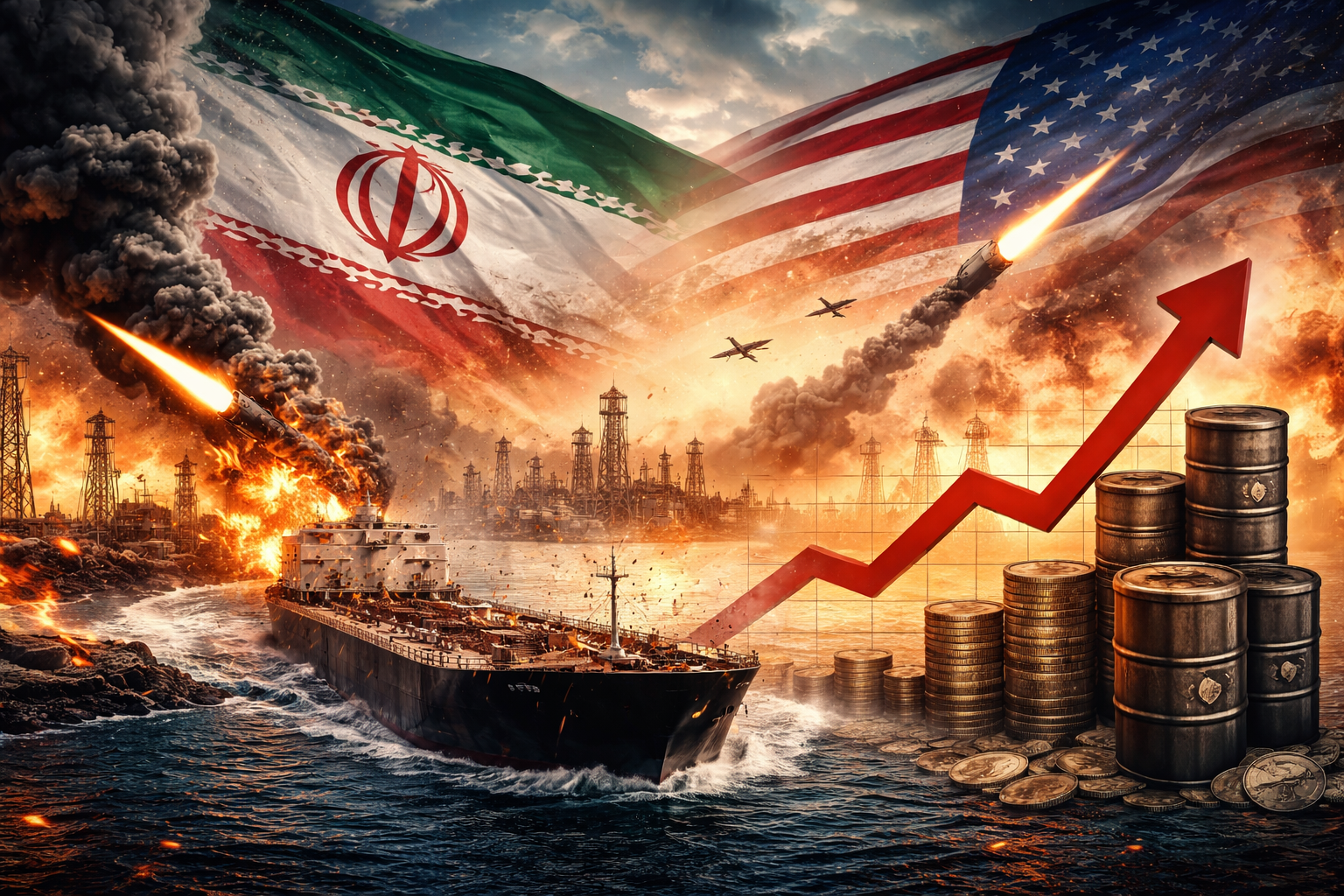
- Washington aims to deter Tehran from intensifying attacks on oil facilities or cutting off vital sea lines of communication by threatening massive reprisal.
- Oil prices have surged due to even minor interruptions, temporarily reaching $120 per barrel before levelling out at about $90.
- A worldwide economic shock akin to past energy crises could occur if the conflict spreads or threatens the Strait of Hormuz.
As the conflict between Iran, the United States, and Israel moves into its second week, it is changing not only the security landscape in the Middle East but also the prognosis for the world economy. Concerns that the conflict might lead to more widespread unrest are growing as a result of rising energy costs, supply disruptions, and Washington’s increasing rhetoric.
U.S. President Donald Trump recently issued a warning that the United States would retaliate “twenty times harder” if Iran attempted to obstruct oil flows through the Strait of Hormuz. Following combined U.S.-Israeli operations that assassinated Iran’s Supreme Leader Ali Khamenei and targeted Tehran’s nuclear and military sites, Iran launched missile and drone attacks against Gulf infrastructure and shipping routes.
From an international relations perspective, Trump’s warning represents an example of a traditional deterrence tactic grounded in realist theory. Washington aims to deter Tehran from intensifying attacks on oil facilities or cutting off vital sea lines of communication by threatening massive reprisal. Deterrence, however, also raises the possibility of a security dilemma, in which an endeavour by one party to improve security prompts retaliation from the other. There are concerns that confrontational rhetoric could harden attitudes rather than encourage de-escalation, particularly as Iranian leaders have already stated that they are ready for a protracted conflict.
The impact on the economy is already being felt outside of combat zones. The Strait of Hormuz is one of the most significant energy chokepoints in the world, with about one-fifth of the world’s oil supply passing through it. Oil prices have surged due to even minor interruptions, temporarily reaching $120 per barrel before levelling out at about $90. Increased energy prices are now contributing to worldwide inflation and endangering the precarious post-pandemic economic recovery.
International organisations caution that persistent increases in energy prices could slow economic growth and boost global inflation. Particularly at risk are economies that rely significantly on imported energy, such as those of many European nations, Japan, and India. On the other hand, nations that export energy, like the US and Norway, would profit from higher prices.
The conflict also demonstrates how economics and geopolitics interact in contemporary warfare. In addition to oil, the Middle East provides essential resources for the manufacture of semiconductors, including ammonia, fertiliser inputs, and helium. Supply chain disruptions might exacerbate the economic strain already brought on by trade disputes and volatile financial markets.
Trump has hinted that the war would be a “short-term excursion,” but experts caution that the global consequences might be far longer-lasting. A worldwide economic shock akin to past energy crises could occur if the conflict spreads or threatens the Strait of Hormuz.
In the end, the crisis highlights a key finding of international relations theory: armed confrontations seldom stay on the battlefield. Regional conflicts can have an immediate impact on the world economy through supply lines, energy markets, and strategic alliances.

Anjali Singh is a postgraduate student of Political Science and International Relations, a Social Media Analyst, and a former Research Intern at the Indian Council of World Affairs. Views expressed are the author’s own.
 Archita Gaur
  Divyanka Tandon
  Aayush Pal