
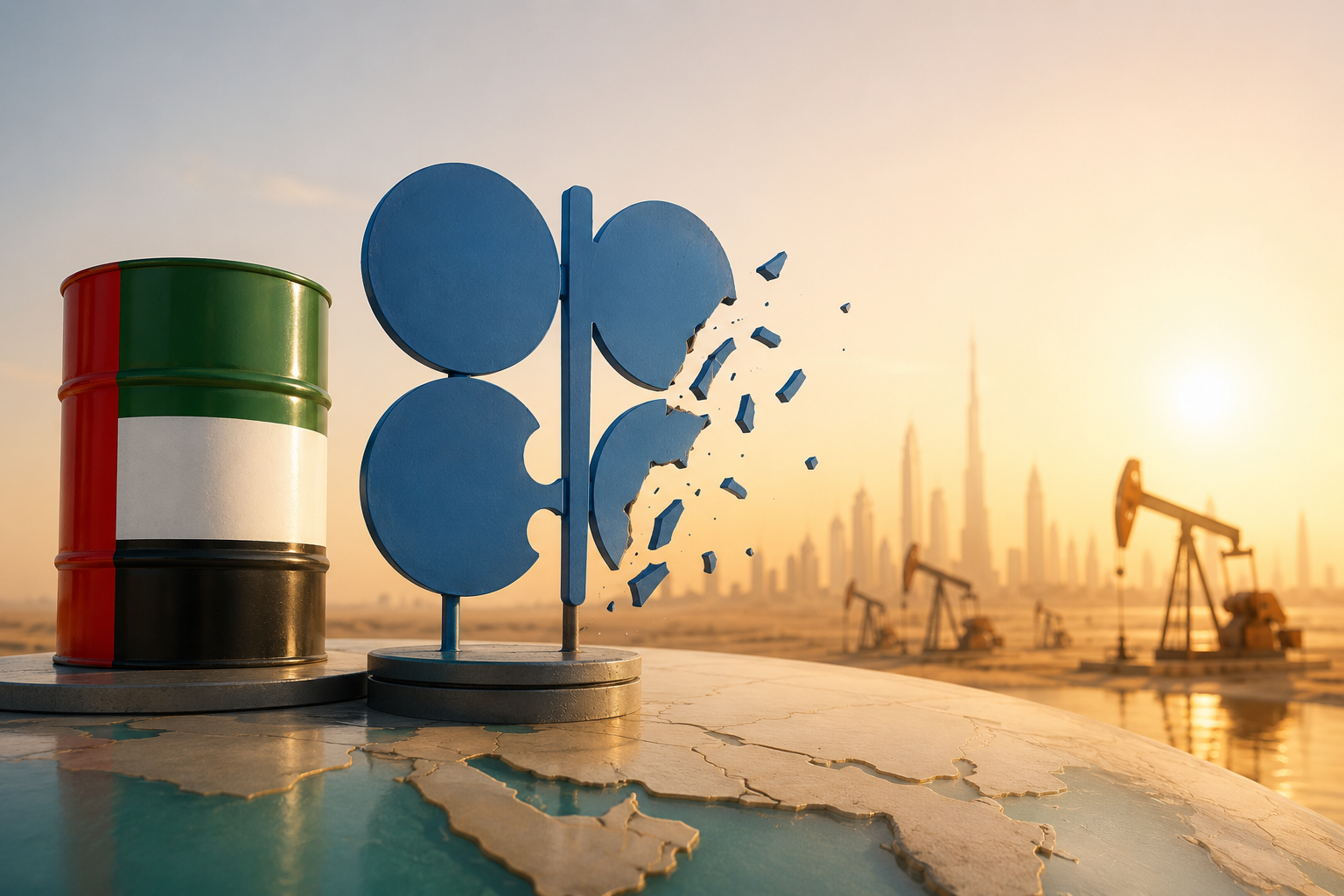
- The UAE’s shift likely reflects a broader objective of maximising returns from its hydrocarbon reserves before global fossil fuel demand begins to decline more sharply.
- Rather than remaining bound by Saudi-dominated OPEC arrangements that constrain its production and revenues, Abu Dhabi appears to be opting for greater strategic autonomy.
- Jorge León, a former OPEC official, has argued that the cartel would become “structurally weaker” without the UAE, particularly given the concentration of spare production capacity among a small number of members.
- From once playing a role akin to a central bank for the global oil market to now striving to maintain internal cohesion, OPEC has traversed a remarkable trajectory.
The global oil landscape has been marked by yet another major development this year. The United Arab Emirates (UAE) bid adieu to the Organisation of the Petroleum Exporting Countries (OPEC) after a decades-long partnership with the world’s most influential energy alliance. This dramatic departure carries implications that go far beyond the immediate headlines.
OPEC was established during the Baghdad Conference held in Iraq in September 1960 by Iran, Iraq, Kuwait, Saudi Arabia, and Venezuela. The UAE joined the organisation in 1967. In accordance with its Statute, OPEC’s mission is to coordinate and unify the petroleum policies of its member countries and ensure the stabilisation of oil markets. In 2016, when oil prices were particularly low, OPEC joined forces with 10 other oil producers, including Russia, to create the wider OPEC+ alliance. According to the US Energy Information Administration (EIA), OPEC+ produces roughly 40% of the world’s crude oil and accounts for nearly 60% of internationally traded petroleum.
The international oil market in the 1960s was dominated by the “Seven Sisters” multinational oil companies. OPEC’s formation came as a coordinated response to these Western oil giants, which controlled vast oil reserves in West Asia and leveraged their influence to dictate prices in ways that served their domestic economic interests. The 1970s marked OPEC’s rise to international prominence as its members gained control over their oil industries through nationalisation. The 1973 oil embargo, imposed in the context of the Yom Kippur War, significantly enhanced both the financial strength and geopolitical leverage of OPEC member states. The Iranian Revolution in 1979 further reinforced the vulnerabilities of oil-dependent developed economies.
These crises led OPEC to institutionalise two key tools: production quotas and spare production capacity.
Production quotas assign output limits to member states in order to regulate supply in accordance with market conditions. While intended to protect against price crashes, they also provide a financial cushion for member states during periods of uncertainty. However, it is these very production quotas that the UAE has historically viewed as restrictive, as they cap output below the country’s actual production capacity.
This becomes particularly significant because the state-owned Abu Dhabi National Oil Company (ADNOC) has set a target of increasing the country’s maximum sustainable crude oil production to five million barrels per day (bpd) by 2027. Before the outbreak of the current regional conflict, the UAE’s production capacity had reportedly grown to 4.8 million bpd, but under its OPEC agreement, it was permitted to produce only 3.2 million bpd. UAE Energy Minister Suhail al-Mazrouei told Reuters that “a careful look at current and future policies related to level of production” had informed the decision to leave. From this perspective, the move, rooted in long-standing frustration, does not appear entirely unexpected.
Andrew Cooper, in his book The Oil Kings, argues that Saudi Arabia functions as OPEC’s swing producer, possessing the capacity to influence oil prices through production decisions. Cooper notes that OPEC’s discipline on output and pricing often comes under strain during periods of market stress, with cartel membership disproportionately benefiting the swing producer. The UAE may be seeking to break from this pattern. Rather than remaining bound by Saudi-dominated OPEC arrangements that constrain its production and revenues, Abu Dhabi appears to be opting for greater strategic autonomy.
The energy minister also told the Financial Times that the move was a “sovereign national decision grounded in the UAE’s long-term strategic and economic vision and evolving energy profile.” The UAE’s shift likely reflects a broader objective of maximising returns from its hydrocarbon reserves before global fossil fuel demand begins to decline more sharply. This aligns with the wider Gulf ambition of transitioning from fossil fuel dependence towards knowledge-based and diversified economies.
The UAE’s decision may also be intertwined with regional security considerations. This becomes relevant given that regional rival Iran remains a founding member of the oil bloc.
Another important factor cited by analysts is the growing divergence between the UAE and Saudi Arabia over regional conflicts, particularly in Yemen and Sudan. While both countries remain strategic partners, differences in regional priorities have increasingly become visible. This has also prompted speculation about deeper tensions within politically significant Gulf institutions such as the Arab League and the Gulf Cooperation Council (GCC).
Though the move may appear sudden, reports suggest that such a decision had been under consideration behind closed doors for several years. Nor is this an isolated precedent. Qatar exited OPEC in 2019, Ecuador in 2020, while other members, such as Indonesia and Angola, have also reassessed their participation. Nevertheless, the UAE’s departure carries significantly greater weight given its economic and strategic standing.
From Abu Dhabi’s perspective, national interests have diverged from those of OPEC and the wider OPEC+ framework. Exiting OPEC would allow the UAE to independently leverage its substantial oil production capacity to cultivate new strategic partnerships. Kingsmill Bond, an energy strategist, has described the move as strategically astute. Notwithstanding the technological advancements made by the UAE to maximise production, analysts suggest that the move is unlikely to have an immediate disruptive impact on oil markets.
Jorge León, a former OPEC official, has argued that the cartel would become “structurally weaker” without the UAE, particularly given the concentration of spare production capacity among a small number of members. As of 2025, the UAE remained one of OPEC’s largest crude exporters. According to the International Energy Agency, OPEC+ produced nearly half of the world’s oil and oil liquids in 2025. With the UAE’s exit, a notable share of OPEC+ production would no longer be bound by quota discipline, potentially weakening the bloc’s pricing influence over time.
At the same time, oil’s declining share in the global energy mix, driven by the US shale revolution and increasing output from countries such as Canada and Brazil, has already eroded some of OPEC’s traditional influence.
From once playing a role akin to a central bank for the global oil market to now striving to maintain internal cohesion, OPEC has traversed a remarkable trajectory. The possibility of other members eventually following suit cannot be dismissed entirely. A fragmented version of this Vienna-based energy heavyweight remains a scenario worth watching closely.
For now, however, this is no longer quite the OPEC the world once knew.

Abhishek Kumar Singh is currently pursuing an MSc in Financial Engineering at the University of Glasgow. With a strong interest in domestic governance and international relations, Abhishek writes on the intersection of public policy, governance, and geopolitics, with a particular focus on India and global developments. Views expressed are the author’s own.
 Aayush Pal
  Anjali Singh