
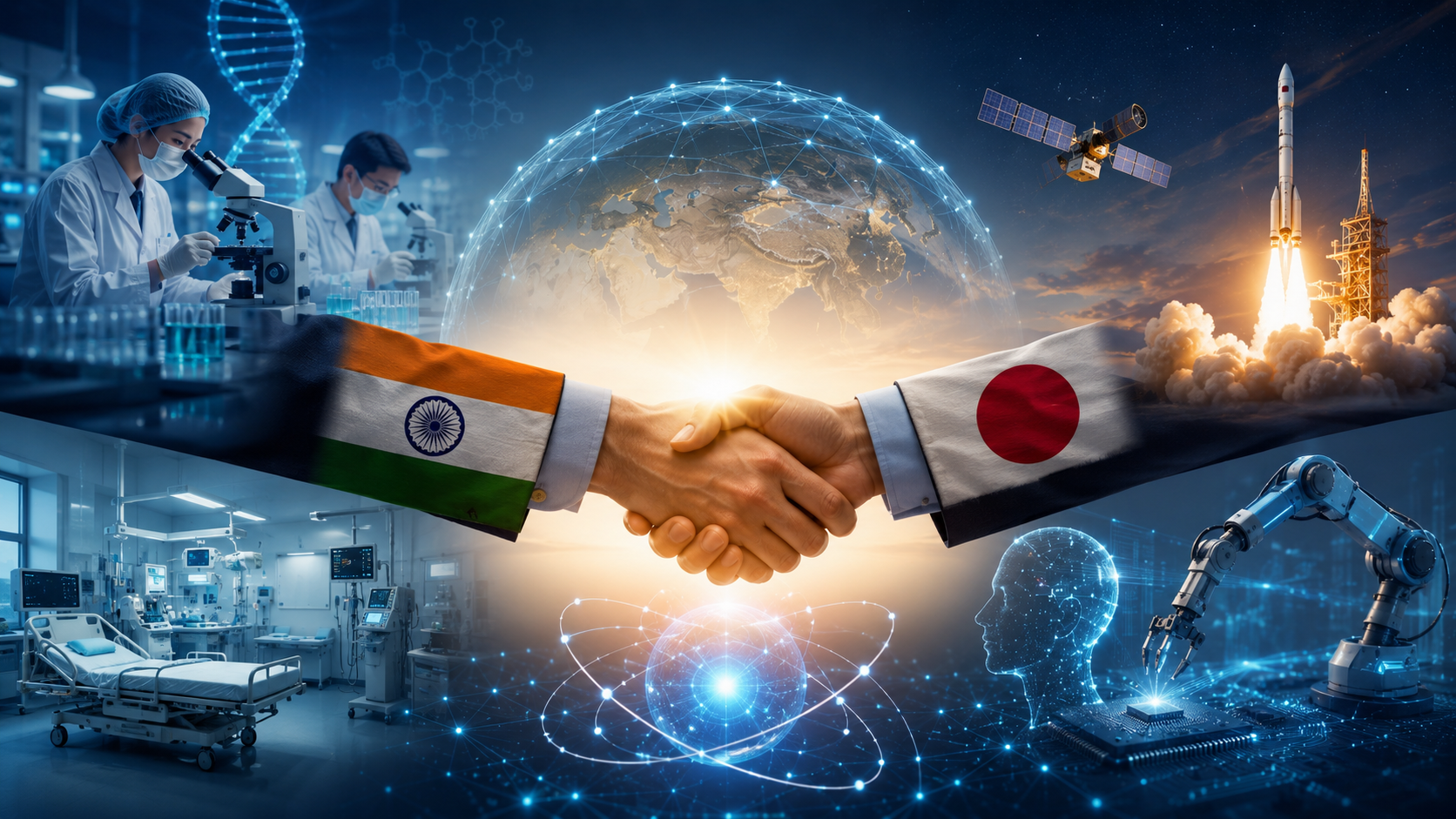
- As technological competition increasingly shapes geopolitical alignments in the Indo-Pacific, India and Japan are expanding their strategic partnership beyond infrastructure and economic cooperation.
- One of the most significant outcomes of the visit was the exchange of a Memorandum of Cooperation involving Japan’s Agency for Medical Research and Development (AMED), India’s Indian Council of Medical Research (ICMR), and the Department of Science and Technology.
- For both India and Japan, collaboration in quantum science presents an opportunity to build trusted technological partnerships while reducing dependence on external technology ecosystems in strategically sensitive sectors.
- As India and Japan deepen collaboration across emerging technologies and strategic domains, their partnership is likely to play an increasingly important role in shaping the geopolitical and technological future of Asia.
As technological competition increasingly shapes geopolitical alignments in the Indo-Pacific, India and Japan are expanding their strategic partnership beyond infrastructure and economic cooperation into science, technology, healthcare, and innovation. The recent visit of Japan’s Minister for Science and Technology Policy and Minister of State for Space Policy, Ms. ONODA Kimi, in May 2026 marked another important step in this evolving partnership.
During the visit, both countries explored opportunities to deepen collaboration in emerging sectors such as quantum technology, healthcare innovation, Artificial Intelligence (AI), and space policy. The engagement reflected a shared commitment to building research-driven growth, technological resilience, and long-term strategic cooperation.
At a time when critical technologies are becoming central to both economic competitiveness and national security, India and Japan’s growing cooperation signals a broader convergence of strategic interests in the Indo-Pacific.
High-Level Bilateral Engagement
The Japanese delegation held detailed discussions with Union Minister of State (Independent Charge) for Science and Technology, Dr. Jitendra Singh, in New Delhi, focusing on scientific research, innovation ecosystems, advanced manufacturing, and next-generation technologies.
India highlighted the rapid growth of its innovation ecosystem, expanding digital infrastructure, and growing talent base, while Japan reaffirmed its interest in strengthening long-term cooperation with India in critical and emerging technologies. The discussions reflected the strategic complementarity between Japan’s technological expertise and India’s scale, scientific workforce, and digital transformation.
This engagement also demonstrates the broadening nature of India–Japan relations. While the partnership has traditionally focused on infrastructure development, economic cooperation, and regional connectivity, it is now increasingly extending into high-value strategic sectors that are expected to shape future geopolitical competition.
Cooperation in Healthcare and Medical Research
One of the most significant outcomes of the visit was the exchange of a Memorandum of Cooperation involving Japan’s Agency for Medical Research and Development (AMED), India’s Indian Council of Medical Research (ICMR), and the Department of Science and Technology.
The agreement seeks to promote joint research in healthcare innovation, medical devices, and advanced medical technologies. It is also expected to facilitate researcher exchanges and strengthen institutional scientific collaboration between both countries.
Healthcare cooperation has acquired greater strategic significance in the post-pandemic world, where resilient public health systems, domestic medical innovation, and technological self-reliance have become critical national priorities. In this context, India–Japan collaboration in healthcare extends beyond scientific cooperation and reflects a broader effort to strengthen health security and public resilience.
Advancing Quantum Science and Technology
Quantum technology emerged as another major pillar of bilateral cooperation. India and Japan exchanged a Letter of Intent on Quantum Science and Technology to encourage collaboration in quantum computing, communication, and advanced scientific applications.
The growing focus on quantum cooperation reflects the increasing strategic importance of frontier technologies in global competition. Quantum technologies are expected to transform computing power, cybersecurity, communications, and advanced industrial innovation, making them a critical domain for long-term technological leadership.
For both India and Japan, collaboration in quantum science presents an opportunity to build trusted technological partnerships while reducing dependence on external technology ecosystems in strategically sensitive sectors.
Expanding Healthcare Partnership Through JICA
The Japan International Cooperation Agency (JICA) continues to play an important role in strengthening India’s healthcare infrastructure and medical education systems.
In March 2026, JICA signed Official Development Assistance (ODA) loan agreements with India worth nearly Rs. 16,420 crore for multiple development projects, including healthcare initiatives in Maharashtra. These projects focus on strengthening tertiary healthcare delivery, upgrading medical colleges, and improving nursing education systems.
This reflects the expanding scope of India–Japan cooperation, where healthcare is increasingly being viewed not only as a social development priority but also as an important component of strategic resilience and national preparedness.
Focus on Emerging Technologies
Beyond healthcare and quantum science, discussions also covered Artificial Intelligence, clean energy technologies, cyber-physical systems, and space policy cooperation.
Japan acknowledged India’s rapid progress in digital transformation and innovation, while India reaffirmed its commitment to expanding strategic cooperation in critical and emerging technologies.
As competition intensifies over technological leadership, trusted partnerships in advanced technology sectors are becoming increasingly important. India and Japan’s cooperation in these domains reflects a shared recognition that technological capability is now central to both economic growth and strategic autonomy.
Space policy cooperation also carries strategic significance, particularly in an era where space capabilities increasingly intersect with communications, surveillance, navigation, and national security interests.
Conclusion
The visit of Ms. ONODA Kimi reflects the growing convergence between India and Japan across science, technology, healthcare, and geopolitics.
What was once primarily an economic and infrastructure-focused partnership is increasingly evolving into a broader strategic relationship centred on technological resilience, trusted innovation ecosystems, healthcare cooperation, and critical technology development.
In the larger Indo-Pacific context, this cooperation reflects a wider effort among like-minded partners to build secure technological alliances, strengthen strategic resilience, and reduce vulnerabilities in critical sectors.
As India and Japan deepen collaboration across emerging technologies and strategic domains, their partnership is likely to play an increasingly important role in shaping the geopolitical and technological future of Asia.
References:
1.https://government.economictimes.indiatimes.com/news/technology/india-and-japan-strengthen-ties-in quantum science-and-healthcare-innovation/130875824
2.https://www.pib.gov.in/PressReleasePage.aspx?PRID=2258349®=3&lang=2
3.https://www.pib.gov.in/PressReleasePage.aspx?PRID=2245940®=1&lang=1

Megna Devkar is a Ph.D. Research Scholar at K.C. Law College with research and writing expertise in social, political, and legal issues. Views expressed are the author’s own.
 Anjali Singh
  Aayush Pal