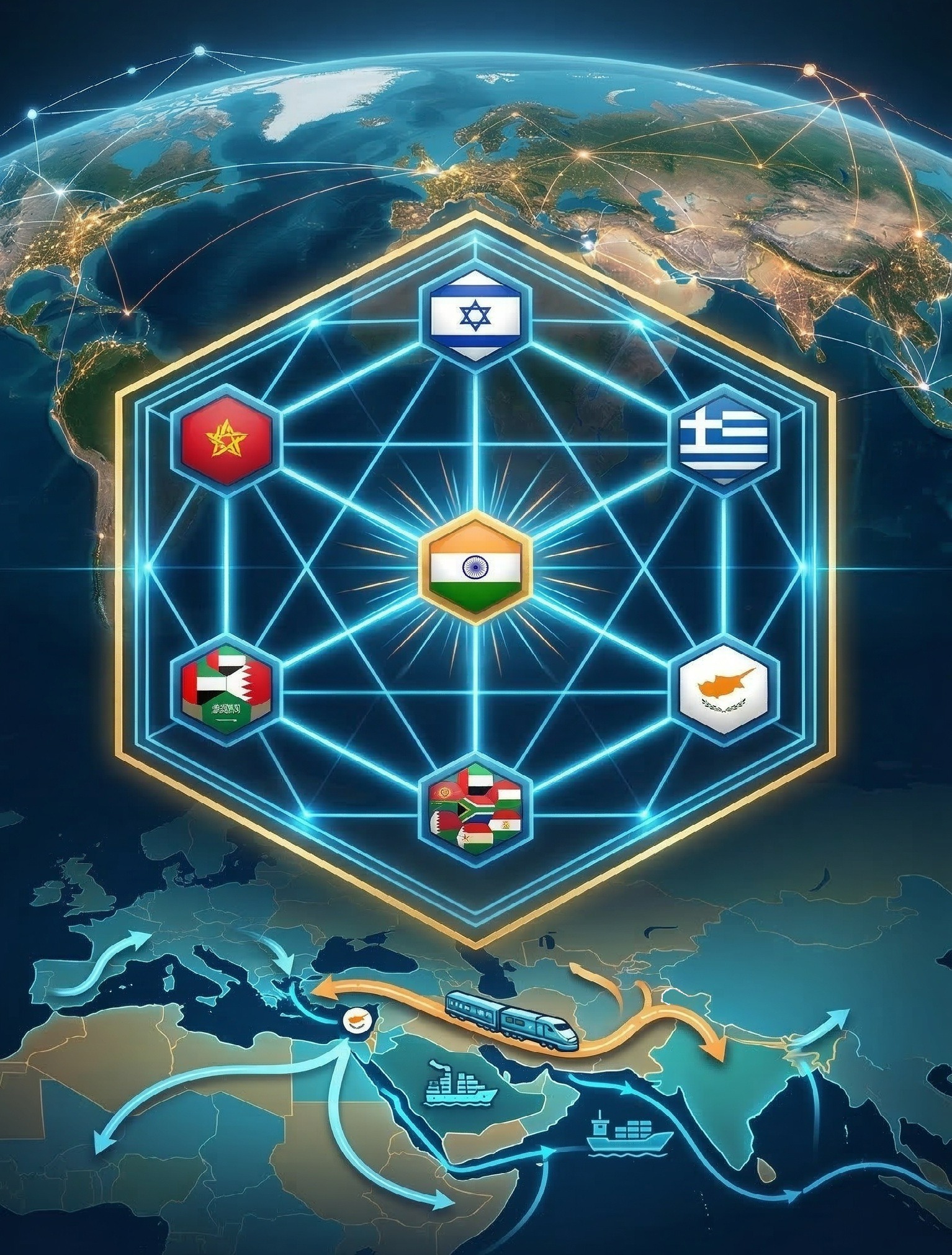
- The proposed hexagon, linking Israel, India, Greece, Cyprus, and selected Arab, African, and possibly Asian partners, is a networked architecture designed to reengineer global connectivity corridors and recalibrate power in a multipolar world.
- India seeks to occupy nodal positions within overlapping strategic networks, and the Hexagon concept potentially positions India as the centre of gravity.
- In the 21st century, the Hexagon represents the geometry of organised power through alliances, with IMEC serving as the corridor and the Hexagon as its network, creating a symbiotic integration of geoeconomics and geopolitics.
During Prime Minister Narendra Modi’s visit to Israel last month, Israeli Prime Minister Benjamin Netanyahu spoke about a “Hexagon Alliance.” As war continues in the Persian Gulf, the remote possibility of a Hexagon Alliance, born out of necessity within a complex geopolitical geometry involving India, Israel, Greece, Cyprus, and a few Arab and African nations, could allow India access to the Mediterranean and the Adriatic Sea, potentially marking a major structural transformation.
This geopolitical geometry that connects India with West Asia, the Mediterranean Sea, and the Adriatic Sea is defined by shifting energy routes, the rise of new economic corridors amid multipolar high-stakes bargaining, an increasingly assertive commercial naval doctrine to protect merchant trade, the safeguarding of freedom of navigation for commercial shipping, and the growing convergence of energy security with naval sea power.
If this works, the Hexagon Alliance could become a bloc capable not only of moving away from Western hegemony but also of sustaining itself in an era where rigid blocs are giving way to fluid coalitions. The proposed hexagon, linking Israel, India, Greece, Cyprus, and selected Arab, African, and possibly Asian partners, is not a military pact but a networked architecture designed for something larger: the reengineering of global connectivity corridors and the recalibration of power in a multipolar world.
Under Prime Minister Narendra Modi, India has transitioned from doctrinal non-alignment to operational multi-alignment. It now engages simultaneously with the Quadrilateral Security Dialogue in the Indo-Pacific, BRICS across Eurasia, and, potentially, the revitalisation of the I2U2 Group in West Asia.
India seeks to occupy nodal positions within overlapping strategic networks, and the Hexagon concept potentially positions India as the centre of gravity with nodal centrality extending into the Mediterranean Sea, the Adriatic Sea, and the Arabian Sea, enabling greater integration with Europe’s energy and logistics matrix.
During the 2023 G20 Summit, the India-Middle East-Europe Economic Corridor (IMEC) was announced, presenting the world with India’s most ambitious maritime connectivity project to date. Envisioned as a multimodal corridor linking Indian ports to the United Arab Emirates, Saudi Arabia, Jordan, and Israel, and onward to Europe via Greece, it integrates maritime routes, rail networks, energy pipelines, and digital cables.
If realised, the India-Middle East-Europe Economic Corridor (IMEC) would serve as a geoeconomic counter and help rebalance fragile supply chains by reducing transit dependency on strategic chokepoints. It would also provide an alternative to Belt and Road Initiative corridors. More importantly, it would embed India within Europe’s industrial value chains. However, IMEC’s viability depends on regional stability and political convergence among participating states. This is where the Hexagon framework could provide greater structural integrity by evenly distributing strategic weight, maximising collective resilience, and enabling stable, gap-free coordination among participating nations.
How the Hexagon Could Reshape IMEC
If institutionalised informally, the Hexagon framework could serve as the economic and political-security umbrella under the India-Middle East-Europe Economic Corridor (IMEC) architecture, providing maritime security, intelligence coordination, and cyber protection. Cooperation among Israel, India, Greece, and regional partners could create a distributed security lattice protecting sea lanes from the Arabian Sea through the Eastern Mediterranean.
Greece and Cyprus have a contentious relationship with Turkey. For India, which is now working aggressively to become a major global transhipment hub, these countries could provide crucial European entry points. A hexagonal grouping would formalise their strategic integration with India and Israel, transforming the India-Middle East-Europe Economic Corridor (IMEC) from a mere transit corridor into a broader geopolitical and economic alignment spanning the Indo-Mediterranean arc and the historically significant Aegean Sea, located between the Greek peninsula to the west and Asia Minor (Turkey) to the east.
In a rapidly polarising world, shaped by the United States-China rivalry, Russia-Europe confrontations, and ongoing regional conflicts, Hexagon-backed India-Middle East-Europe Economic Corridor (IMEC) demonstrates that middle powers can design alternative connectivity architectures independent of traditional hegemonic blocs. The Hexagon framework has the potential to reshape global partnerships and assist India in pursuing diversified alliances, thereby reducing vulnerabilities associated with interdependence while maintaining strategic autonomy.
All new geopolitical ideas entail risks because of geopolitical fragility. However, India has demonstrated it can conduct business with nations that balance its interests, and even if there are domestic political shifts in any participating country, it can maintain ties with Iran and Russia.
Geometry Over Ideology
India is regarded as a pioneering civilisation in geometry, with origins dating back to at least 1000–800 BCE, predating Greek contributions. Ancient texts such as the Sulba Sutras by Baudhayana, Manava, Apastamba, and Katyayana exemplify this legacy. Even Chanakya employed the metaphor of geometry in the “geometry of life,” emphasising structure, balance, and strategic positioning rather than mathematical theorems. In the 21st century, the Hexagon represents the geometry of organised power through alliances, with IMEC serving as the corridor and the Hexagon as its network, creating a symbiotic integration of geoeconomics and geopolitics.
Conclusion
For India, this is the right time to become indispensable to multiple global systems simultaneously. India must possess the architectural blueprint that others must use.

Balaji is a freelance writer with an MA in History and Political science and has published articles on defence and strategic affairs and book reviews. He tweets @LaxmanShriram78. Views expressed are the author’s own.
 Archita Gaur
  Anjali Singh
  Divyanka Tandon