
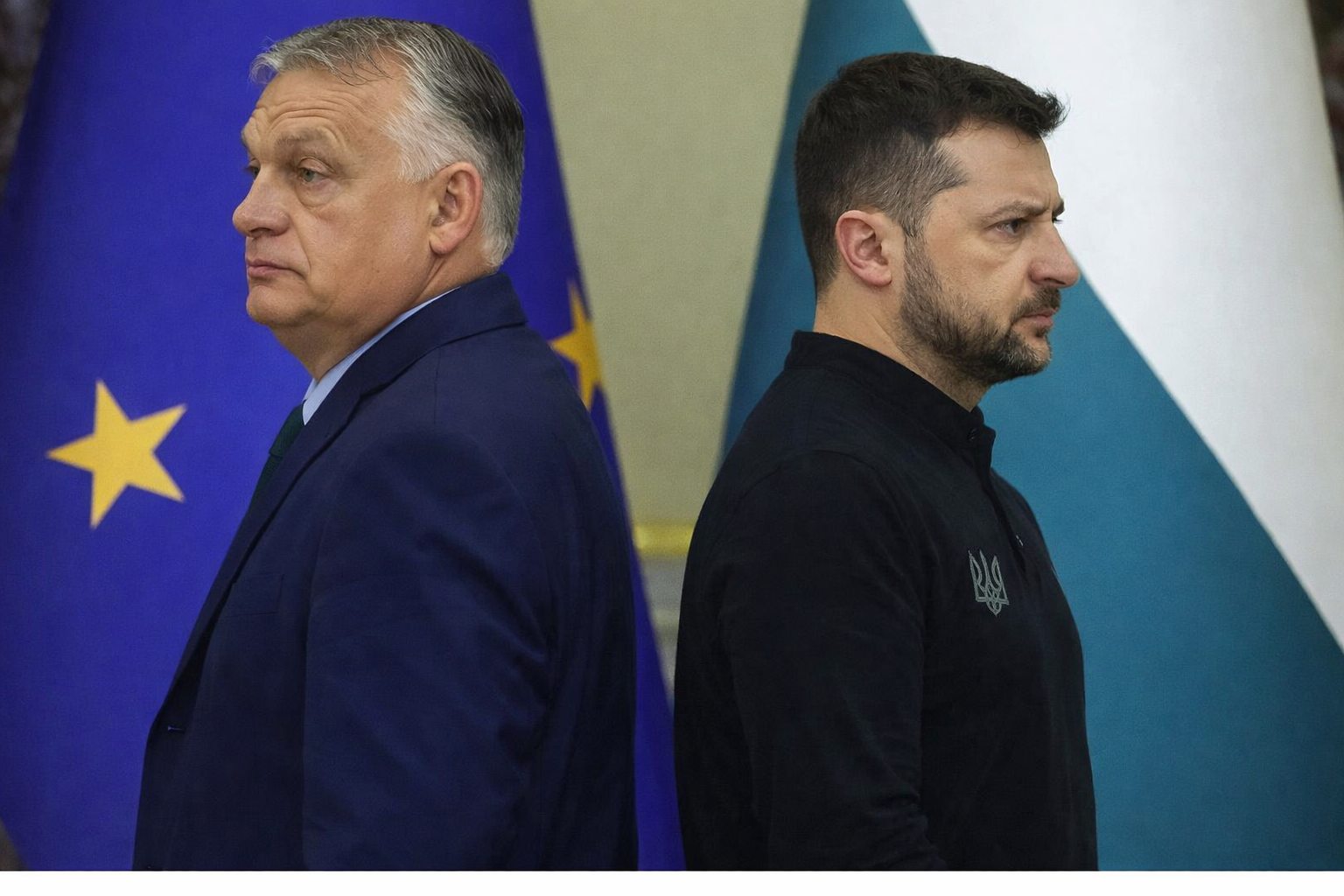
- The European Union has emerged as a central actor, providing financial and strategic support to Kyiv.
- Hungarian PM Viktor Orbán has been openly critical of the European Union’s financial and military support for Kyiv, describing it as a strategic miscalculation that burdens an already strained European economy.
- Tensions escalated further when Hungary blocked a €90 million European Union financial support package for Ukraine.
- Hungary’s position exposes a structural vulnerability within the bloc.
The ongoing war in Ukraine has created a major security challenge for Europe. The European Union has emerged as a central actor, providing financial and strategic support to Kyiv. For the first time since the Second World War, war is reshaping the European continent directly, with consequences not only for security but also for economic stability. A region long associated with prosperity now faces stagnation and uncertainty.
Hungary’s Strategic Dissent Inside the European Union
Amid this shifting landscape, Hungary has drawn sustained attention. A member of both the European Union and NATO, it is led by Prime Minister Viktor Orbán, who places Hungarian national interests above broader European alignment. His government has frequently clashed with the EU establishment and is often accused by critics of being sympathetic to Moscow.
From the outset of the war in 2022, Orbán has maintained a sceptical view of Ukraine’s prospects. He has argued that Ukraine cannot realistically defeat Russia and has consistently called for diplomacy rather than prolonged conflict. More importantly, he has been openly critical of the European Union’s financial and military support for Kyiv, describing it as a strategic miscalculation that burdens an already strained European economy.
Orbán has also opposed Ukraine’s potential accession to the European Union. He has questioned how a country with contested borders, uncertain demographic data, and suspended electoral processes can meet the criteria for membership.
The Financial Aid Dispute and War of Words
Tensions escalated further when Hungary blocked a €90 million European Union financial support package for Ukraine. The move once again underscored the EU’s internal constraint: unanimity is required for key decisions, allowing a single member state to stall collective action.
The decision triggered a sharp exchange between Kyiv and Budapest. Ukrainian President Volodymyr Zelenskyy criticised unnamed European actors opposing aid, remarks widely interpreted as directed at Hungary. He went so far as to suggest that identifying such actors could have military implications, a statement that drew immediate backlash.
Hungary condemned the remarks as irresponsible, while the European Union, despite its strong support for Ukraine, issued a rare caution urging restraint and responsible rhetoric from both sides. The episode revealed growing friction not only between Hungary and Ukraine but also within the broader European consensus.
Energy Politics and Hungarian Domestic Calculations
Energy remains a critical fault line in Hungary–Ukraine relations. Hungary depends heavily on Russian oil and gas delivered through the Druzhba pipeline. Budapest has accused Ukraine of disrupting these supplies, while Kyiv has attributed the interruptions to Russian military strikes earlier this year—an explanation Hungary disputes.
In retaliation, the Hungarian government detained seven employees of Oschadbank, seizing millions in cash and gold. Ukraine further criticised this move. All of this is happening at a very important time for Hungary because the country is preparing for elections in April of this year. The opponent of Prime Minister Viktor Orbán, Péter Magyar, has been described by Orbán as a Ukrainian and European Union puppet.
The dispute is not merely technical; it reflects deeper strategic divergence. For Hungary, energy security is non-negotiable, and any perceived threat to supply routes quickly becomes a national issue.
These tensions are unfolding against the backdrop of Hungary’s domestic politics. With elections approaching, Orbán has positioned Ukraine as a central issue, portraying himself as a defender of national interests against external pressures. His political opponent, Péter Magyar, has been framed by the government as aligned with both Brussels and Kyiv, reinforcing the narrative of foreign influence.
The Transcarpathia Question and the Future of Hungary–Ukraine Relations
Beyond immediate wartime disagreements, Hungary’s concerns also stem from longstanding ethnic and historical issues. In Ukraine’s western region of Transcarpathia, approximately 150,000 ethnic Hungarians reside. The area was part of Hungary until 1939 before being absorbed into the Soviet Union and later becoming part of independent Ukraine.
The Hungarian government has accused Ukraine of restricting the linguistic and cultural rights of this minority. These claims have become a recurring point of contention, with Budapest arguing that ethnic Hungarians are not being adequately protected.
This argument bears a notable resemblance to Russia’s justification regarding ethnic Russians in eastern Ukraine, though the scale and context differ significantly. Nonetheless, it adds another layer of complexity to an already strained relationship.
A Relationship at a Strategic Crossroads
The Hungary–Ukraine relationship is thus shaped by overlapping factors: strategic disagreement over the war, economic concerns—particularly energy dependence—and domestic political calculations. What might appear as simple obstructionism is, from Budapest’s perspective, a combination of national interest, electoral strategy, and long-standing grievances.
For Ukraine, however, the implications are serious. While it continues to receive broad support from much of the European Union, Hungary’s position exposes a structural vulnerability within the bloc. EU decision-making mechanisms mean that even a single dissenting member can delay or dilute collective action.
This reality places Ukraine in a difficult position. Despite political tensions, it cannot afford to ignore Hungary. Maintaining at least a functional relationship with Budapest is essential if Kyiv hopes to secure consistent European backing.
Conclusion
Hungary’s defiance is not an isolated anomaly but a reflection of deeper fractures within Europe’s approach to the Ukraine war. It highlights the limits of consensus in a union of diverse national interests. As the conflict continues, these internal divisions may become more pronounced, complicating both Europe’s strategy and Ukraine’s path forward.

Aayush Pal is a freelance writer on contemporary geopolitical developments. The views expressed in his work are entirely his own.
 Divyanka Tandon