
- Nearly 90 per cent of Japan’s total energy imports come from West Asia, and any disruption directly affects Japan’s national security.
- The US-Japan relationship is also crucial from a strategic and security perspective, particularly in the Asia Pacific region.
- As Japan moves closer to the United States, it risks increasing its distance from regional actors such as China, North Korea, and even Russia.
Amid critical international geopolitical developments arising from the West Asian conflict, the situation has significantly impacted the global order. The crisis has triggered a rising global energy shock, threatened maritime navigation, and pushed countries to search for ways to navigate the ongoing instability. At such a crucial time, an important bilateral visit took place last week between the United States of America and Japan.
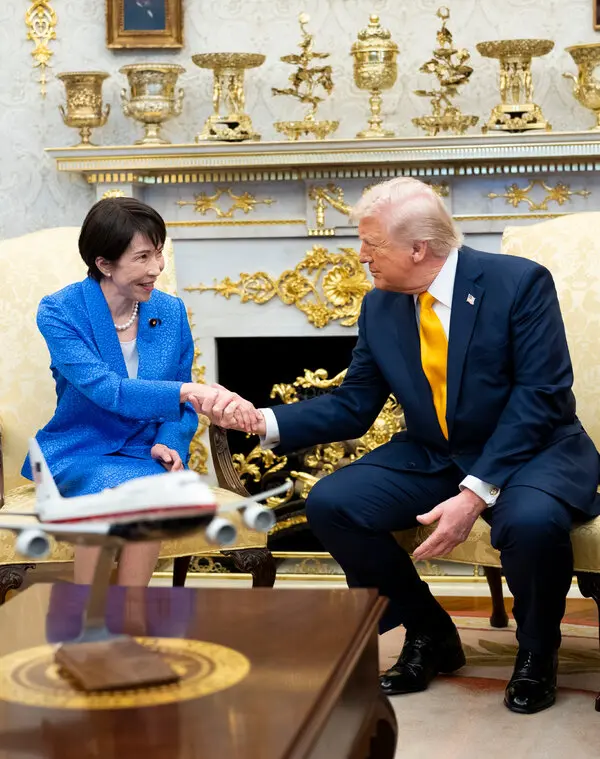
Japanese Prime Minister Sanae Takaichi, after securing a landslide victory in the recently concluded general elections, visited the United States for the first time. This visit was reciprocal in nature, as a month earlier, US President Donald Trump had visited Japan. Japan remains the largest Asian ally and the most important non-NATO ally of the United States. Both countries share strong common ground in their outlook on international developments.
This alignment is also visible in their stance on the ongoing Iranian conflict. Prime Minister Sanae Takaichi has openly criticised Iran and has urged it to unblock the Strait of Hormuz. This position is not solely because Japan is an ally of the United States, but also because Japan is heavily dependent on West Asian energy supplies. Nearly 90 per cent of Japan’s total energy imports come from West Asia, and any disruption directly affects Japan’s national security.
The West Asian crisis, therefore, holds direct importance for Japan. It is not just about alliance obligations or US involvement, but about Japan’s own energy security. This becomes even more significant at a time when President Trump has repeatedly emphasised that countries heavily dependent on West Asian energy should contribute more actively to securing maritime routes and ensuring the flow of energy.
There was anticipation that during the visit, the United States might seek assistance from the Japanese Self-Defence Forces to help secure the Strait of Hormuz. However, President Trump did not make such a request publicly during the bilateral meeting. This was received positively in Japan, as constitutional limitations restrict the overseas deployment of Japanese forces, and Japan itself is reluctant to get directly involved in the conflict.
At the same time, US-Japan relations have experienced a degree of friction in recent times. One major point of tension has been the Nippon Steel deal, where the United States rejected the attempt by a Japanese firm to acquire a major American steel company. Additionally, President Trump’s demand for massive investment commitments, reportedly around 500 billion dollars, has drawn criticism within Japan, with concerns that such expectations are not entirely fair.
During the visit, Prime Minister Takaichi focused on trade and energy cooperation. Japan agreed to invest approximately 73 billion dollars into US business projects, which is part of a broader 550 billion dollar investment framework. Furthermore, Japan has agreed to collaborate on the development of small modular nuclear reactors in the states of Tennessee and Alabama.
Politically, this moment is also significant for Japan. The country has faced instability, with three prime ministers in the last five years. The Liberal Democratic Party has been dealing with anti-incumbency pressures and corruption allegations. In this context, Prime Minister Takaichi has emerged as a figure of stability and renewed leadership, offering hope for both political consolidation and stronger governance.
The US-Japan relationship is also crucial from a strategic and security perspective, particularly in the Asia Pacific region. China continues to expand its regional ambitions and seeks to assert dominance in East Asia. The Taiwan issue remains a potential flashpoint. In the event of a Taiwan conflict, Japan would become a central actor, especially because of the presence of US military bases in the region. Any US military response would likely involve operational support from Japanese territory.
Just as West Asia has become the epicentre of the current conflict involving the United States, Israel, and Iran, Japan could play a similarly critical role in a Taiwan contingency. Recognising this, the new Japanese leadership has made it clear that Japan stands firmly aligned with the United States on security matters.
However, this alignment carries its own consequences. As Japan moves closer to the United States, it risks increasing its distance from regional actors such as China, North Korea, and even Russia. This evolving balance will shape not only Japan’s strategic future but also the broader geopolitical dynamics of the Indo-Pacific region.

Aayush Pal is a freelance writer on contemporary geopolitical developments. The views expressed in his work are entirely his own.
 Dr Mohmmad Rizwan
  Parag Gilada
  Archita Gaur