
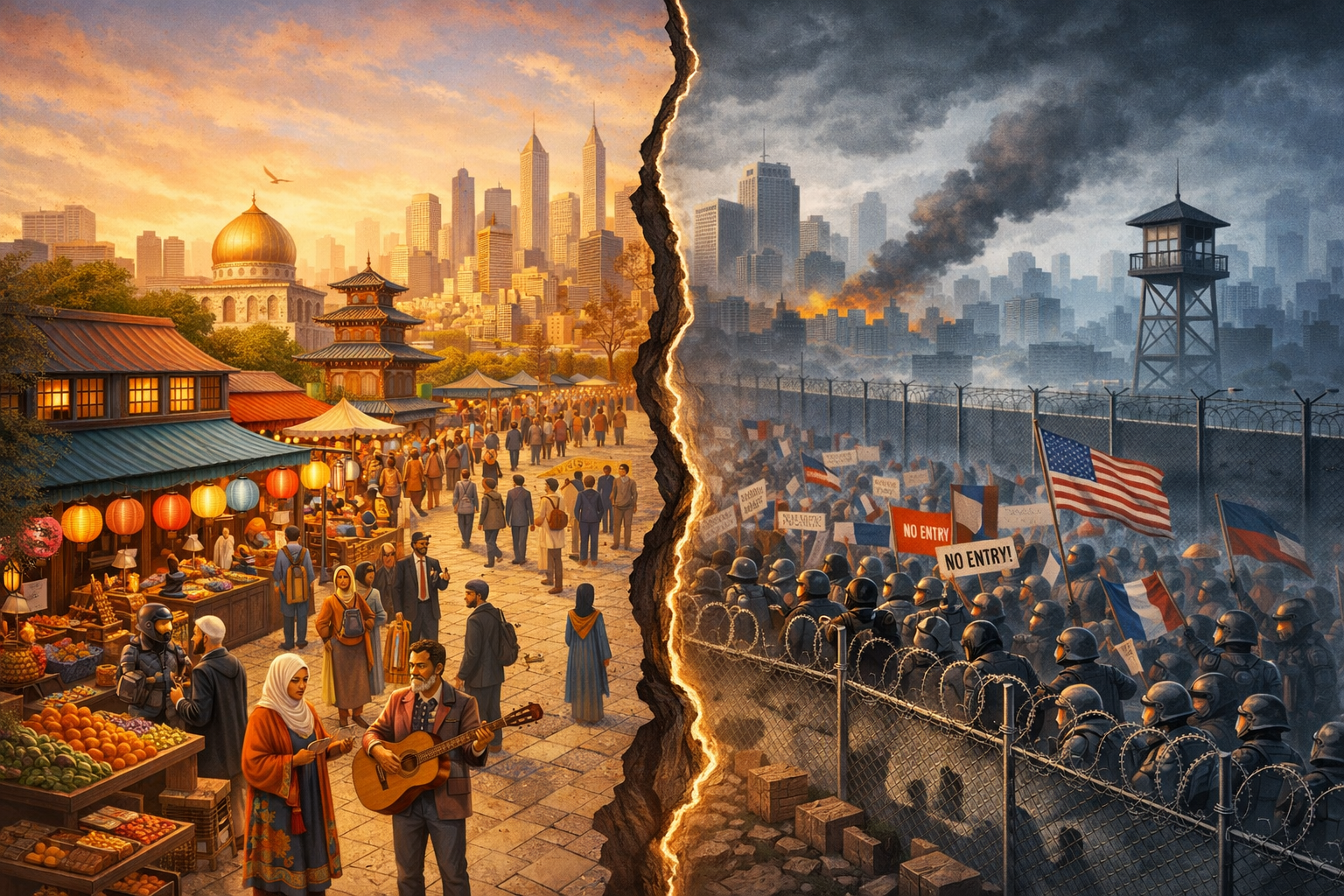
- Many Western countries adopted attractive immigration policies to address skill shortages and rapidly ageing populations—this created pathways for migrant workers,
- It was this extraordinary juxtaposition that constituted cultural diversity or multiculturalism, adding special charm to the social landscape that the immigrants had now become part of.
- A serious and deep-rooted fear and ideological concern of the impact immigrants pose by thrusting their alien and contrary norms and mores in an already well-established social environment and thereby, creating social confusion, discord and conflict.
Cultural diversity has been a buzzword for the past couple of decades, and for good reason. In a 2009 Harvard Business School publication, championing diversity was seen as a sound business strategy that added value through enhanced output efficiency, reduced costs, and increased market access, as well as inculcating social inclusiveness and cultural sensitivity in a globalised work environment. Taking a cue, foreign universities of repute began to see international students not only as a major source of much-needed revenue but also as the basis of a genuine global learning experience that was critical for work-ready graduates entering a rapidly integrated marketplace. Multiculturalism emerged as the key to success and a universally acknowledged mantra.
Consequently, many Western countries adopted attractive immigration policies to address skill shortages and rapidly ageing populations—this created pathways for migrant workers, including caregivers from developing countries such as the Philippines. Immigrants came to occupy a wide range of roles, from everyday services – taxi driving, plumbing, gardening, and electrical work – to advanced technical jobs in construction, shipyards, railways, airports, and hospitality. In Italy, agricultural labour was largely drawn from northern India, while in the UK, medical professionals were predominantly of South Asian origin. Across the UK, North America, Canada, Australia, and New Zealand, immigrants increasingly owned and operated small businesses, becoming integral to local economies.
The early view on immigrants was driven by the ‘melting pot’ perspective, where immigrants coming from different cultures to America were assimilated by adopting the culture and identity of their new home and becoming indistinguishable from the receiving culture. It was as if they had left behind their old ways of seeing and embracing a new one through their blending in. This was rebirth and absorption – a new face, a new identity, a new reckoning. Whether they were Somalians or Thai, Irish or Turkish, they were now totally and solely Americans.
This mono-cultural perspective was widely debunked by sociologists, who argued that while immigrants integrated, they also proudly retained their own distinct identity and culture. Little Italys, China Towns, and South Asian precincts, for instance, testified to this, reflecting a ‘salad bowl’ identity, where two or more cultures could live harmoniously with each other, each adding value, rather than one dissolving into or consumed by the other. It was this extraordinary juxtaposition that constituted cultural diversity or multiculturalism, adding special charm to the social landscape that the immigrants had now become part of. Multiculturalism lifted the entire population and provided a glimpse of another world, another people, and how, in multiple ways, a common thread bound everyone together.
Migration was a response to labour shortages. By the 18th century in the United States, for instance, ‘white’ was used to distinguish slave owners from slaves, and the brutal trading of African Americans as slaves became widespread. ‘White’ was, in fact, defined by law (Naturalisation Act of 1790), and anyone who did not pass the colour test was denied citizenship. Racism, with all its cruelty, took deep roots among the American white population and led to the creation of the Ku Klux Klan, infamous for lynching African Americans or negros, as they were referred to. Great literature emerged, including an American president who fought against slavery and discrimination, and was assassinated for his thoughts. But then, after the American Civil War, the dream of a new America was born. Sadly, the violence against the blacks hasn’t stopped in contemporary America. Race, police brutality, and wrongful convictions in the US show an alarming nineteen times higher conviction rate of innocent blacks for drugs and other related crimes than their white counterparts, as per the 2022 National Registry of Exonerations. Racial abuse and hatred continue in the US among a wide section of the white population, which has extended to immigrants.
John Howard Griffin’s Black Like Me (1960s) is an extraordinary experiment in empathy and social inquiry. A white man, Griffin, who temporarily darkened his skin, lived as a black person in the American South to understand everyday racism. Working as a shoeshine boy, he was accepted by black communities while remaining unrecognised by whites, including people he personally knew. As a result, he endured severe discrimination, verbal abuse, and dehumanisation. Griffin encountered entrenched stereotypes portraying blacks as criminal, inferior, hypersexualised, culturally exotic, or simply “good-for-nothing.”
The book deeply affected many Americans, yet reinforced the beliefs of others who viewed black people as a societal “problem.” From this historical injustice emerged powerful literature, music, and poetry—such as To Kill a Mockingbird, the blues, and spirituals—expressing suffering alongside resilience and hope. Despite cultural contributions and even assimilation into Christianity, blacks were denied equality. This persistence of prejudice was evident even during the presidency of a black American, whose elevation challenged deeply rooted racial assumptions.
The term ‘multiculturalism’ has been used in several different ways: for example, as a political model, a policy model, and to describe a set of social practices. It has usually been regarded as a defence of cultural pluralism and diversity, protecting the characteristics and unique contributions of a range of cultural and minority groups. Historically, it has also been regarded as a departure from the monocultural nation-state and the ideal of assimilation. Multiculturalism is associated with identity politics, that is, a political movement centred on the recognition of minority rights and cultural differences. The theoretical discussion of multiculturalism in the 1990s was, therefore, dominated by themes of different human rights and social justice. Issues of social cohesion and shared symbolic and public spheres were not prioritised at that time.
The Australians, who, like the Americans, wrested the land from its original inhabitants and populated it with white, Christian convicts from their British colonisers, blindly followed the Americans. Up until 1958, it clung on to the shameful ‘white’s only’ migration policy. Checks were carried out at entry points to the country on the skin tone of the aspiring immigrant before granting entry. Today, unlike the US, especially under President Trump in his second term, Australia is seen as a beacon of multiculturalism. Every province in Australia has a Multicultural Commission, especially set up to promote community welfare and harmony. Immigrants from multiple countries, especially non-white, consider Australia their home. This is a remarkable achievement.
It is noteworthy that the immigrants flourished. Many did well in professional jobs as chartered accountants, doctors, lawyers, teachers, and professors in universities. Some joined the civil service, while others took to public life and became Ministers, while a few rose to become heads of state or government. By any criterion, they were successful. Even those less fortunate were financially far better off than their parents were in their home country, but sadly, also the local population, which started to be seen as a problem and perceived as a contradiction. Envy of the immigrant grew silently but quickly.
It is also a fact that America and many other Western societies were, in fact, built by migrants. They did this through hard work and extraordinary sacrifices. This celebration of the immigrant is no small achievement. Yet, it created envy and a sense of discontent in the local population.
Over time, this culminated in strong indications that tougher border control measures would be introduced to curb immigration. This is a transformative shift in global affairs. Societies once open and welcoming would now move rapidly towards new policies that would make them insular. The outsider, in other words, would be kept out. Strong ultranationalist sentiment, sweeping across Western countries, has become increasingly vocal and assertive, gaining significant traction from the public. Widespread and uncontrolled immigration is seen as destroying their very civilizational identity, which can only be salvaged through national unity policies that are directed against the immigrant.
It is surprising that while each of these countries – the US, Canada, the UK, Australia, to name a few – has been built by immigrants and has often openly acknowledged their enormous contribution, mainstream parties find themselves under increasing pressure, for reasons of political survival, to debunk present-day liberal migration policies and seek tougher laws to deter potential migrants. Electoral compulsions can be a significant influence, especially when concerns about cultural diversity jeopardising national security are openly voiced. Coupled with far-right anti-immigration advocacy, this suggests that restrictive immigration policies could well become the new normal.
Indeed, it is not unsurprising that Western governments have started to see immigrants as the Trojan horse and that welcoming them is an invitation to discontent in the local population and the existing value system. This is primarily driven by a common and deeply ingrained view that immigrants refuse to fully integrate and are often in conflict with prevailing social norms, values, and ideology, and challenge the social landscape that has welcomed them in. Instead of gratitude, they confront.
German Chancellor Angela Merkel has often been lauded internationally for her humanitarian approach to the refugee crisis. Yet, as early as 2010, she unsettled many of her supporters by declaring that multiculturalism in Germany had “utterly failed”. She reiterated this position in a Washington Post article dated 14 December 2015, pointedly titled “Multiculturalism is a sham, says Angela Merkel.” In it, Merkel argued that multiculturalism fosters parallel societies and therefore constitutes a “life lie.” She further asserted the need to “noticeably reduce” the number of refugees entering Germany.
For Merkel, multiculturalism had come to signify the formation of socially isolated communities and the failure of effective integration. These remarks were made against a broader European backdrop in which right-wing and populist movements were gaining momentum across several countries in 2015, amplifying anxieties around immigration, identity, and social cohesion.
Cultural diversity, in other words, is a rejection of homogeneity, thereby opening the way to cultural clashes. A new narrative then emerges, and multiculturalism starts to be perceived as a disruptive force with a contrary ideology that poses a credible threat to the Western worldview. Immigrants are perceived as foreigners, who are disrespectful of the prevailing cultural unity by asserting – even imposing – an alien way of thinking and behaving. Suspicion and distrust become the predominant vocabulary in such a narrative. Consequently, it is argued that limits to multiculturalism are warranted on security grounds.
There are several reasons behind the rapidly rising anti-immigrant resentment. One is purely economic, in that there is fear that immigrants are taking away jobs from the local population, as they are willing to work longer hours and for less pay and thereby create unhealthy and unfair competition. A related concern is about pressures on social welfare systems that increasing numbers impose on the health, education, infrastructure, and housing sectors. These are populist-driven fears. In several cases, the local population would refuse to do several of the jobs immigrants regularly perform. Similarly, arguments on how the social welfare schemes are put under increasing pressure are specious in nature and actually point to poor governance. Indeed, opponents of the restrictive immigration policies pointed to this repeatedly and argued that shutting the inflow of talent would seriously impair the growth, performance, and technological dominance that the US and some other Western countries enjoyed.
There is, however, a more serious and deep-rooted fear and ideological concern of the impact immigrants pose by thrusting their alien and contrary norms and mores in an already well-established social environment and thereby, creating social confusion, discord and conflict. It is argued that this hugely disruptive dissonance can tear apart the social fabric that the local population had grown accustomed to and assiduously built. It had come to define their identity. They were white and Christian. And now, almost overnight, this was undergoing a huge and challenging shift. The celebrated German film Goodbye Lenin captures this startlingly well metaphorically through a story about a comatose woman in East Germany, who wakes up to a unified Germany. The Berlin Wall has fallen, the statue of Lenin is no longer there, and she simply cannot understand the dramatic changes that have taken place, and yet, she needs to now adjust to the new reality. It is almost as if the world she knew and was familiar with has been turned upside down. This is the kind of change that the local population is experiencing with the large-scale entry of immigrants. Fear of the unfamiliar can be intimidating.
Human resilience is hugely accommodating, unless the challenges strike at the very core of what one holds dear. It would be fair to say that, to a significant extent, this extraordinary shift in approach is also driven by geopolitical considerations, especially the concern that the existing global order is on the cusp of profound disruption, with the distinct possibility that immigrants might take sides and question the legitimacy of a unipolar global order based on Western values.
In his provocatively seminal essays that culminated in The Clash of Civilisations, Samuel Huntington predicted the fading dominance of Western civilisation because of the emergence of new and credible challenges. There would be, in other words, a reconfiguration of global power along cultural lines. Consequently, people and countries with similar cultures would gravitate towards each other, while those with dissimilar cultures would become adversarial. Alignments would now be driven by culture and civilizational similarities.
In such a construct, the 9/11 attacks in the US, as also the October 7 attacks on Israel, can be understood as a culture-driven ideological attack by rapidly growing Islamist terrorism against a clearly identified threat against their religion (which gives them identity). Islamist terror, whether by Al Qaida, ISIS, or Hamas-Hezbollah (in the above instances), is, thus, an ideological and civilizational assault to reshape the existing Western (American) and Israeli-dominated global worldview. This will necessarily trigger clashes and dangerous conflicts. In several Western countries, consequently, the counterculture of Islam is perceived as challenging the existing social cohesion and identity.
Charles Taylor, the Canadian philosopher, places recognition and identity at the forefront of the discussion of multiculturalism. The identities he discusses are largely collective social identities, based on social categories such as gender, ethnicity, religion, sexuality, etc.
A year ago, a stabbing in northwest England that killed three young girls aged six to eleven and injured several others became a catalyst for widespread unrest. Unverified rumours rapidly circulated on social media claiming the assailant was Muslim and an asylum seeker. These claims, amplified online, triggered riots and violent clashes with the police. Videos—some possibly fabricated—showed protest marches featuring priests in white cassocks, visible crucifixes, and demonstrators carrying banners declaring, “Give our country back to us.” While the government responded by granting the police sweeping powers to restore order, its primary concern lay in how swiftly misinformation had mobilised crowds through social media and how such escalation could be prevented in the future.
Less openly discussed, however, was a deeper and more troubling reality. The scale of participation and the intensity of the violence reflected a forceful assertion of ultranationalist identity and a pronounced hostility toward Muslims and foreigners. The riots revealed the depth of public support and mobilisation capacity enjoyed by far-right movements advocating selective immigration. Although counter-protests did take place, the visibility and momentum of ultranationalist groups signalled their growing influence over electoral politics and immigration debates.
Only weeks later, a stabbing in Solingen, Germany, left three dead and eight injured. A Syrian suspect surrendered himself, and ISIS claimed responsibility, describing the attacker as acting in retaliation for Germany’s stance on Israel, framed against the backdrop of historical guilt. This incident unfolded amid growing political anxiety in Germany, particularly following major electoral gains by the far-right Alternative for Germany party. With anti-migration policies at the centre of its platform, the party’s rise prompted calls for unity among mainstream political forces. Yet the broader reality remained stark: Germany’s multicultural model was facing mounting resistance and resentment.
Similar tensions surfaced in Australia after a Muslim father-son attack at Bondi Beach during Hanukkah, which killed several members of the Jewish community, including a ten-year-old child. Public anger focused on perceptions of governmental appeasement and rising antisemitism. At the same time, the intervention of a Muslim individual who disarmed the attacker offered a sobering reminder of the danger of collective blame.
Taken together, these incidents point to ominous trends. They have emboldened suppressed fears of outsiders and fuelled narratives of cultural and civilizational conflict rooted in religion and identity. The accelerating rise of far-right movements across Western democracies poses a direct challenge to multiculturalism and cultural diversity, long presented as defining strengths of these societies. Increasingly, even centre-left governments face profound ethical and political dilemmas over regulating migration. The prospect of closed, ideologically driven societies risks deepening polarisation in an already fractured world. These are deeply unsettling times.
Most of us are living with differences in multi-cultural societies. However, we are also living in a time when multiculturalism is being questioned, and nationalism and assimilationism have again spread out and coloured the political debate. Today, there is an increasing gap between the dominant ideological and policy frameworks and everyday multiculturalism. Looking closer at the everyday multiculturalism, the daily routines and the unreflective inter-ethnic encounters, we can find emergent and positive shared intersubjectivity that has come to characterise our everyday life experience and biography, offering hope that the promise of open minds would continue to prevail and nurture open societies.

Amit Dasgupta is a former Indian diplomat with an interest in management studies. Uma Sudhindra is a strategy consultant and a member of the Advisory Board at Strategic Research & Growth Foundation & Centre for National Security Studies. Views expressed are the author’s own.
 Dr Mohmmad Rizwan
  Parag Gilada
  Archita Gaur