
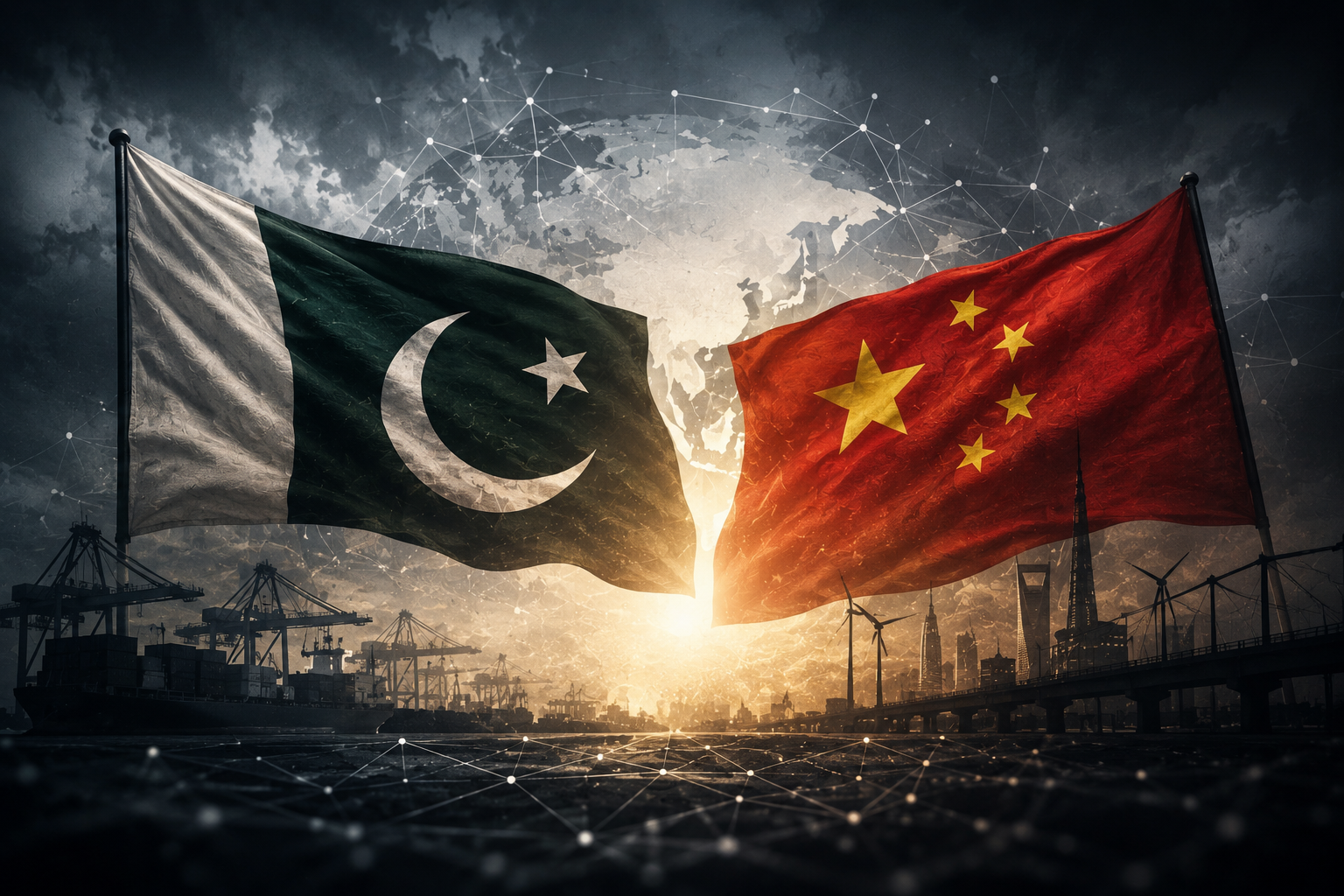
- The primary foundation of the Sino-Pakistan partnership is rooted in their mutual animosity for India.
- The mutual animosity towards India established the basis for robust strategic and military collaboration between the two nations.
- In addition to these conventional considerations, other new elements are contributing to the current development of bilateral relations between the two countries.
- They are no longer solely reliant on the Indian factor and have expanded their collaboration beyond the military domain. This transition enhances the strength and stability of their relationship compared to the previous day.
- “China’s existing investments in Pakistan’s economy, infrastructure, and education offer Beijing further motivation to endorse the country.”
Pakistan has recently garnered global academic and media interest for its role as a mediator in the U.S.-Iran conflict. However, there has been minimal scholarly discourse regarding the culmination of 75 years of diplomatic relations between Pakistan and China. Remarkable stability and mutual trust characterise the bilateral relations between Pakistan and China.China steadily maintained a deeper alliance with Pakistan, notwithstanding its varying geostrategic and military affiliations with Washington over different occasions. Pakistan opted to maintain its alignment with China, notwithstanding Beijing’s robust economic relations with India. This adjustment by the two nations demonstrated their mutual recognition of the importance of their bilateral relations.
This essay is both descriptive and exploratory, aiming to elucidate bilateral relations and investigate the rationale for the establishment of partnerships between the two countries. It also examines the present dynamics of bilateral relations between the two nations.
The mutual animosity towards India
Kautilya’s Arthashastra introduced the concept of statecraft that posits ‘the enemy of my enemy is my ally.’ The primary foundation of the Sino-Pakistan partnership is rooted in their mutual animosity for India. Pakistan and China established diplomatic ties in 1951. The significant transformation in bilateral relations occurred with the onset of the Sino-Indian War in 1962. China executed unilateral military operations against India, resulting in military humiliation for New Delhi. Islamabad viewed the situation as an opportunity because of its political, geographical, and military issues with New Delhi. In his book ‘China-Pakistan Axis: Asia’s New Geopolitics,’ Andrew Small noted that high-ranking Pakistani military officials proposed to China the option of consulting Pakistan over any future military moves against India. The mutual animosity towards India established the basis for robust strategic and military collaboration between the two nations. They resolved their territorial disputes with a boundary agreement in 1963. This enabled China to furnish military and nuclear assistance to Pakistan, thus enhancing the latter’s capabilities to maintain turbulence along India’s western frontier. This diverted India’s focus from the border and the military threat posed by China, thus granting China the opportunity for strategic manoeuvring.
Pakistan served as a clientelist state for China.
From the 1950s to the 1960s, China experienced diplomatic isolation from the West and its European allies. Washington and its allies disapproved of the Chinese communist regime and its affiliation with the Soviet Union. The U.S. sought rapprochement with China in the early 1970s in response to the change in its foreign policy against communism and the growing Sino-Soviet rift. Pakistan played a crucial role in the building of the Sino-U.S. rapprochement. Islamabad facilitated Kessinger’s historic visit to China in 1971. As a Muslim state, Pakistan provided China with access to the Muslim world. Islamabad facilitated China’s favourable reputation within the Muslim world. Pakistan’s clientelist services were important for China in overcoming its diplomatic isolation following the 1949 revolution.
The present element of multidimensionality
The historical dynamics of India and Pakistan as client states continue to be essential to bilateral relations between Pakistan and China. Pakistan is pivotal in China’s military strategic considerations amid the increasing military cooperation between New Delhi and Washington. Beijing views the U.S. military’s closeness to India as a continuation of the historical Western strategy of encircling China. Pakistan plays a pivotal role in hindering this development. Consequently, Pakistan’s reliance on China has intensified due to the diminishing support from the United States. China and Pakistan require mutual diplomatic support to address their shared threats.
In addition to these conventional considerations, other new elements are contributing to the current development of bilateral relations between the two countries. Initially, Pakistan became crucial in the economic securitisation of China, a concept derived from Barry Buzan. The Chinese economy is strongly reliant on natural oil and gas from West Asia. Approximately 80% of China’s oil transits through the constricted chokepoints of the Indian Ocean region. Neighbouring countries may obstruct these constricted chokepoints, potentially stifling China’s economic expansion. Pakistan offers an alternate terrestrial route for oil supplies to China. Secondly, China’s economic presence has expanded considerably. China has become Pakistan’s top creditor. A significant portion of foreign direct investment in Pakistan originates from China through the China-Pakistan Economic Corridor (CPEC) project. China has made substantial investments in Pakistan’s civilian and infrastructural projects under the CPEC. The success of CPEC is vital for China, as it is a flagship initiative of the BRI. The validity of the Belt and Road Initiative is significantly contingent upon the China-Pakistan Economic Corridor. Third, there is an increasing collaboration between China and Pakistan in the realm of education. For instance, the Pakistan Embassy College, established in 1960, became China’s first international school, with the emergence of China’s Confucius Institute. Both nations have strengthened their collaborations in the domains of technology and science.
Conclusion: Consequences for India
The contemporary China-Pakistan collaboration’s aforementioned features demonstrate that one cannot neatly characterise the relationship between Pakistan and China. They are no longer solely reliant on the Indian factor and have expanded their collaboration beyond the military domain. This transition enhances the strength and stability of their relationship compared to the previous day.
Ultimately, India must recognise that it can no longer disregard the burgeoning alliance between Pakistan and China. The notion of a two-front war as a long-standing security danger to India is very contentious, with experts divided on the issue. Chinese military support to Pakistan during India’s Operation Sindoor exemplifies China’s robust commitment to Pakistan. They will support Pakistan in all essential measures to mitigate India’s military power directed at Pakistan. China’s existing investments in Pakistan’s economy, infrastructure, and education offer Beijing further motivation to endorse the country. India must acknowledge this new reality and adopt a pragmatic strategy to address this enduring, yet evolved, threat.

Dr Mohammad Rizwan holds a PhD in political science from Jamia Millia Islamia. His doctoral research focuses on Pakistan’s relations with major global powers. Views expressed are the author’s own.
 Anjali Singh
  Parag Gilada