

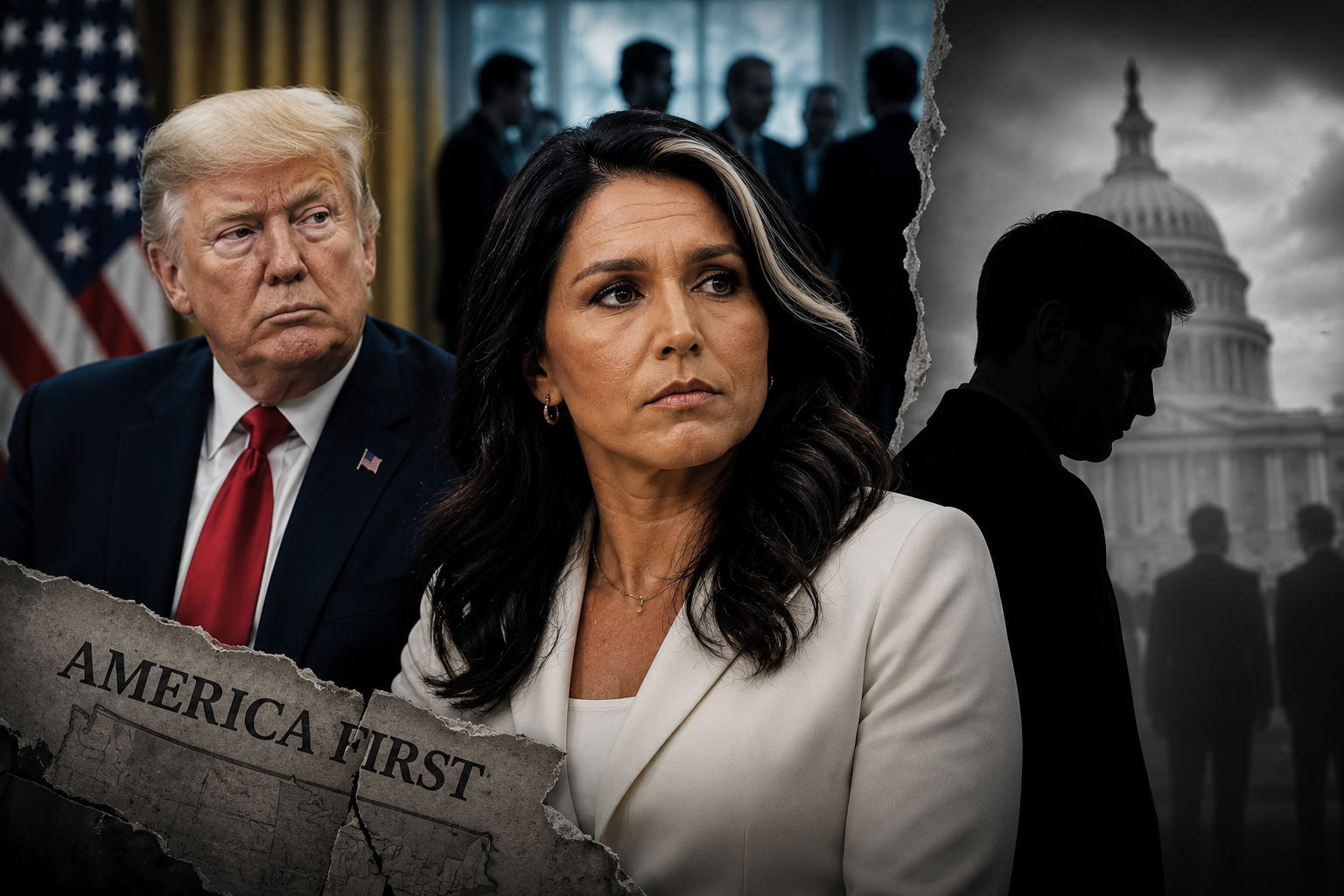
- Tulsi Gabbard, who was considered one of the most rational, pragmatic, and genuinely “America First” leaders in the administration, has also stepped down.
- Many critics are now calling this the decline of the America First movement and the weakening of the MAGA ecosystem.
- The final blow came with the resignation of Joe Kent, Tulsi Gabbard’s deputy, who openly criticised President Trump and accused him of abandoning the America First agenda by involving the United States in another war.
- Several of President Trump’s former allies and associates have themselves become some of his strongest critics.
In an unprecedented move, Director of National Intelligence Tulsi Gabbard has resigned from President Trump’s administration, citing personal reasons. She stated that her husband is suffering from a life-threatening cancer disease and that she wants to take care of him, which is the reason behind her resignation. This move comes at a major moment for the Trump administration as it goes through a difficult period both domestically and internationally. The war with Iran, rising inflation, and, more importantly, President Trump’s erratic behaviour have raised serious questions about the administration’s credentials.
This move is important because it comes at a particularly difficult time when several former cabinet members have either resigned or been removed from office. For example, the ousting of Kristi Noem as Secretary of Homeland Security and Attorney General Pam Bondi created major political discussions. Now, Tulsi Gabbard, who was considered one of the most rational, pragmatic, and genuinely “America First” leaders in the administration, has also stepped down. Many critics are now calling this the decline of the America First movement and the weakening of the MAGA ecosystem.
Tulsi Gabbard’s Political Journey from Democrat to Republican
Tulsi Gabbard has had an interesting political journey. Coming from a Democratic background, she was once a member of the Democratic Party before leaving it, calling it a party of war-mongering and endless conflicts rather than one focused on American interests. She has consistently been a critic of wars and American global interventions, particularly in West Asia. Even while being part of the Democratic Party, she openly criticised American foreign policy.
She argued that former Syrian President Bashar al-Assad was not a direct threat to the United States and that Syria did not possess nuclear weapons. She also challenged the justification behind the American invasion of Iraq, arguing that Iraq never possessed weapons of mass destruction. Gabbard has long opposed American interventionist policies. She has also been critical of the Ukraine conflict and has argued that the United States should maintain cordial relations with Russia.
Some of her remarks led critics to label her as being close to Russia, China, and even India. However, her supporters have consistently argued that her policies were not anti-American but rather pragmatic and rational.
It was in 2024, just months before the Presidential election, that Tulsi Gabbard made the shocking announcement of joining the Republican Party. Her entry into the Republican camp was seen as a major political boost for President Trump. More importantly, it helped strengthen confidence in Trump’s America First image, as he had campaigned on reducing American involvement in foreign wars and interventions.
Growing Divide Over America First Foreign Policy
However, many now argue that the situation became paradoxical once Trump returned to office. According to critics, the administration ended up doing the opposite of what had been promised during the campaign. The same contradiction can also be seen in Tulsi Gabbard’s political journey.
After joining the administration, she was given one of the most important portfolios, Director of National Intelligence, a position responsible for briefing the President on foreign intelligence and national security matters. Despite her anti war position, it took only months after the administration came to power for the United States to enter into direct confrontation with Iran. In June 2025, the United States targeted Iranian nuclear sites.
What became particularly interesting was that Tulsi Gabbard had reportedly maintained that Iran was not close to developing nuclear weapons. Despite intelligence assessments from the Director of National Intelligence and the CIA, President Trump reportedly disagreed publicly with Gabbard and stated that she was wrong. This created an impression that Gabbard was increasingly isolated within the administration.
Despite holding one of the most important positions in government, her intelligence assessments were seemingly not being fully considered. Reports also suggested that President Trump had gradually lost confidence in her and believed that she was not supporting the administration strongly enough. At the same time, for Tulsi Gabbard herself, remaining silent on several issues appeared to go against the principles and political values she had long stood for.
Internal Dissent and the Future of the MAGA Movement
The final blow came with the resignation of Joe Kent, Tulsi Gabbard’s deputy, who openly criticised President Trump and accused him of abandoning the America First agenda by involving the United States in another war. Questions were also raised about why Tulsi Gabbard remained largely silent during these developments.
While Gabbard has officially resigned citing personal reasons, many observers believe that there were bigger political differences within the administration that contributed to her decision. These differences could eventually damage the MAGA ecosystem, which is already facing internal divisions. Several of President Trump’s former allies and associates have themselves become some of his strongest critics.
President Trump is now facing visible internal dissent within his political movement, something that could become a serious challenge ahead of the upcoming midterm elections. These elections will likely become the first major political test for President Trump since returning to office in November 2024.
Reference:
1)https://www.foxnews.com/politics/exclusive-tulsi-gabbard-resigns-from-trump-cabinet.amp

Kumar Satish is a postgraduate in International Relations with a keen interest in reading and writing on geopolitical affairs.
 Anjali Singh
  Archita Gaur