
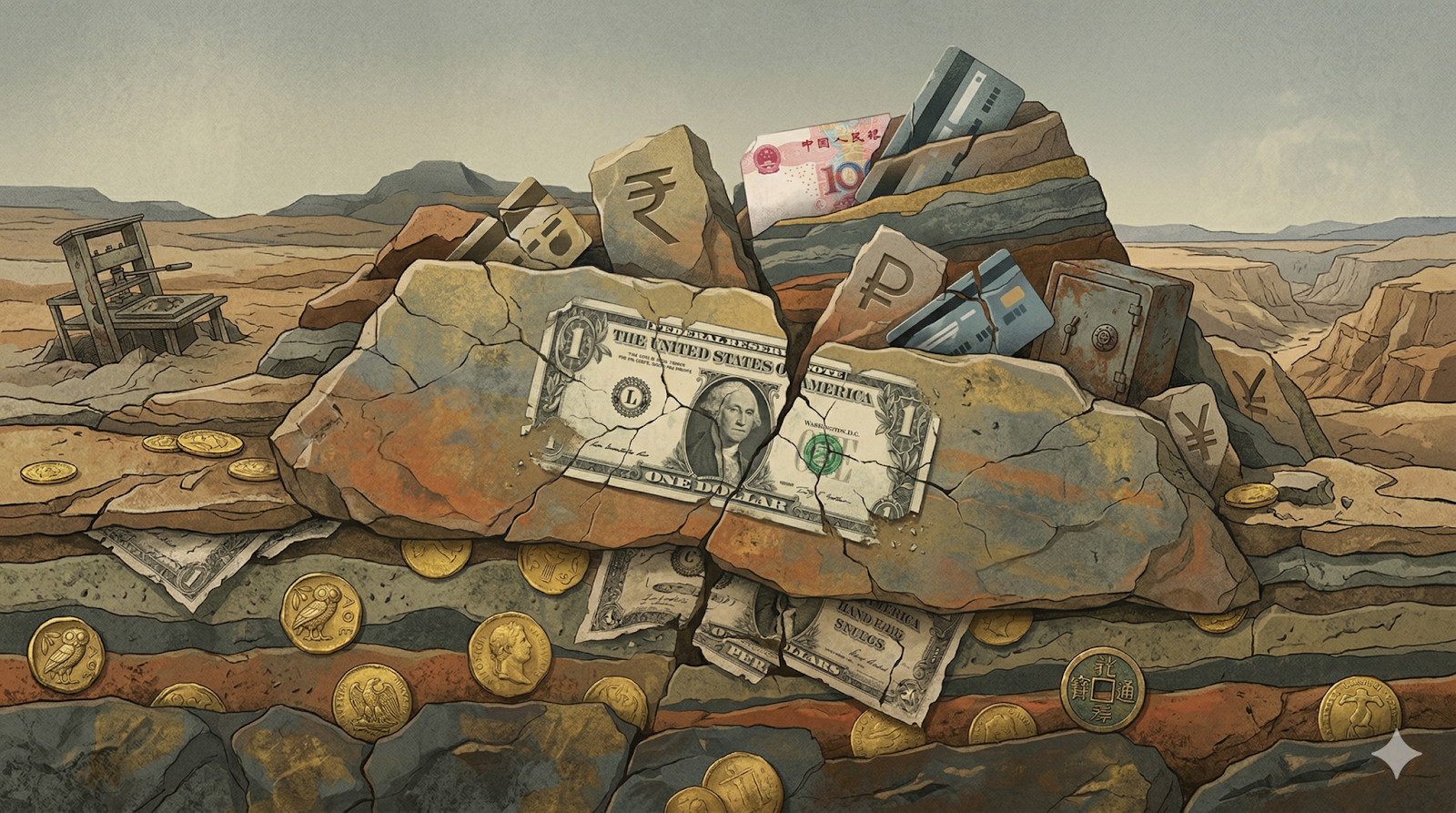
- Rather than eroding the dollar, current trends point to a fragmented, multipolar currency system driven by risk hedging and strategic autonomy.
- At its core, geoeconomics is the application of economic tools to advance or defend a country’s geopolitical priorities.
- For many states, this marked a turning point: financial integration came to be seen as a strategic vulnerability.
- The emerging monetary order will not replace one hegemon with another but reflect fragmentation, diversification, and strategic hedging.
Introduction
The supremacy of the US dollar, long regarded as an anchor of the international monetary system, is being challenged in a period of geopolitical tensions and economic realignment. From sanctions introduced after the Russia–Ukraine war to the increasing use of local currency trade among developing countries, the global financial system is undergoing subtle but important changes. This has reignited the debate on “de-dollarisation”, the post-dollar world that some see on the close horizon.
Still, such narratives run the risk of reducing a much more complicated transformation to a simple story. Instead of indicating the erosion of the dollar, the patterns appear to be revealing the advent of a fractured, multipolar currency system where states pursue risk hedging, strategic autonomy, and the navigation of a more weaponised financial system. Against this backdrop, currency has become more than a means of exchange; it is also an instrument of geopolitical influence that alters the balance of power in the global economy.
Geoeconomics and the Politics of Currency
At its core, geoeconomics is the application of economic tools to advance or defend a country’s geopolitical priorities. This has become all the more coercive and competitive in recent years, with tools like tariffs and investment screening, and financial sanctions and payments system control. The predominance of the US dollar in this system has, in turn, allowed the United States to exert outsized influence over world finance and to rely on access to mechanisms such as SWIFT and dollar-clearing systems as significant levers of power. Therefore, economic interdependence is not only “weaponised” in the pursuit of geopolitical aims but actively facilitates cooperation in that pursuit.
It is against this backdrop that currency politics has regained prominence. The pre-eminence of the dollar is not just a matter of market efficiency but also of institutional power, network effects, and geopolitical trust. As these foundations come under greater challenge, particularly from emerging powers and sanction-hit economies, states are experimenting with alternative arrangements, such as bilateral currency settlements, regional financial architectures and digital payments systems. Such changes, however, do not necessarily signal a coherent or unified assault on the dollar but rather a wider endeavour on behalf of states to reposition and recalibrate in a shifting geoeconomic world.
Sanctions, Financial Power, and the Push for Alternatives
The tightening of Western sanctions, following especially the Russia–Ukraine war, has brought the dollar’s geoeconomic power into sharp relief. The seizure of Russia’s foreign exchange reserves and its de facto exclusion from global payment systems highlighted the degree to which access to dollar-denominated networks can be restricted as an effective tool of coercion. For several states, that represented a pivotal inflexion point: the recognition that financial integration, which had long been seen as a route to stability and growth, could also be understood as a source of strategic vulnerability.
In response, some countries have started to investigate ways to shield themselves from dollar-based systems. Bilateral trade agreements expressed in local currencies, expansion of currency swap arrangements and alternative payment infrastructure have gained ground in the last few years. Crucially, such developments are not motivated by some common ideological front against the dollar, but rather by pragmatic considerations of risk diversification and economic sovereignty. In this way, they do not coalesce into a coordinated dismantling of dollar dominance but into a branching off of parallel financial routes.
India and the Logic of Strategic Hedging
India’s response to these changes has been a delicate balancing act, involving both continuity and change. Although the dollar is still predominant in India’s external trade and financial transactions, recent policy decisions have shown an increasing willingness to consider other options. The launch of the rupee trade settlement, the use of local currencies in trade with a few partners and talks on non-dollar payment systems all indicate a policy of cautious diversification.
Nevertheless, India’s position is not there to bring support to an overt de-dollarisation agenda. It is not a full-scale de-risking of the system but rather a strategic hedging, keeping the best aspects of integration with the global financial system while slowly creating buffers against its potential vulnerabilities. This practical viewpoint demonstrates a distinctive characteristic of the new geo-economic world: countries do not forsake the dollar but are reluctant to place all of their eggs in one basket.
The Limits of De-dollarisation
Although the chatter about de-dollarisation has been rising, the structural reasons why the dollar reigns supreme are very well entrenched. The US dollar still represents a large portion of global foreign exchange reserves, the billing currency for international trade, and cross-border financial transactions. The dominance of the US dollar is due to not just the size and stability of the US economy, but also the depth and liquidity of its financial markets, the liquidity of dollar assets and the institutional credibility of its monetary system.
Moreover, the lack of a viable, cohesive alternative also constrains any quick move off the dollar. The euro, although important, is constrained by political divisions within the European Union, and China’s renminbi is hobbled by capital controls and its limited convertibility. Projects as a common BRICS currency have also encountered practical and political challenges, with member states giving priority to national economic interests rather than monetary integration. So, we should not expect a Great Transformation from dollar supremacy to an alternative hegemon in the global monetary system any time soon.
Fragmentation and the Future of Currency Power
Instead of a decisive turn away from the dollar, the global monetary system is fragmenting and becoming multi-dimensional, with multiple currencies and payment systems coexisting. In this environment, the dollar will probably continue to figure prominently, but less exclusively, as countries move towards regional currencies, bilateral settlement systems and alternative financial infrastructures. This decentralisation of currency power reflects a broader geoeconomic truth, one in which states are trying to reconcile integration and autonomy, and efficiency and security. Such fragmentation may result in greater strategic flexibility, but also potentially greater complexity and fragility in the global financial system, a reminder of the volatile path of the international monetary order itself.
Conclusion
The changing conversations around de-dollarisation reveal less about the decline of the dollar and more about the shifting tectonic plates of global economic power. With financial tools getting ever more intertwined with geopolitical ones, currencies don’t just serve as neutral mediums of exchange, but rather are active instruments of statecraft. Hence, the new monetary system will not feature the replacement of one hegemonic currency by another, but rather a disintegration, fragmentation, diversification and strategic hedging. For countries such as India, the shift is both an opportunity and a limitation, and they will need to strike a delicate balance between reaping the benefits of an integrated financial system and protecting themselves from its weaknesses. In this fluid context, the future of currency politics will be less about rupture and more about recalibration.
References:
- Eichengreen, B. (2011). Exorbitant privilege: The rise and fall of the dollar and the future of the international monetary system. Oxford University Press.
- Farrell, H., & Newman, A. (2019). Weaponised interdependence: How global economic networks shape state coercion. International Security, 44(1), 42–79.
- Posen, A. S. (2022). The end of globalisation? What Russia’s war in Ukraine means for the world economy. Foreign Affairs, 101(3), 111–124.
- Prasad, E. S. (2014). The dollar trap: How the US dollar tightened its grip on global finance. Princeton University Press.

Archita Gaur is a postgraduate student at the School of International Studies, JNU. She specialises in the World Economy and has a strong interest in public policy, economic research, and governance. The views expressed are the author’s own.
 Shivendra Shukla
  Anjali Singh
  Divyanka Tandon