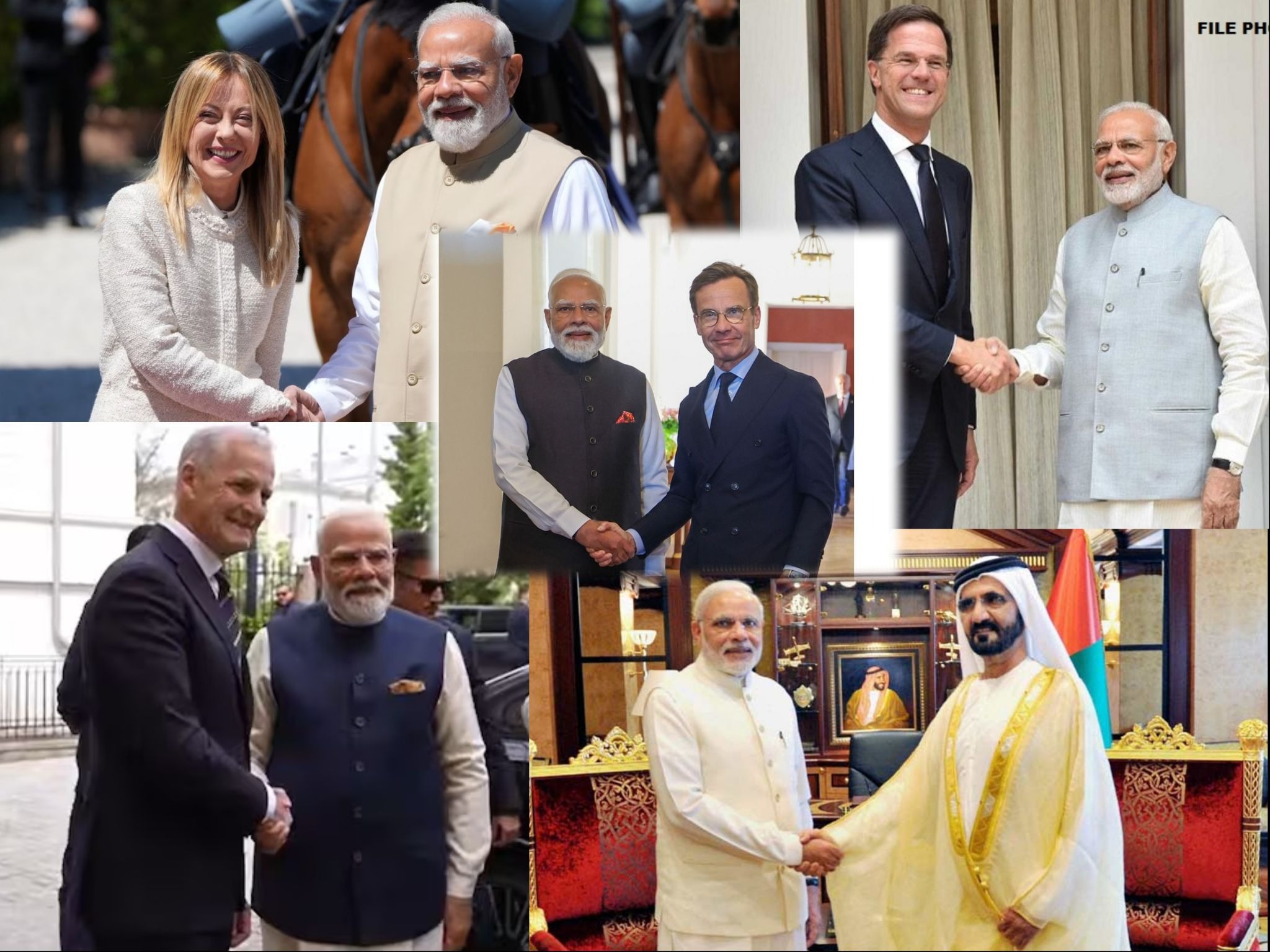
- What New Delhi is doing is more practical: building issue-based coalitions where energy, supply chains, technology, ports, finance and talent mobility matter as much as old military alignments.
- Semiconductors, ports, digital infrastructure and resilient supply chains are now instruments of power.
- Taken together, the five stops show how India’s multi-alignment now works.
- If that happens, Modi’s May 2026 tour will be remembered not as diplomatic choreography, but as part of India’s attempt to shape the operating system of a multipolar world.
Prime Minister Narendra Modi’s visit to the UAE, the Netherlands, Sweden, Norway and Italy from May 15-20, 2026 was more than a crowded diplomatic itinerary. It was a map of India’s changing external priorities. The tour connected the Gulf’s energy and capital, Europe’s technology base, the Nordics’ green transition, and Italy’s Mediterranean reach into one larger strategic story.
The point is not that India has abandoned non-alignment for alliance politics. It has not. What New Delhi is doing is more practical: building issue-based coalitions where energy, supply chains, technology, ports, finance and talent mobility matter as much as old military alignments.
UAE: Energy, Capital And The Gulf Anchor
The UAE leg underlined why the Gulf remains central to Indian strategy. The relationship is no longer just about oil imports and expatriate remittances, although both remain important. The UAE is India’s third-largest trading partner, hosts more than 4.5 million Indians, and has become a key investor and logistics partner.
The visit produced agreements on strategic petroleum reserves, LPG supplies, defence cooperation, ship repair, maritime skills and an eight-exaflop supercomputing cluster with G42. Press reports also placed UAE investment commitments at about $5 billion, including proposed investments in Indian infrastructure and financial institutions.
The geopolitical message is clear. India’s energy security now means more than buying crude. It means storage, shipping, financial flows, digital infrastructure and secure sea lanes. Modi’s emphasis on free navigation through the Strait of Hormuz showed how deeply Gulf stability is tied to India’s food, fuel and trade security.
Netherlands: Technology And The New Strategic Partnership
The Netherlands visit was important because India’s European outreach is increasingly about technology and supply-chain resilience. The two sides elevated relations to a Strategic Partnership and adopted a roadmap covering semiconductors, AI, quantum systems, cyber security, space, water management, sustainability and defence.
This is where geopolitics has moved. Semiconductors, ports, digital infrastructure and resilient supply chains are now instruments of power. For India, cooperation with the Netherlands is not a narrow bilateral exercise. It is part of a larger effort to reduce technological vulnerability and deepen ties with Europe’s advanced industrial ecosystem.
Sweden: Innovation As Strategy
Sweden’s value to India lies in innovation, advanced manufacturing, clean technologies and defence industry. During the Gothenburg summit, India and Sweden elevated ties to a Strategic Partnership and adopted a Joint Action Plan for 2026-2030. The partnership rests on stability and security, next-generation economic cooperation, emerging technologies, and people-planet-resilience.
The Swedish government statement also pointed to cooperation in AI, trusted connectivity, space, critical minerals, industrial decarbonisation and supply-chain security. This matters because the future balance of power will not be decided by armies alone. It will also be shaped by those who command clean industry, digital networks, advanced manufacturing and research ecosystems.
Norway And The Nordics: India Moves North
The Norway visit and the third India-Nordic Summit widened India’s strategic map. This was the first visit by an Indian Prime Minister to Norway since 1983. Norway and India established a green strategic partnership focused on trade, technology, renewable energy, oceans, AI, digital public goods and health cooperation.
The Nordic summit gave this outreach a regional frame. Modi described India and the Nordics as natural partners because of their shared interest in democracy, rule of law, technology and sustainability. He also linked Nordic strengths in blue economy, Arctic research, geothermal energy, maritime systems, digital technologies and advanced manufacturing with India’s scale.
The India-EFTA Trade and Economic Partnership Agreement adds weight to this engagement. The pact, which entered into force on October 1, 2025, carries an investment objective of $100 billion over 15 years and the creation of one million direct jobs in India.
Italy: Europe, Defence And The Mediterranean Link
The Italy leg gave the tour a strong Mediterranean finish. India and Italy elevated ties to a Special Strategic Partnership and agreed to create a foreign-ministers-led mechanism to review the India-Italy Joint Strategic Action Plan 2025-2029.
The joint declaration set a target of expanding bilateral trade to €20 billion by 2029 and identified cooperation in critical minerals, ports, maritime transport, defence industrial collaboration, AI, quantum computing, semiconductors, clean energy and IMEC. Italy matters because it sits at the intersection of Europe, the Mediterranean and transatlantic politics. For India, Rome is not just another European capital; it is a gateway to Mediterranean connectivity and defence-industrial cooperation.
India’s Multi-Alignment In Practice
Taken together, the five stops show how India’s multi-alignment now works. The UAE offers energy, capital and Gulf access. The Netherlands offers technology and logistics. Sweden brings innovation and advanced industry. Norway and the Nordics bring sustainability, Arctic relevance and green technology. Italy adds Mediterranean connectivity, defence manufacturing and EU leverage. This is not bloc politics. It is a search for a strategic room in a fragmented world. India is trying to work with many centres of power without becoming captive to any one of them.
From Presence To Influence
The real significance of the tour lies not in the number of agreements signed, but in the architecture it reveals. India wants to be present in the Gulf, embedded in Europe’s technology networks, active in Nordic sustainability debates, and relevant to Mediterranean connectivity.
The harder task begins after the visits: turning declarations into projects, investments, jobs and technology partnerships. If that happens, Modi’s May 2026 tour will be remembered not as diplomatic choreography, but as part of India’s attempt to shape the operating system of a multipolar world.
References:
[1] Visit of Prime Minister to UAE, Netherlands, Sweden, Norway, and Italy, May 15-20, 2026
[2] PIB: Prime Minister’s Visit to the UAE
[3] Business Standard: Modi’s UAE visit secures $5 bn investments
[4] PIB: Prime Minister’s visit to the United Arab Emirates
[5] PIB: India-Netherlands Joint Statement
[6] PM India: PM holds bilateral talks with Prime Minister of Sweden
[7] Government of Sweden: Joint Statement on the India-Sweden Summit
[8] Government of Norway: Norway and India to strengthen cooperation
[9] PM India: Press statement at the Third India-Nordic Summit
[10] PIB: India-EFTA Trade Pact
[11] PM India: India-Italy Joint Declaration

Kritant Mishra is a Public Policy Consultant and Director of an NGO. His areas of interest include socio-anthropology, geopolitics, health, and associated policy issues.
 Dr Mohmmad Rizwan
  Parag Gilada
  Archita Gaur