
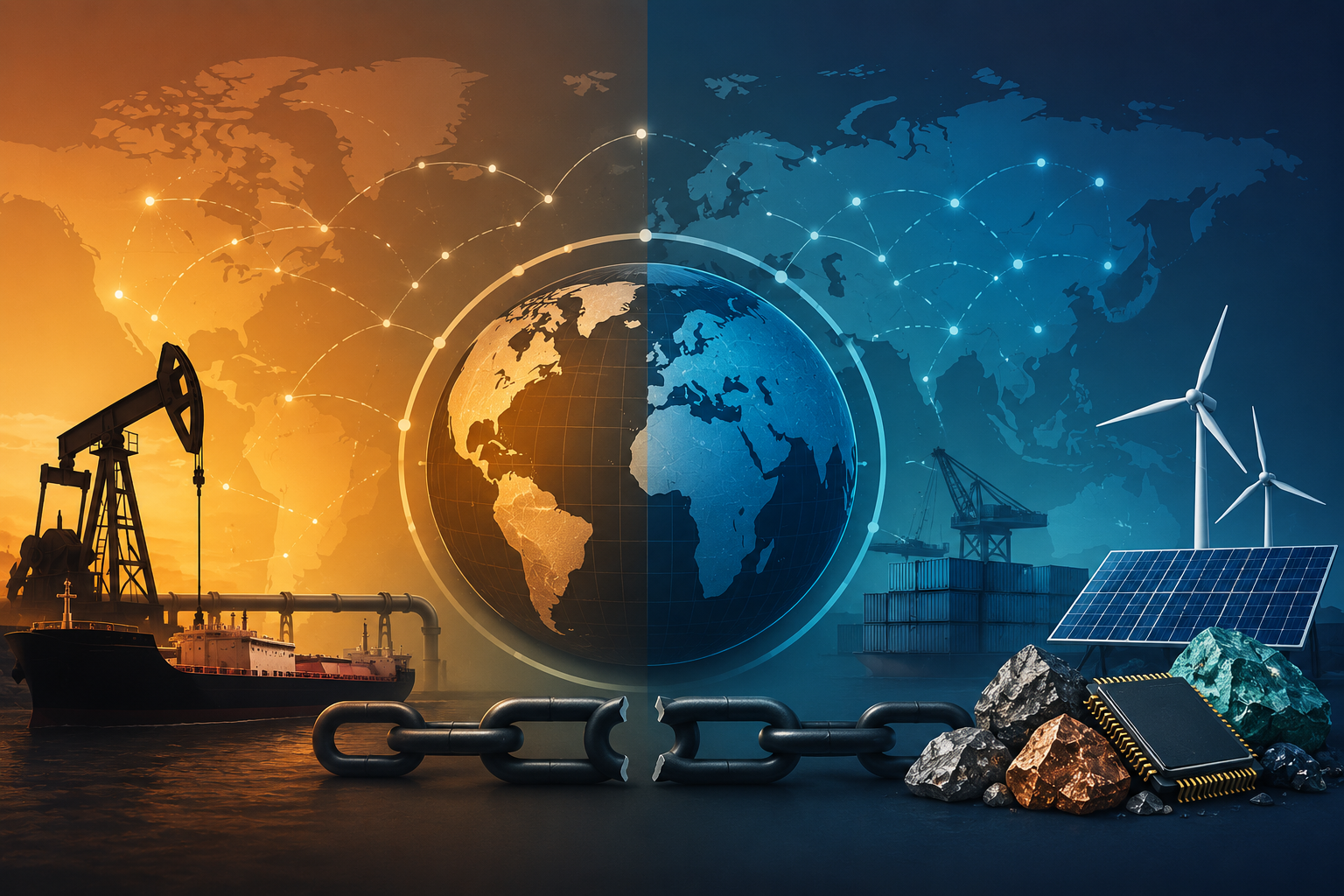
- The new frontier of resource power is not in the oil field but in the mine shafts.
- The question is no longer whether mineral supply chains carry geopolitical risk, but whether any major power can afford to let them be.
- Instead of oil, countries are competing for critical minerals, advanced microchips, and the technologies involved in advanced systems and advanced manufacturing.
- As states increasingly use economic interdependence as a means of deliberate economic warfare through export controls, sanctions, and supply-chain dominance, achieving economic resilience will no longer be viewed simply as a developmental concern but as a strategic necessity.
Oil has historically been the preeminent currency of power projection in the twentieth century. The oil embargo placed against the U.S. in 1973 following its support for Israel in the Yom Kippur War highlighted how devastatingly powerful oil could be as a means of causing economic harm to other major powers. Academics and analysts have spent decades analysing the various choke points, pipelines, and tanker lanes that allowed an energy economy dependent on oil to be made politically vulnerable. The world created as a result of the clean energy transition will function according to a very different material logic. Energy systems reliant on clean energy technologies differ significantly from those that utilise more traditional sources of hydrocarbon energy, as they tend to need more mineral content to construct than their fossil fuel-powered predecessors. The new frontier of resource power is not in the oil field but in the mine shafts.
The sheer scale of this transition cannot be overstated. An average electric vehicle has six times more mineral content than its non-electric counterpart, and offshore wind farms require nine times as much mineral extraction as gas-powered facilities, with total demand for minerals expected to increase by 100% by 2040 if we hope to achieve the ambitions laid out in the Paris Climate Accord, doubling that increase if those plans are to be taken seriously. Lithium, cobalt, nickel, rare earths, and copper have all become key materials for a modern economy. However, whereas oil production once allowed for competitive strategy and diversity of supply, today China holds sway over no less than fifteen critical minerals and roughly ninety per cent of the world’s rare earth refinery capabilities.
China’s dominance is no accident; it is the result of deliberate vertical integration backed by state financing, leveraging entire value chains for geopolitical influence. US and EU leaders now call for “de-risking” as supply chains grow fragmented and, in the National Security Advisor’s words, “weaponised.” The question is no longer whether mineral supply chains carry geopolitical risk, but whether any major power can afford to let them be.
From Oil Geopolitics to Geoeconomics
During much of the twentieth century, oil was integral to global power dynamics. Evidence supporting this statement is found throughout The New Map, where it is shown that countries fought over oil, rather than fought over ideologies and borders. Countries fought over oil fields and pipelines, and even the most important shipping routes of the world. The 1973 oil embargo, following the Yom Kippur War, demonstrated that energy was a more valuable resource than just a form of power. Energy was a resource that could be used as a weapon. Even the most powerful nations in the world were vulnerable when another nation turned off the oil supply. The most important and most urgent issue on the agenda of world leaders became energy.
Today, the nature of geopolitical competition is undergoing a transformation. The world isn’t as focused on oil as it was in the past. Now the focus is on clean energy, advanced manufacturing, and the technologies that run the world. Instead of oil, countries are competing for critical minerals, advanced microchips, and the technologies involved in advanced systems and advanced manufacturing. Other technologies and Electric Vehicles, as well as technologies that rely heavily on renewable energy, artificial intelligence, lithium, cobalt, nickel, and other rare earth elements for which there is a high demand, are creating a strategic dependence.
Henry Farrell and Abraham Newman refer to this as ‘weaponised interdependence.’ Farrell and Newman assert that power imbalance in interdependence creates geopolitical challenges. Power dominance no longer rests heavily on natural resource acquisition. Rather, the power gradient shifts with advanced technologies and the capabilities to process and manipulate information and data.
Recent examples are more illustrative of the trends discussed. The CSIS reports noted the intensifying competition between China and the United States. This competition is no longer exclusively political or economic. Rather, it is the competition to control the technologies, trade, and export of critical elements. The competition in the control of supply chains has dominated challenges in the field of modern diplomacy. China’s dominance in rare earth processing and recent limitations on its exports exemplify this.
Supply Chains as Strategic Weapons
Globalisation was once considered mainly as a process of increasing economic interdependence and thus decreasing the chance of war between states. But the concentration of vital industries and supply lines has come to make economic networks an arm of geopolitical coercion. Those states that control critical nodes of production, processing, or transportation can also press their rivals in a strategic sense, with considerable effect.
That dynamic is especially clear in the escalating rivalry between the US and China. The U.S. curbs on exports of advanced semiconductors to China and sanctions on technology companies, including Huawei, are attempts to deny Beijing access to areas of technology that are strategically important. At the same time, China’s monopoly over rare earth processing and its restrictions on exports of critical minerals like gallium and germanium reveal how supply chains can themselves be weaponised to achieve geopolitical ends.
Instead of historical geopolitical competition focused on state-to-state territorial competition or military confrontation, today’s geoeconomic competition increasingly works through competition over technological ecosystems, industrial infrastructure, and critical nodes in the economy. Semiconductors, batteries, digital infrastructure, and logistics corridors have become core elements of national security thinking. Thus, economic resilience and supply-chain diversification are now not only economic priorities but strategic musts for states pursuing a diminution of external dependence and the maintenance of geopolitical autonomy.
India’s Strategic Challenge
The increasing importance of supply chains and critical technologies in India has implications for both opportunities and vulnerabilities. As it attempts to carve a niche as a counterweight in manufacturing and technology to the escalating US-China rivalry, it still relies on external supply chains for semiconductors, critical minerals and high-tech components.
Recent policy actions, like the semiconductor production incentives, critical mineral partnerships, and cooperation in strategic formats such as the Quad, all suggest growing appreciation of economic security as a part of national security. But you can’t just throw resources at it. Strategic resilience is increasingly a function of processing power, technological infrastructure and industry coordination.
With global economic systems being disaggregated by export controls, sanctions and strategic competition, India has to find a way to balance economic integration with strategic autonomy. Its long-term geopolitical power will rest not just on its military capabilities, but also on its ability to build resilient technological and industrial ecosystems.
Conclusion
The landscape of global competition is changing fundamentally. To cite an old analogy, while oil once shaped the strategic thinking of the great powers, today’s antagonism concerns the networks of supply, trade, and the technology infrastructures of economies. Semiconductors and critical minerals have become the central security and influence components of nation-states.
As states increasingly use economic interdependence as a means of deliberate economic warfare through export controls, sanctions, and supply-chain dominance, achieving economic resilience will no longer be viewed simply as a developmental concern but as a strategic necessity. In the new geoeconomics, the balance of power will increasingly determine those countries that are able to design and secure the infrastructures of the world economy.
References:
- Farrell, H., & Newman, A. L. (2019). Weaponised interdependence: How global economic networks shape state coercion. International Organisation, 73(1), 42–79.
- International Energy Agency. (2021). The role of critical minerals in clean energy transitions.
- Reuters. (n.d.). Coverage on China’s export controls and critical minerals.
- Yergin, D. (2020). The new map: Energy, climate, and the clash of nations. Penguin Press.
- Centre for Strategic and International Studies. (n.d.). Critical minerals and semiconductor supply chains.

Archita Gaur is a postgraduate student at the School of International Studies, JNU. She specialises in the World Economy and has a strong interest in public policy, economic research, and governance. The views expressed are the author’s own.
 Divyanka Tandon
  Aayush Pal