
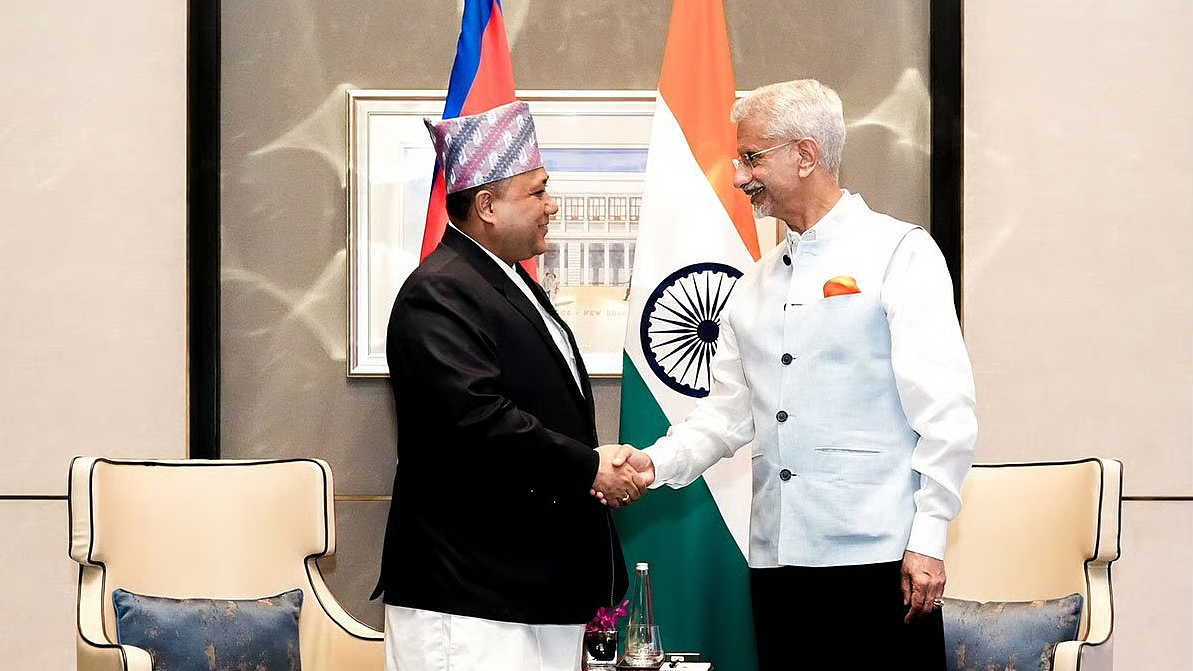
- The first important visit by a Nepali delegation after the coming to power of the new Prime Minister of Nepal, Balen Shah, who rose to prominence through the popular Gen Z-led protests across the country.
- During the visit, both sides discussed a wide range of issues, including development cooperation, connectivity, trade and transit, energy cooperation, people-to-people ties, and regional and multilateral matters.
- Foreign Minister Shishir Khanal has affirmed that the new administration in Kathmandu does not intend to carry the baggage of past differences with India and would instead seek to build a relationship based on mutual growth, cooperation, and stability.
- While New Delhi seeks to strengthen its partnership with Kathmandu, it would also prefer that Nepal does not tilt excessively towards China.
Nepal’s Foreign Minister Shishir Khanal visited India last week on an important bilateral visit. This visit of the Nepali Foreign Minister came at the invitation of India’s External Affairs Minister Dr S. Jaishankar. It was the first important visit by a Nepali delegation after the coming to power of the new Prime Minister of Nepal, Balen Shah, who rose to prominence through the popular Gen Z-led protests across the country.
The visit was important as India and Nepal have historically shared a close relationship. Nepal has been greatly dependent on India, and India has consistently been among Nepal’s first responders and strongest supporters during times of need. During the visit, both sides discussed a wide range of issues, including development cooperation, connectivity, trade and transit, energy cooperation, people-to-people ties, and regional and multilateral matters.
Importantly, the two countries completed the internal procedures for the India-Nepal Mutual Legal Assistance Agreement in Criminal Matters, which will improve cooperation against cross-border crime. Another key development was the launch of a peer-to-peer payment linkage between India’s UPI and Nepal’s National Payments Interface, enabling easier cross-border personal remittances.
From Border Disputes to Renewed Engagement
The relationship between India and Nepal has not only been very close but has also gone through difficult phases. Nepal has a long history of political instability, and particularly under the Communist Party-led governments, relations between India and Nepal deteriorated despite Nepal’s significant dependence on India. Both countries share an open border, and India has been one of the largest employment providers for Nepali citizens, with large numbers of Nepalis working in India. India has also been a major supporter of Nepal’s energy sector and broader economic development.
However, issues have emerged in the bilateral relationship, particularly after former Nepali Prime Minister K.P. Sharma Oli raised border disputes involving the Kalapani, Limpiyadhura, Lipulekh tri-junction, and the Susta region. These disputes significantly strained relations between the two countries. Nepal’s greater tilt towards China under Communist administrations further widened the distance between New Delhi and Kathmandu.
However, after 2022, when the Nepali Congress-led government under Sher Bahadur Deuba came to power, relations between the two countries improved considerably.
The Balen Shah Government and Emerging Challenges
Another major political development occurred in Nepal in September last year, when widespread Gen Z-led protests swept across the country, remarkably overturning the existing political order and bringing Kathmandu Mayor Balen Shah, a former music artist, to power.
There have, however, been some interesting exchanges since the new government assumed office. Prime Minister Balen Shah recently stated in the Nepali Parliament that it is not only India that has taken Nepali land, but Nepal has also occupied Indian land. This was a significant statement as it was among his first remarks touching upon the India-Nepal border issue.
Another development that has attracted attention since the new Prime Minister came to power is the decision by Nepali border authorities to levy taxes on goods purchased by Nepali citizens from India and brought across the border. This is a notable development and one that could have implications for India-Nepal bilateral relations.
Despite these issues, Foreign Minister Shishir Khanal has affirmed that the new administration in Kathmandu does not intend to carry the baggage of past differences with India and would instead seek to build a relationship based on mutual growth, cooperation, and stability.
Security Concerns and the China Factor
A strong India-Nepal relationship remains critical for India, not only for strengthening bilateral ties but also from a security perspective. Given the open border between the two countries, Indian authorities have identified the presence of various non-state actors, human trafficking networks, illegal cross-border activities, and other security concerns that exploit the porous frontier. The Indian administration would like to remain closely aligned with the Nepali government to curb such activities and ensure that Nepal does not become a safe haven for such networks.
The China factor is another important aspect of the relationship. Nepal-China ties have evolved significantly, particularly under Communist governments in Nepal. China has emerged as a major infrastructure partner for Nepal, investing heavily in the country. Nepal is also a participant in China’s Belt and Road Initiative. China’s close relationship with Nepal provides Beijing with greater strategic visibility in India’s immediate neighbourhood.
India has remained cautious about these developments. While New Delhi seeks to strengthen its partnership with Kathmandu, it would also prefer that Nepal does not tilt excessively towards China. India would like Nepal-China relations to develop in a manner that does not come at the cost of India’s security interests.

Aayush Pal is a freelance writer on contemporary geopolitical developments. The views expressed in his work are entirely his own.
 Hridbina Chatterjee