
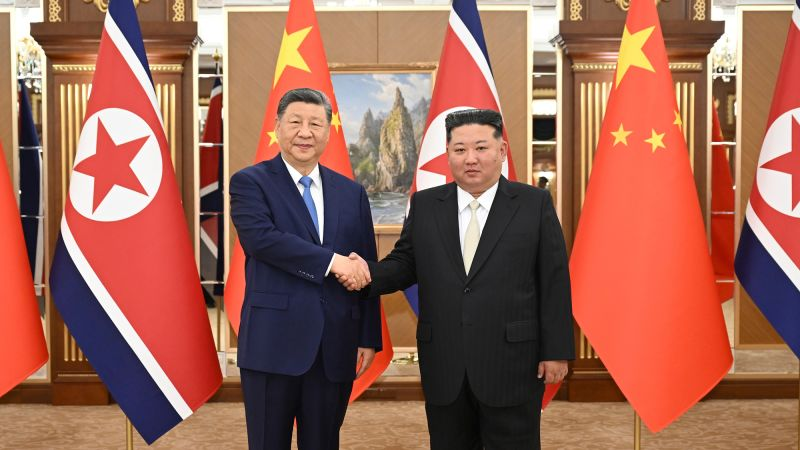
- Beijing’s visit is about more than just maintaining relations with a long-time ally. It is an attempt to recapture control of a neighbour that has grown in its strategic alliances, especially with Russia.
- Another purpose of the visit is to regain the diplomatic initiative on Korean Peninsula issues, as Beijing wants.
- The most pressing problem looming over the visit is probably North Korea’s rapidly expanding nuclear program.
- The timing of Xi’s visit also speaks to the broader strategic rivalry between the United States and China.
President Xi Jinping of China will be the first Chinese leader to visit North Korea in seven years when he arrives in Pyongyang on June 8. The tour is reportedly to mark the 65th anniversary of the signing of the 1961 China-North Korea Treaty of Friendship, Cooperation and Mutual Assistance. But underneath the symbology is a geopolitical story of much greater significance. Xi’s visit comes amid a major strategic shift in northeast Asia fuelled by North Korea’s nuclear ambitions, Russia’s resurgence in East Asia and the intensifying US-China rivalry.
Beijing’s visit is about more than just maintaining relations with a long-time ally. It is an attempt to recapture control of a neighbour that has grown in its strategic alliances, especially with Russia. And it is an effort to maintain China’s centrality in any future discussions on the Korean Peninsula. Xi’s visit is more about strategic management than friendship in many ways.
The Changing Northeast Asian Balance
In North Korea’s foreign policy, China held a special place for many years. Beijing served as Pyongyang’s most significant diplomatic defender at the UN, its biggest trading partner, and its main source of financial support. Even though there were frequently tense moments in the relationship, North Korea’s economic survival depended mostly on China.
However, since Xi’s last visit in 2019, the strategic landscape has undergone a significant shift. North Korea was given new opportunities as the Russia-Ukraine war broke out and Moscow’s relations with the West deteriorated. As a result of the sanctions, Russia became more and more dependent on nations that would help it achieve its geopolitical goals. Pyongyang became one of their allies.
As a result, Russia-North Korea relations have rapidly grown. There has been an increase in high-level diplomatic interactions, commercial exchanges, and military collaboration. When Russian President Vladimir Putin visited Pyongyang in 2024, both nations signed accords that signalled a closer strategic alignment, marking a new turning point in the relationship.
From Beijing’s point of view, this is a problem.
Historically, China has considered the Korean Peninsula to be on its strategic periphery. Beijing does not want Moscow to serve as Pyongyang’s substitute center of influence, even though it is happy that North Korea and Russia have cordial relations. A crucial part of China’s regional security strategy has always been its influence over North Korea. North Korea eventually becomes less reliant on Beijing and more independent when it has several influential backers.
Thus, it is possible to read Xi’s visit as a reminder that China is still North Korea’s most significant ally.
Taking Back the Diplomatic Initiative
Another purpose of the visit is to regain the diplomatic initiative on Korean Peninsula issues, as Beijing wants. There have been a lot of big events related to North Korea in the last ten years where China has not been the lead player. The Trump-Kim summits of 2018 and 2019 were watched by the whole world. The world has been watching the growing ties between North Korea and Russia in recent times. China is determined to change that perception.
Xi’s face-to-face meeting with Kim Jong Un shows that Beijing is still a player on the regional stage. But the message is not just for Pyongyang, it’s for Washington, Seoul, Tokyo and Moscow. At any rate, historically, any long-term diplomatic framework on North Korea has required Chinese involvement. Only a few countries have the leverage that Beijing does, controlling important economic lifelines to North Korea. Chinese authorities are well aware that the Chinese will inevitably be involved in future talks on denuclearisation, economic aid, sanctions relief or regional security arrangements.
The visit, therefore, demonstrates that China remains relevant at a time when the world’s focus is shifting elsewhere.
The Nuclear Component
The most pressing problem looming over the visit is probably North Korea’s rapidly expanding nuclear program.
Kim Jong Un has jettisoned many of the constraints that have defined North Korean nuclear policy in recent years. The leadership has broadened its strategic capacity, increased missile testing and maintained a narrative that nuclear weapons are essential to the country’s survival. Kim reportedly called for an “exponential” increase in North Korea’s nuclear arsenal just days before Xi’s arrival. Such pronouncements underscore that Pyongyang no longer appears interested in returning to denuclearisation talks under existing frameworks.
This development places China in a difficult geopolitical position. Beijing formally backs the denuclearisation of the Korean Peninsula. But China actually has more complex goals. Chinese officials fear that excessive pressure on North Korea could lead to instability, a flood of refugees across the border or even the regime’s collapse. Such scenarios could result in a united Korea allied with the US and US military forces on China’s border.
So in China’s strategy, disarmament has often taken a back seat to stability. So Xi’s conversations with Kim are unlikely to be about stopping North Korea’s nuclear advances and more about how to contain the fallout. Beijing is unlikely to press for immediate denuclearisation. Instead, China seeks to prevent nuclear tensions from escalating into a regional crisis that could threaten Chinese security.
A Note to Washington
The timing of Xi’s visit also speaks to the broader strategic rivalry between the United States and China. There has always been a great power competition on the Korean peninsula. It was one of the main issues of conflict between ideological blocs during the Cold War. It has become an important battleground in the broader China-U.S. competition.
Washington’s growing security partnerships with South Korea and Japan have fueled China’s worries about being contained in the region. In recent years, the three countries have vastly expanded their trilateral military cooperation, primarily driven by shared concerns over North Korea’s missile program and China’s military development.
Beijing sees these developments as a threat to the development of a more unified East Asian security architecture under the leadership of the United States. China’s close relations with North Korea give it strategic depth. North Korea is a geopolitical buffer between US military assets in South Korea and Chinese territory. If Chinese influence in Pyongyang waned, it might be unacceptable to Beijing.
Xi’s visit underscores China’s resolve to sustain its strategic stance in the Korean Peninsula. Moreover, the trip illustrates China’s capacity to engage with entities that are still out of reach for Western diplomacy. While Washington is still struggling to set up serious communication channels with Pyongyang, Beijing still has direct links to the North Korean leadership.
This diplomatic advantage remains a key tool in China’s broader contest with the United States.
Economic Aspects of the Relationship
While security issues make for front-page news, economic factors are equally important.
North Korea is slowly opening up parts of its economy after years of being shut down due to the pandemic. Trade with China across the border has resumed, transit links have been re-opened, and official contacts have been more frequent. For North Korea, deeper economic engagement with China offers access to investment, technology, consumer goods and critical imports. China is still by far North Korea’s most important economic partner, although ties with Russia are growing.
Beijing has several goals in its economic engagement. It stabilises North Korea, maintains Chinese influence and assists in developing northeastern provinces that have historical economic ties with the Korean Peninsula. The economic dimension also gives China leverage that neither Russia nor other international actors can easily replicate.
This leverage is one of Beijing’s most powerful tools to shape North Korean behaviour.
Regional Security Implications
Xi’s visit will be closely monitored throughout northeast Asia, as the ramifications will extend well beyond the two countries.
Closer China-North Korea ties could stoke fears in South Korea and Japan of a nascent alliance of China, Russia and North Korea. These perceptions could promote more security cooperation with the United States and hasten regional military modernisation. The trip highlights the challenges of Washington’s diplomatic efforts to isolate North Korea. It also underscores China’s ongoing capacity to shape the course of events in the Korean Peninsula.
The visit serves as a reminder to Russia that, despite recent progress in Pyongyang, China is still the most important external player in North Korean affairs. Most importantly, the visit is a symbol of the emergence of a more competitive and multipolar regional order. The Korean Peninsula is emerging as a battleground for many great powers with overlapping and sometimes conflicting agendas.
Conclusion
Xi Jinping’s trip to Pyongyang is more than a diplomatic courtesy call between old pals. It is a carefully calculated strategic move aimed at strengthening China’s position in a time of huge geopolitical change.
The trip highlights Beijing’s concerns over Moscow’s expanding role in North Korea, the issue of Pyongyang’s growing nuclear stockpile and the wider context of US-China competition in the Indo-Pacific. It also shows China’s desire to preserve its leading position in diplomacy on the Korean Peninsula. The visit gives North Korea a chance to balance its ties with Beijing and Moscow, while enhancing its international status. This is a strategic exercise in reassurance and geopolitical positioning for China.
Xi’s return to Pyongyang may be viewed as more than a symbolic anniversary visit as Northeast Asia enters a new era of great power competition. This could be the start of China’s efforts to reset its place in one of the world’s most strategically important regions, ensuring that as the regional order unfolds, Beijing is right in the middle.

Anusreeta Dutta is a columnist and climate researcher with experience in political analysis, ESG research, and energy policy. Views expressed are the author’s own.
 Hridbina Chatterjee
  Divyanka Tandon
  Kumar Satish