
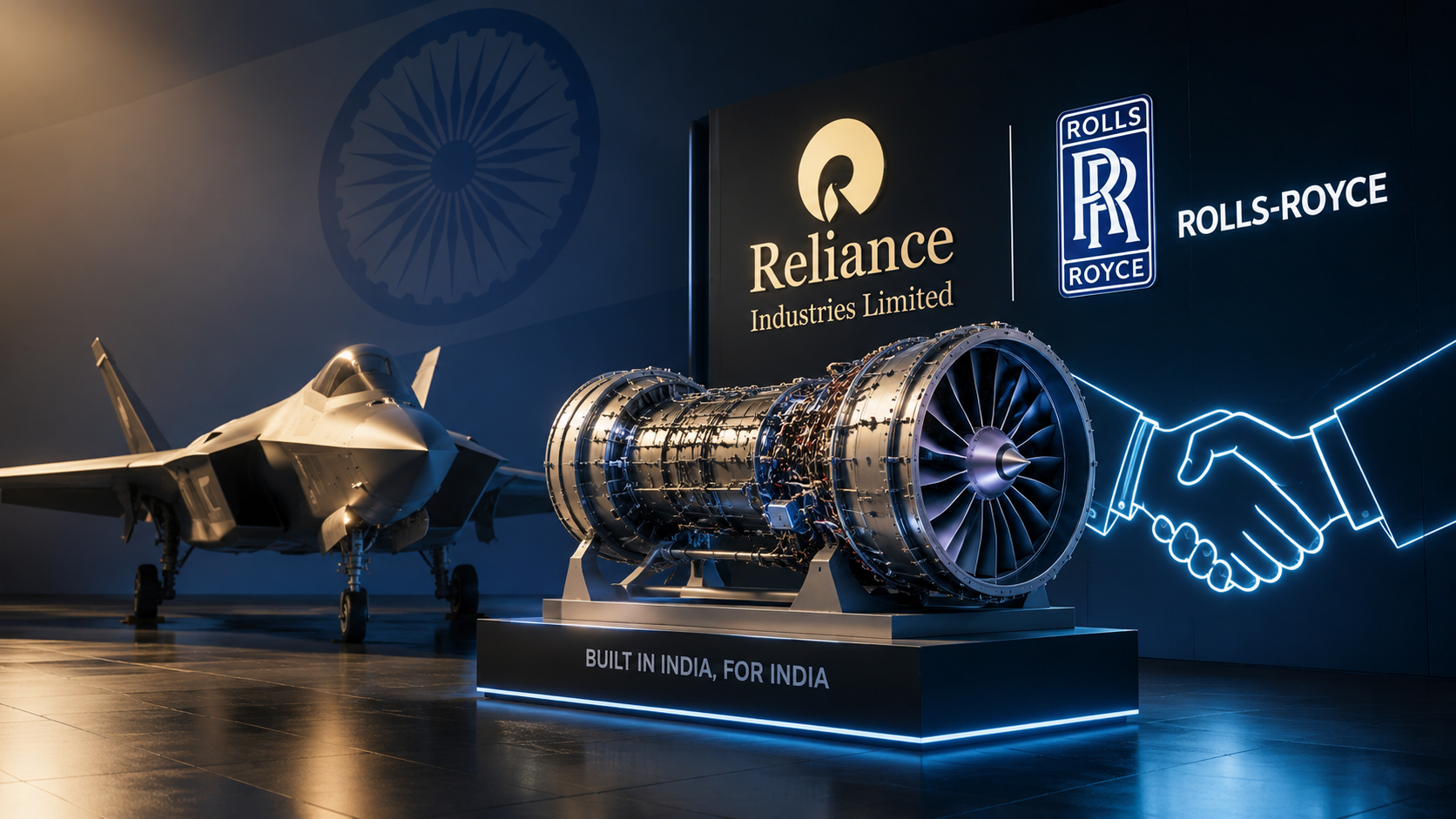
- Reliance Industries Limited and Rolls-Royce have announced that both companies would come together to design, develop, manufacture and deliver an engine for India’s Advanced Medium Combat Aircraft (AMCA).
- With this particular deal, the two companies would also set up a dedicated Aerospace Gas Turbine Complex in India, which would act as an epicentre for advanced propulsion technology in the world of defence and strategy.
- If India goes ahead with purchasing fifth-generation fighter jets from outside, India would not necessarily need to wait, and this may change the statistics of air power in South Asia. However, doing this comes at the cost of strengthening a foreign defence industry instead of India’s own.
- One of the greater requirements has been to include private players in the defence sector to create a sense of competition and greater accountability among all the involved parties.
In a significant development and a major boost towards bolstering the Indian military-industrial complex and advancing the Indianisation of Indian defence, a significant landmark move has been made. Reliance Industries Limited and Rolls-Royce have announced that both companies would come together to design, develop, manufacture and deliver an engine for India’s Advanced Medium Combat Aircraft (AMCA).
This is a significant move for India, considering that India is in great need of boosting its military-industrial complex and is also looking towards the Indianisation of its defence.
With this particular deal, the two companies would also set up a dedicated Aerospace Gas Turbine Complex in India, which would act as an epicentre for advanced propulsion technology in the world of defence and strategy.
Fifth-generation aircraft have now become increasingly common, and almost every country is advancing, diversifying and bolstering its squadrons and air arsenals. Fifth-generation fighter jets have become an important part of modern warfare, and India is extremely keen on developing its own fifth-generation stealth aircraft.
This comes at a time when India has also looked at many foreign options, and there is a great conundrum that exists for India. The question that comes up is whether India should look for a foreign, advanced and well-established fighter jet engine for a fifth-generation aircraft, or whether it should continue on its own path.
Both options have their own interesting angles. If India goes ahead with purchasing fifth-generation fighter jets from outside, India would not necessarily need to wait, and this may change the statistics of air power in South Asia. However, doing this comes at the cost of strengthening a foreign defence industry instead of India’s own, and this is something which India does not necessarily want to do.
That is why India, despite continuous proposals coming from Russia and the United States of America, is keen on developing its own capabilities. This is not only news which would greatly support the Indianisation of Indian defence, but more importantly, it could also change the strategic calculus of South Asia.
There have been multiple reports suggesting that Pakistan has been looking for Chinese fifth-generation aircraft, and China is very much interested in providing them to Pakistan to create a potential continental dilemma for India. Keeping this in context, India is in greater need of developing its own fighter jet.
One of the major problems that has come up in India over the years, and which has been greatly questioned by the military brass and the establishment, is that the Indian military-industrial complex has been largely dominated by the government-led Hindustan Aeronautics Limited.There has been a lack of accountability and a great deal of red-tapism over the years, because of which many projects have faced delays.
Such is the reason that the Tejas aircraft, which was supposed to be given to the Indian Air Force almost a decade ago, has still faced significant delays in delivery. This has been one of the major problems. Because of all of this, one of the greater requirements has been to include private players in the defence sector to create a sense of competition and greater accountability among all the involved parties.

Aayush Pal is a freelance writer on contemporary geopolitical developments. The views expressed in his work are entirely his own.
 Anjali Singh
  Piyush Anand