- The declaration, which was unanimously endorsed by the delegates, signals the BRICS nations’ shared understanding of the need to institutionalise sporting ties beyond rhetoric and turn them into a tool for diplomatic and economic leverage.
- Thus, by facilitating deeper economic ties between the Global South nations, India is not only fulfilling its BRICS obligations but also securing the domestic supply chain of high-quality sporting equipment for years to come.
- By institutionalising regular science and technology cooperation between the member states, the Working Group will promote the adoption of a shared approach to high-performance sports in BRICS.
- The meeting in Visakhapatnam has demonstrated that sports are truly a holistic, people-oriented activity and that their diplomatic potential extends far beyond the athletic field.
In the modern multipolar world, sports soft power is undergoing a significant transformation: the era of friendly exhibitions and goodwill athletic events is over, as sports are now at the forefront of International Relations, economic, and even existential struggles between the Global South and the status quo powers.
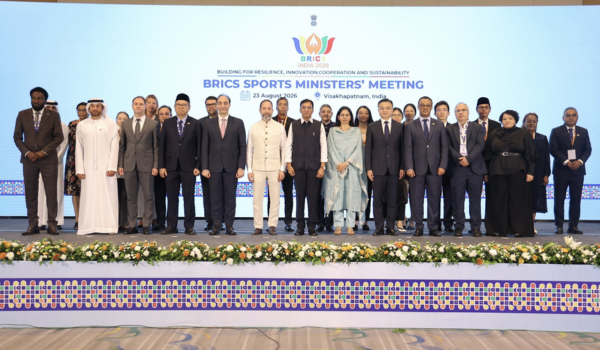
The BRICS Sports Ministers’ Meeting, which was held in Visakhapatnam, Andhra Pradesh, under the Indian chairmanship, has recognised the centrality of sports in the broader diplomatic tussle. Themed “Building for Resilience, Innovation, Co-operation and Sustainability”, the two-day meeting concluded with the adoption of the Visakhapatnam Joint Declaration by the participating ministers. The declaration, which was unanimously endorsed by the delegates, signals the BRICS nations’ shared understanding of the need to institutionalise sporting ties beyond rhetoric and turn them into a tool for diplomatic and economic leverage. As emphasised by Indian Union Minister for Sports and Youth Affairs Mansukh Mandaviya in his opening remarks, the BRICS nations are set to deliver on their pledge to “go beyond declarations” and “build a sporting partnership”, thus transforming the relationship between sports, society, and the state.
Why Sports Governance and Institutional Design Matter: Trust, Trade, and Soft Power
At the conceptual level, the meeting in Visakhapatnam has made it clear that in the twenty-first century, sports are inseparable from broader geopolitical, economic, and even military questions. The very existence of multinational sporting events, let alone leagues, is predicated on the ability of any given nation-state to secure supply chains and generate demand for sporting goods at home. It is therefore not surprising that the meeting in Andhra Pradesh prioritised the topic of industrial policy and supply chains. International sports markets for technical apparel, technical equipment, and other sport-related goods are currently highly integrated with the global economy. This integration, which has been accelerated by the liberalisation of international trade, has created dangerous vulnerabilities for the Global South.
India’s proposal to host the maiden BRICS Sports Manufacturing Conclave in Udaipur, Rajasthan, in November 2026, has been endorsed by all delegations. The conclave, which will be held under the overarching theme of ‘Sports Manufacturing Ecosystem’, seeks to build on India’s existing domestic initiative to promote sports goods manufacturing clusters. Notably, the Udaipur event will provide an important platform for exporters, suppliers, venture capitalists, small-scale manufacturers, and researchers to connect with potential partners from other BRICS nations. Thus, by facilitating deeper economic ties between the Global South nations, India is not only fulfilling its BRICS obligations but also securing the domestic supply chain of high-quality sporting equipment for years to come.
Technology Transfer and Performance Gaps
Beyond the industrial base, the question of technology transfer has been a critical pillar of the BRICS Sports Ministers’ Meeting. At present, the gap between the Global North and South in cutting-edge sports performance technology is an important impediment to athletic success. Contemporary high-performance sports are characterised by the use of algorithmic decision-making, biomechanical monitoring, and performance prediction: in short, modern technology assists in maximising athletic performance. However, as the case of Russia demonstrates, access to such technology is often limited to well-resourced Western athletic institutions and leagues. To close this technological divide and generate a level playing field for BRICS athletes, the delegates in Visakhapatnam have endorsed the idea of the BRICS Working Group on Sports Technology.
By institutionalising regular science and technology cooperation between the member states, the Working Group will promote the adoption of a shared approach to high-performance sports in BRICS. India’s leadership in the Working Group will be vital in view of the country’s vast reservoirs of technological expertise and innovation. In the longer term, the BRICS nations can work together to develop their own domestic technology ecosystem, which would reduce their reliance on costly proprietary software and systems from the West.
Rebalancing the Global Sports Governance and Institutional Design
The BRICS nations, at the meeting in Visakhapatnam, have recognised the need to collectively reshape the international sports governance architecture. For the longest time, international sports law, rules, regulations, and institutions have been firmly in the custody of Western nations. The jurisdiction of organizations such as the World Anti-Doping Agency (WADA) extends to all nations and jurisdictions, which often puts Global South nations at a disadvantage when it comes to resolving disputes. The sports ministers in Andhra Pradesh have committed to reviewing this situation and have pledged to develop multi-jurisdictional forensic expertise in each nation to review WADA regulations and evaluate doping allegations. Thus, by adopting a more balanced approach to international sports governance, the BRICS nations will be able to protect their athletes and ensure equal treatment on the global stage.
The BRICS Nations Are Coming Together to Celebrate Diversity: Traditional and Indigenous Sports
Notably, the meeting in Visakhapatnam has devoted considerable attention to matters of culture and community. The delegates have endorsed the organization of the BRICS Traditional and Indigenous Sports Demonstration Games, which are due to be held in Ahmedabad, Gujarat, on October 12-13, 2026. The games, which have been declared as a public holiday in Gujarat, will see teams from all over the BRICS nations showcasing traditional sports such as India’s Kabaddi and Mallakhamb. While the sporting world has long been captivated by mainstream Western esoteric sports, the Games in Ahmedabad will provide an opportunity for people across the BRICS nations to reconnect with their sporting heritage.
The public holiday in Gujarat is an important statement that recognizes the need to preserve traditional sports and promote wider societal inclusiveness. The sporting event in Ahmedabad can play an important role in building stronger cultural, social, and economic ties between the BRICS nations. Furthermore, the event coincides with efforts to boost the overall development and visibility of Para-athletes and promote gender inclusiveness across the sporting sector.
A New Era for Sports Diplomacy
The meeting in Visakhapatnam has demonstrated that sports are truly a holistic, people-oriented activity and that their diplomatic potential extends far beyond the athletic field. The meeting has adopted a series of groundbreaking initiatives, which will contribute to sports, culture, science, and technology cooperation between the BRICS nations. The Udaipur Sports Manufacturing Conclave, the BRICS Working Group on Sports Technology, the BRICS Traditional and Indigenous Sports Demonstration Games in Ahmedabad, and the enhanced emphasis on anti-doping measures in the Visakhapatnam Declaration have the potential to become important pillars of BRICS integration. In the future, as the BRICS nations continue their geopolitical and economic rise, their diplomatic engagements in the field of sports can serve as a model for other developing countries around the world.
References
- BRICS Youth and Sports Ministers’ Meeting to take place in Visakhapatnam on August 22 & 23, 2026- https://www.pib.gov.in/PressReleasePage.aspx?PRID=2301860®=48&lang=2
- BRICS Sports Ministers adopt joint declaration at Visakhapatnam meeting-https://www.aninews.in/news/sports/others/brics-sports-ministers-adopt-joint-declaration-at-visakhapatnam-meeting20260823171521/
- India-Led BRICS Sports Meeting Concludes In Visakhapatnam With Joint Declaration On Sporting Cooperation- https://swarajyamag.com/sports/india-led-brics-sports-meeting-concludes-in-visakhapatnam-with-joint-declaration-on-sporting-cooperation

Parag Gilada is a Master’s student at IISM Mumbai in Sports Management, with a bachelor’s from OP Jindal Global University in Global Affairs, with an interest in Sports Diplomacy and Governance. Views expressed are the author’s own.
 Aayush Pal
  Kumar Satish