
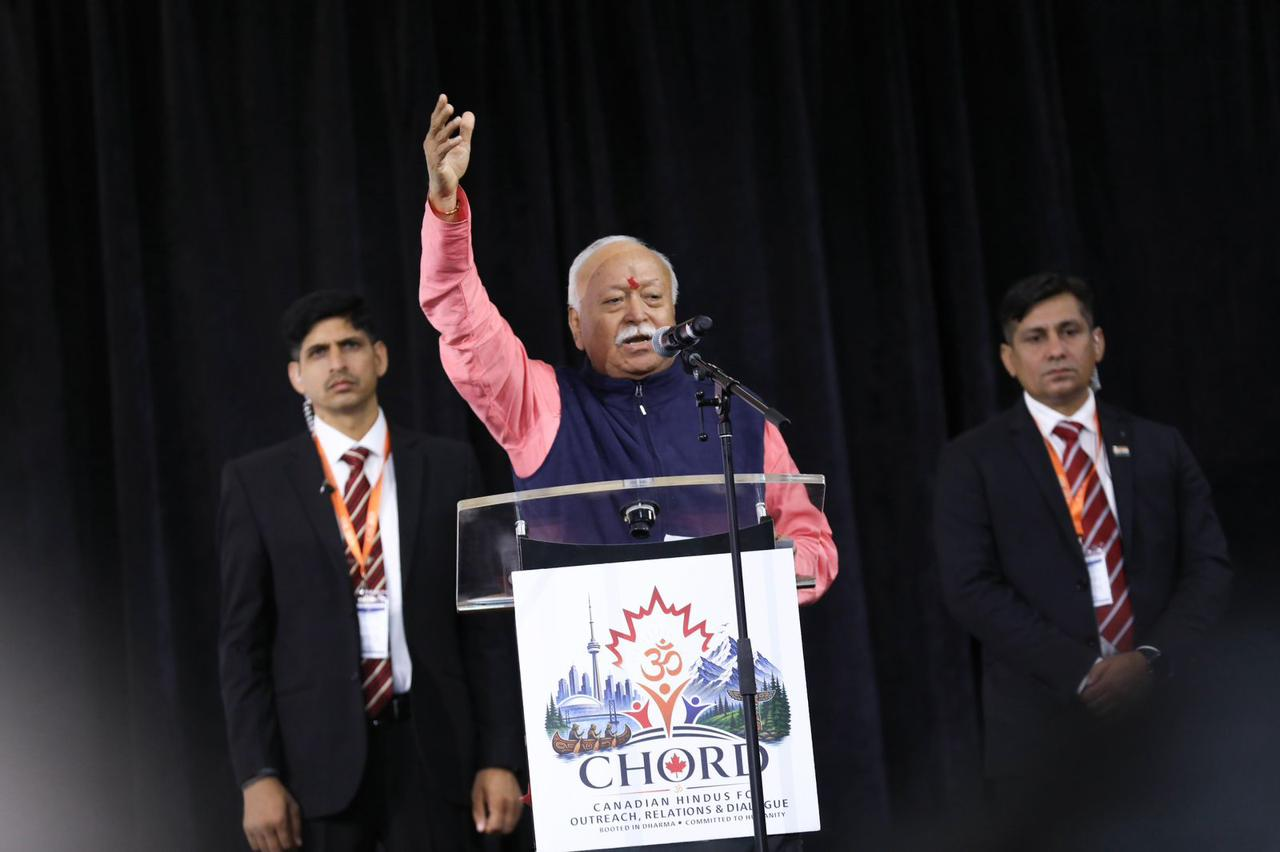
- The significance of this speech from the point of view of international relations is that it attempts to portray India not just as a nation-state but as a civilization with a global role.
- A central theme of Bhagwat’s address was that humanitarian concerns should transcend political, religious and national divisions.
- According to Bhagwat, Dharma must not be viewed as a mere concept of religion or worship; rather, it is a principle of sustenance through which man, society, and the environment develop hand-in-hand.
- By invoking the ideas of unity, responsibility, empathy and Vasudhaiva Kutumbakam, Bhagwat presented Bharat’s civilisational identity as a potential contribution to global dialogue.
RSS Leader Promotes ‘Unity in Diversity’ as Global Message of Bharat
Mohan Bhagwat, leader of Rashtriya Swayamsevak Sangh (RSS), speaking to thousands of people at the event of Universal Oneness Celebrations in New York, spoke about how diversity could be the very means by which harmony among people could be achieved rather than the cause for division. At the Infosys Theater located in Madison Square Garden on August 29, Bhagwat pointed out that “unity in diversity” was Bharat’s “DNA” and that India had an extra responsibility of making it clear to the whole world that different identities can live harmoniously without forgetting their common identity as human beings.
This is a speech delivered amidst the RSS centenary celebrations as well as when Bhagwat embarks upon his three-nation outreach program covering the USA, Canada, and the United Kingdom. The significance of this speech from the point of view of international relations is that it attempts to portray India not just as a nation-state but as a civilization with a global role.
India’s Message and Responsibility as a Civilisation
Bhagwat drew a contrast between “pluralism” – a concept related to the United States – and “unity in diversity” – a concept linked with India. According to Bhagwat, diversity is a natural element of any human society, but at the same time, oneness is a basic concept that could become the basis for peaceful coexistence.
In the words of Swami Vivekananda, according to Bhagwat, “every country has its message, its mission, and its destiny”. The destiny of Bharat, according to Bhagwat, is constantly proving to the whole world the existence of unity in diversity.
Thus, the philosophical culture of India is placed in a broad international discussion about peace, coexistence and global solidarity. Not diversity elimination, but diversity celebration, respect and preservation are needed along with recognition of human dignity in Bhagwat’s view.
Our (Bharat) tradition tells us not only unity in diversity, but also diversities of unity. All the diversities are expression of unity. So that we who have to live for some years on this earth should not be bored. We have to serve, accept, respect this diversity because it is expression of unity. It beautifies it. It is the decoration. We celebrate it. We always see the unity.
Humanitarianism Above Political and Social Divisions
A central theme of Bhagwat’s address was that humanitarian concerns should transcend political, religious and national divisions. He argued that people may differ in their languages, nationalities, lifestyles and material circumstances, but possess an “innate oneness” that creates empathy and responsibility towards others.
He illustrated this through the simple example of a person encountering someone who is hungry while eating a meal. According to Bhagwat, human beings possess the capacity to recognise another person’s suffering and respond to it. His argument therefore moved beyond questions of identity towards a broader humanitarian principle: human welfare should remain above individual self-interest.
He also stressed that material prosperity alone cannot provide lasting fulfilment. In this context, Bhagwat said that what matters is not simply how much a person earns but how much they contribute or distribute for the benefit of others.
“Whenever Bharat has been asked for help anywhere in the world, it has never refused and it extends a helping hand even without even being asked. This is our tradition, the DNA of Bharat.”
‘Dharma’ as a Principle of Balance
The next major point from Bhagwat’s speech was his take on Dharma. According to Bhagwat, Dharma must not be viewed as a mere concept of religion or worship; rather, it is a principle of sustenance through which man, society, and the environment develop hand-in-hand.
This point is highly relevant from a humanitarian viewpoint, as Bhagwat contends that development cannot come at the cost of suppressing man or society, and that man, society, and the environment must develop together.
Message to the Diaspora of Indians
Bhagwat talked about the role that the diaspora of Indians plays, especially for those Indians living in America. According to Bhagwat, Indians in the diaspora must be faithful to their “karma bhumi,” meaning their country where they reside, while still having some cultural ties with “janma bhumi,” or the country from which they come.
He stressed that Indians do not have an obligation to contribute anything to India, but they can still carry forward the values of their culture. This, in the language of international relations, means that the diaspora is playing an increasingly important role as a bridge between nations.
“Embrace diversity, strengthen dialogue and build bridges across communities.”
Religion, Dialogue and One Humanity
Before the Madison Square Garden event, Bhagwat was also present at an interfaith gathering where religious and community leaders discussed peace, coexistence, and collective responsibility. As per reports, the “five-point call to action” opposed the use of religion for promoting hatred, humiliation, dehumanization, and violence.
However, Bhagwat also talked about his past encounters with the Muslim community and said that one cannot be a Hindu believing that Muslims have no place in Bharat. The general idea presented by Bhagwat is that various religious traditions can live together without denying the human dignity of everyone.
The response to the event also reflected the wider international discussion surrounding Bharat’s civilisational approach to coexistence and human dignity. While supporters viewed the gathering as an opportunity to present the Bharatiya understanding of unity in diversity and Vasudhaiva Kutumbakam to a global audience, some critics expressed concerns based on their differing perceptions of the RSS and its ideological position. The contrasting responses demonstrate the diverse ways in which Bharat’s civilisational ideas are understood and engaged with in the international sphere.
“True global harmony begins by respecting differences and finding common ground.”
From National Identity to Global Humanity
Bhagwat’s New York address ultimately sought to place humanitarianism above narrow divisions of nationality, religion and material interest. His message that diversity should be respected while humanity remains united resonates with the broader international-relations principle that global challenges—conflict, inequality, environmental degradation and humanitarian crises—cannot be addressed through isolation alone.
By invoking the ideas of unity, responsibility, empathy and Vasudhaiva Kutumbakam, Bhagwat presented Bharat’s civilisational identity as a potential contribution to global dialogue. Whether this vision translates into wider international engagement will depend on how such ideas are reflected through social initiatives, interfaith dialogue and cooperation across borders.
At its core, the New York message was that humanity must remain the common denominator of international relations—with differences acknowledged, identities respected and human dignity placed above division.
“Bharat’s rise means a more united humanity. Bharat’s duty is to serve the world as Vishwa Guru, not superpower. Its rise means more united humanity.”
The International Campaign around Bhagwat’s New York Address
Bhagwat’s New York address also became the focus of a concerted campaign by sections of the American activist and political establishment. Organisations including those that project themselves as champions of Hindu human rights, along with the Indian American Muslim Council, mobilised dozens of groups against the programme, while elected representatives joined calls for Madison Square Garden to cancel it. The campaign soon went beyond criticism of the RSS: demands were made for Bhagwat to be denied entry into the United States, while the US Commission on International Religious Freedom called for the revocation of his visa and sanctions against the RSS.
What emerged was an attempt to internationalise an ideological contest using activist networks, political pressure and the language of human rights to portray the RSS before an American audience through an overwhelmingly hostile frame. The objective was no longer merely to challenge Bhagwat’s views, but to delegitimise the very presence of the organisation in an international public forum and prevent its civilisational message from being heard on its own terms.
That effort, however, failed to stop the event. The Universal Oneness Celebration went ahead at Madison Square Garden, drawing around 5,000 participants. Organisers said representatives of more than 250 US-based organisations and multiple religious traditions took part.
The episode is significant from an international-relations perspective because it points to a larger contest over India’s growing global presence and who gets to define it. As Bharatiya civilisational ideas acquire greater visibility abroad, attempts to pre-emptively discredit them through established ideological and political frameworks are likely to intensify. The New York event demonstrated something equally important: organised opposition may generate headlines and political pressure, but it cannot be allowed to monopolise the global conversation about Bharat or define its institutions for the world.

Anjali Singh is a postgraduate student of Political Science and International Relations, a Social Media Analyst, and a former Research Intern at the Indian Council of World Affairs. Views expressed are the author’s own.
 Aayush Pal
  Archita Gaur