
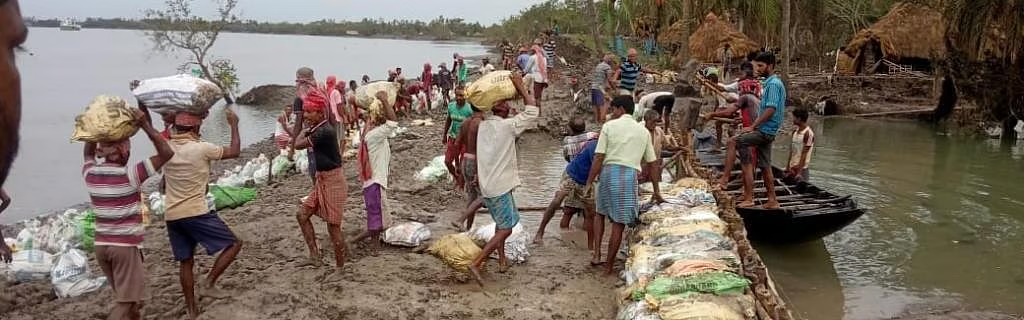
- Climate-induced environmental degradation is no longer a distant theoretical threat; it is an active engine of human displacement.
- National policies inevitably stop at sovereign borders, yet ecological and human crises pay no heed to political geography.
- A collaborative regional framework aimed at addressing climate-induced displacement issues is urgently needed by India and its neighbouring countries for several economic, social, and geopolitical reasons.
- India, as the region’s largest economy and geographic anchor, has a pivotal responsibility and opportunity to lead this diplomatic and humanitarian endeavour alongside its neighbours.
The Bay of Bengal represents one of the most ecologically fragile and humanly dense geographic regions on the planet. Encompassing the coastal stretches of India, Bangladesh, Myanmar, Sri Lanka, and Thailand, this marine and riverine ecosystem faces unprecedented pressures from accelerating climate change. The basin is geographically predisposed to extreme weather events, characterised by low-lying deltaic terrain, vast mangrove forests, and shallow ocean waters that act as heat sinks. As global surface temperatures continue to rise, the Bay of Bengal endures increasingly frequent and severe tropical cyclones, extreme precipitation, tidal surges, and relentless sea-level rise. Oceanographic data confirms that the rate of sea-level rise in the Bay of Bengal exceeds the global average, threatening to inundate immense swaths of fertile agricultural land and coastal settlements over the coming decades.
The impact of the ecological crisis on human life is disastrous. People living in coastal regions rely on climate-dependent sources of livelihood, including subsistence agriculture, coastal fishing, aquaculture, and forest production. As soon as saltwater inundates their farmland, aquifers, and drinking water supplies, the local farming systems are totally broken down. Coastal land salinization leads to reducing crop productivity and soil microbiology so that once-prosperous farmers become poor and miserable. At the same time, extreme coastal erosion destroys the ground along with houses, schools, roads, and landmarks, making the lives of millions of people living in the most vulnerable places in the world, such as the Sundarbans of India and Bangladesh, the Mahanadi Delta, and Rakhine State, impossible. Climate-induced environmental degradation is no longer a distant theoretical threat; it is an active engine of human displacement.
In the Bay of Bengal, unlike the sudden-onset disasters such as earthquakes or flash floods, climate displacement is characterised by both acute catastrophes and slow-onset process environmental deterioration or siltation. Acute events such as super cyclones displace millions of people during immediate and temporary emergency evacuations. Although many return to reconstruct their lives, each storm becomes a new trauma, sapping community resilience, depleting household savings, and furthering damage to critical infrastructure. Whereas in the same time slow-onset processes–for instance, with riverbank erosion, ocean acidification, and salinization–silently, they affect migration at a sluggish pace. Entire families are leaving ruined farms and salinised wells on an incremental basis towards the big cities, in search of a life. This slowly escalating, unregulated person-displacement is now generating crippling socio-economic distress, changing agricultural labourers into fragile urban migrants who live an informal life in the slums of major South Asian metropolitan areas.
Limitations of Isolated National Responses
The countries around the Bay of Bengal have their respective national adaptation plans, coastal protection measures, and disaster management systems in place. India has made substantial expenditures of resources on cyclone shelters, early warning techniques, investments in coastal protection as well as climate-resilient agricultural development. Bangladesh is recognized globally for the establishment of disaster management systems, community warning systems, and coastal afforestation programs. Other regional countries have also devised their national policies to address disaster threats and to construct local infrastructure. However, although these strategies have significantly helped to reduce the number of casualties in disasters, their impact does not address long-term structural issues of displacement of people across borders and whole ecosystems.
National policies inevitably stop at sovereign borders, yet ecological and human crises pay no heed to political geography. All ecosystems at the Bay of Bengal are interrelated; for instance, the mangrove forest Sundarbans is a natural barrier for the countries and, due to its location, it can protect people from a natural disaster across the border between India and Bangladesh. Any act in terms of river management, coastal embankment, or forest management in any state will influence the environment and the displacement of people in neighbouring states. If any actions are conducted by the countries separately from one another, it might lead to problems related to resource conflicts and misallocation of resources.
Furthermore, national frameworks often lack the political and institutional mechanisms needed to address the legal and human rights status of climate-displaced populations. Existing domestic legal structures typically categorise individuals moving across borders due to environmental degradation as illegal migrants or economic refugees. Under current international legal paradigms, including the 1951 Refugee Convention, individuals fleeing environmental collapse do not qualify for official refugee status, leaving them without legal protection, fundamental social rights, or access to basic humanitarian assistance. When neighbouring countries manage cross-border climate movement through rigid national security lenses, it increases human suffering, fosters social friction, and exposes displaced individuals to severe exploitation and precarious living conditions.
Strategic Imperatives for a Joint Regional Framework
A collaborative regional framework aimed at addressing climate-induced displacement issues is urgently needed by India and its neighbouring countries for several economic, social, and geopolitical reasons. Through a synchronised approach to regional governance, countries can combine their economic resources and technological capabilities to harmonise their scientific research activities. They can effectively identify complex oceanographic processes, predict local climate threats, and monitor coastal geomorphology using advanced satellite technology, meteorological modelling, and continuous data exchange. With a regional joint platform, it is possible to create a real-time information-sharing system to exchange meteorological data, warnings, and ecological risk assessments.
In addition to scientific cooperation, a collaborative framework is an organised method of creating uniform legal definitions and protection for people affected by climate change. By defining the rights, legal status, and social benefits of people displaced by climate change and environmental degradation, countries in South and Southeast Asia can build humane regulations for people moving across borders, receiving emergency assistance, and finding temporary relocation. Such an agreement would shift the regional conversation about border management from security to humanitarian governance. It would reduce political tensions between neighbouring countries by replacing bilateral claims with clear and institutionalised schemes for mutual assistance, labour integration, and shared accountability.
Economic integration and resilience funding represent another vital pillar of a joint regional framework. Implementing large-scale climate adaptation, constructing durable coastal infrastructure, restoring degraded mangroves, and facilitating planned community relocations require massive capital investments. Acting as a unified regional bloc allows Bay of Bengal nations to more effectively negotiate with international financial institutions, global climate funds, and developed nations for loss-and-damage compensation and adaptation financing. Furthermore, a regional framework could establish a dedicated Bay of Bengal Climate Resilience and Mobility Fund, financed jointly through regional contributions and international aid, to fund sustainable community adaptation, skill-building programs, and dignified resettlement projects across the basin.
Path Forward Towards Integrated Regional Governance
Creating a functioning joint regional framework will require the combination of current regional institutions with new tools that can boost environmental and human security. Institutions such as the Bay of Bengal Initiative for Multi-Sectoral Technical and Economic Cooperation (BIMSTEC) and the South Asian Association for Regional Cooperation (SAARC) provide the necessary diplomatic foundation. Among others, BIMSTEC in particular has the necessary infrastructure for this undertaking. The member nations should enhance the objectives of the existing institutions so that climate migration, trans-frontier environmental conservation, and collective risk management become the key elements in the build-up of regional security and economic integration.
In order to be successful, a regional framework must act proactively through planned relocation and community-led adaptation and avoid using only reactive emergency measures. Voluntary relocation strategies that involve close collaboration with vulnerable coastal population groups guarantee that the relocation process itself goes smoothly and without creating obstacles to social structure, culture and economic sustainability for the undoubted participants of the process. At the same time, the framework needs to focus on “green infrastructure,” that is, the restoration of mangroves on a large scale, sustainable transboundary drainage basin management, and smart agricultural trade. By doing so, countries will achieve the goal of investing in the ecology of their river deltas and coastal areas.
Ultimately, the escalating crisis of climate displacement in the Bay of Bengal demands a profound paradigm shift in how South and Southeast Asian nations view their borders, security, and shared environment. India, as the region’s largest economy and geographic anchor, has a pivotal responsibility and opportunity to lead this diplomatic and humanitarian endeavour alongside its neighbours. By transcending traditional geopolitical rivalries and recognising their shared ecological destiny, the nations of the Bay of Bengal can create a groundbreaking regional framework. Such a joint effort will not only protect millions of vulnerable citizens and preserve fragile ecosystems, but also establish a global model for cooperative, human-centred climate governance in an increasingly turbulent world.

Hridbina Chatterjee is a columnist and policy researcher with a focus on South Asian geopolitics, India’s foreign policy, and the Indo-Pacific.
 Richa Khandelwal Bhat
 Parag Gilada