

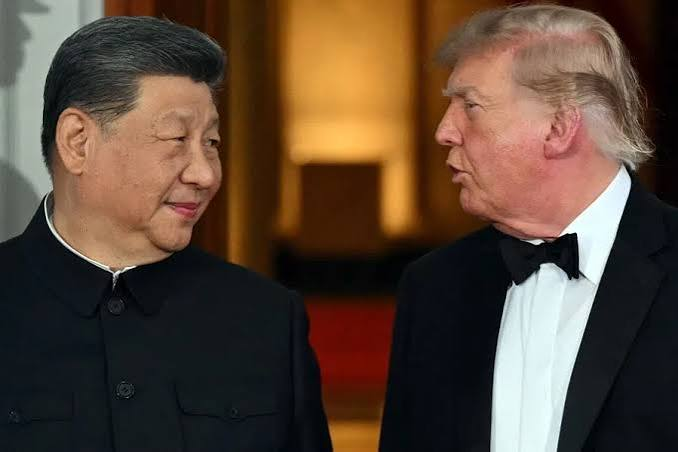
- The most significant development to emerge from the visit was that China and the United States extended their trade truce until January, extending the existing trade truce between the two countries.
- One of the reasons is the domestic economic pressure China has been facing.
- The biggest bone of contention that has existed in the relationship between China and the United States has always been the issue of Taiwan.
- What will therefore be particularly interesting to watch is how far this temporary thaw in relations can go and whether the current understanding between China and the United States can eventually develop into a more stable relationship.
In a historic visit, Chinese President Xi Jinping visited the United States of America for the first time in 11 years for a state visit. The much-anticipated visit came after President Trump’s visit to China earlier this year and was essentially a reciprocal visit by the Chinese President. The two-day visit of the Chinese President to the United States attracted global attention, as major countries around the world closely monitored the developments.
The visit came at a time when both China and the United States have been trying to reset their geopolitical relationship. Both countries have been attempting to renegotiate their trade terms and reach common ground. The most significant development to emerge from the visit was that China and the United States extended their trade truce until January, extending the existing trade truce between the two countries.
It is important to understand that when President Trump came to power, he initiated a series of sanctions and tariffs against China. Since then, the tariffs have been negotiated, and both countries have now reached an understanding to further extend the existing tariff framework. Under this arrangement, almost $30 billion worth of goods from each side would receive tariff relief.However, it is important to understand that both countries do not necessarily agree on all terms. There has only been a temporary understanding between the two countries. The very important question that arises is: why has President Xi Jinping agreed to these trade terms with the United States?
One of the reasons is the domestic economic pressure China has been facing. China has been under considerable economic pressure domestically, while the international economic situation has also become increasingly challenging. China’s energy security has also faced significant pressure, and with the war in Ukraine continuing, Chinese domestic demand has stagnated while international demand is also facing increasing threats.
As a result, China does not necessarily want any additional international pressure to be imposed on it. This is why negotiations between the United States and China have become very important. This was also visible in President Xi Jinping’s statements, in which he said that both China and the United States need to renegotiate their relationship and that the relationship between the two countries needs to move away from confrontation and towards cooperation.
The same can also be said for the United States. President Trump very much wanted a deal. President Trump wants American agricultural exports to China and has been consistent in seeking greater access for American products to the Chinese market, particularly in the field of agriculture. American farmers would benefit from greater access to the Chinese market.
Along with that, the United States has been concerned about fentanyl, much of which has been linked to China. The United States has repeatedly raised this issue with China, and both countries wanted to reach a common understanding so that China could take steps to address the issue. However, the biggest bone of contention that has existed in the relationship between China and the United States has always been the issue of Taiwan.
China has maintained that Taiwan is not a matter for negotiation. Taiwan, according to Beijing, is an inseparable part of China, and under the One-China policy, no country, including the United States, should interfere in Taiwan’s political or military affairs. What makes this particularly interesting is that there have been multiple reports of the United States providing billions of dollars’ worth of weapons to Taiwan. There have also been reports that American fighter pilots have been involved in training Taiwanese fighter pilots.
The United States has argued that it has primarily been providing defensive weapons rather than offensive weapons. The United States, although maintaining its commitment to the One-China policy, has also attempted to create a balance by maintaining its defensive support and strategic access to Taiwan.
This becomes particularly important because the Indo-Pacific has increasingly become a major theatre of geopolitics. The United States is increasingly competing with China in the region, while China has been developing greater strategic access and influence across the Indo-Pacific. The United States is also concerned about China’s growing presence in the region, while China has been concerned about the growing American presence in Southeast Asia, particularly in the Philippines. Japan and South Korea’s growing relationships with the United States are also a source of concern for Beijing.
At the same time, the United States remains concerned about China’s growing influence across the Indo-Pacific. This competition has brought the Taiwan issue back into the focal point of the relationship.
The other major development between China and the United States was in the field of artificial intelligence. This becomes particularly interesting because President Trump, in recent times, has been very enthusiastic about the development of artificial intelligence and has even expressed his willingness to change the terminology from artificial intelligence to “super intelligence.”
This comes at a time when there has been considerable concern among some leading figures in the field of artificial intelligence, particularly OpenAI CEO Sam Altman and Anthropic CEO Dario Amodei. They have both argued that the development of artificial intelligence should be approached with greater caution and should not necessarily proceed at the pace currently being witnessed.
This has created a debate around artificial intelligence. There are concerns that artificial intelligence could become a threat to the wider world, while President Trump has emerged as a major advocate for its development. Trump has argued that artificial intelligence does not necessarily pose the kind of threat that some critics suggest and has supported the continued development of the technology. Both China and the United States are currently at the forefront of artificial intelligence. China is the biggest competitor and strategic adversary of the United States in this field.
China’s advantage mainly lies in its manufacturing capabilities and access to large-scale electricity generation and infrastructure. This is an important advantage that has emerged in the competition over artificial intelligence development. The United States remains concerned that China has been rapidly developing its capabilities and replicating aspects of the American model, increasing the strategic challenge for Washington.
This is why both countries have increasingly recognised the need for sustainable and pragmatic development in the field of artificial intelligence. Therefore, the visit of the Chinese President to the United States can very much be seen as an attempt to reset the relationship between China and the United States. Both countries want their relationship, which has increasingly been characterised by confrontation, to move towards greater cooperation.
This essentially demonstrates that both countries need each other despite their differences. However, this does not mean that the strategic differences between the two countries have disappeared. China has a greater ambition of becoming a central power in the world, while the United States remains reluctant to accept the rise of Chinese power. These fundamental differences continue to shape the relationship between the two countries.
What will therefore be particularly interesting to watch is how far this temporary thaw in relations can go and whether the current understanding between China and the United States can eventually develop into a more stable relationship.

Kumar Satish is a postgraduate in International Relations with a keen interest in reading and writing on geopolitical affairs.
 Anjali Singh